AI & Data Consulting
 Digital Products
 Digital Commerce
 Scale
ScaleThe Operational Reality of Modern eCommerce in 2026
Sector: Digital Commerce
Author: Nisarg Mehta
Date Published: 03/23/2026

Contents
- Introduction: Launching Is Easy. Scaling Is Hard.
- Challenge 1: Rising Customer Acquisition Costs Are Compressing Margins
- Challenge 2: Inventory Forecasting and Cash Flow Pressure
- Challenge 3: Checkout Abandonment Is Still Costing You Revenue
- Challenge 4: App Overload Is Slowing Your Store and Draining Your Budget
- How Does Your Store Measure Up? 2026 eCommerce Benchmarks
- The Bottom Line: Operational Excellence Is the Real Competitive Advantage
- FAQs
Introduction: Launching Is Easy. Scaling Is Hard.
There has never been a better time to start an eCommerce business. Platforms like Shopify have dramatically lowered the barrier to entry, entrepreneurs can launch a fully functional online store in days, without large upfront investments, technical expertise, or a warehouse full of inventory. The tools are better, the payment infrastructure is more reliable, and the global reach available to even a small brand is extraordinary.
But here is the uncomfortable truth that most eCommerce success stories leave out: launching is the easy part.
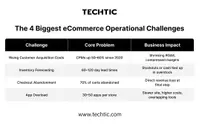
Once a store begins to grow, the operational reality sets in quickly. Customer acquisition costs that looked manageable at small scale become unsustainable. Inventory planning breaks down when production lead times stretch to 90 days. Checkout flows that seemed fine convert poorly under scrutiny. And the app stack that felt like a solution starts to feel like a problem.
This article covers the four most critical operational challenges facing modern Shopify merchants in 2026, and exactly what to do about each one.

Challenge 1: Rising Customer Acquisition Costs Are Compressing Margins
The Problem
Customer acquisition has become significantly more expensive, and the trend shows no signs of reversing. Most DTC brands were built on the back of relatively affordable paid social advertising on Meta and Google. Those economics have fundamentally shifted.
Industry data shows that the average cost per thousand impressions (CPM) for digital advertising has increased by 50–60% since 2020. A skincare brand that previously generated a 3x ROAS from Meta campaigns may now see results closer to 1.5–2x, a threshold that makes profitable scaling extremely difficult when factoring in cost of goods, fulfillment, and overhead.
The core problem is over-dependency. Brands relying entirely on paid channels are now exposed to platform volatility, iOS privacy changes that degraded targeting precision, and a competitive auction environment where bigger brands push up costs for everyone.
The Solutions
The merchants navigating this environment successfully are doing two things differently: diversifying acquisition channels and investing aggressively in retention.
Retention is the most immediate lever. Acquiring a new customer costs five to seven times more than retaining an existing one, and existing customers convert at higher rates, spend more per order, and require far less persuasion.
Here’s what winning merchants are doing:
- Build owned audiences — Grow email and SMS lists at every touchpoint and nurture them with value-driven content, not just promotional blasts
- Launch referral programs — Turn satisfied customers into your lowest-cost acquisition channel
- Invest in organic content — Build a brand presence that generates consistent traffic without paying for every impression
- Introduce subscription models — Where the product category supports it, convert one-time buyers into predictable recurring revenue
Challenge 2: Inventory Forecasting and Cash Flow Pressure
The Problem
Inventory planning is one of the most structurally difficult operational challenges for eCommerce brands, and it doesn’t get easier as stores scale, it gets harder.
Most Shopify merchants manufacturing physical products work with suppliers in countries like China, Vietnam, or Bangladesh, where production and shipping timelines typically range from 60 to 120 days. This means merchants must forecast demand months in advance, before campaigns run, before seasonal trends confirm, and before viral moments can be anticipated.
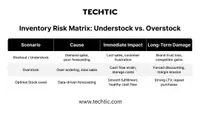
Getting it wrong is costly in both directions. Understock and you sell out, miss revenue, and wait months to restock while competitors fill the gap. Overstock and you tie up working capital in slow-moving inventory, strain cash flow, and discount to clear stock, eroding brand positioning.

The Solutions
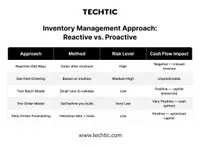
Sophisticated inventory management starts with data-driven forecasting rather than gut-feel ordering. Merchants should rigorously analyze historical sales data, seasonal patterns, campaign performance correlation, and product velocity trends, before placing large orders.
Beyond forecasting, these tactical approaches significantly reduce inventory risk:
- Run test batches first — Validate real demand before committing to large quantities. Higher cost per unit, but dramatically lower overstock risk
- Use pre-orders strategically — Collect payment before production begins, validate demand with real purchase data, and keep customers informed throughout
- Integrate inventory management tools — Real-time velocity tracking, low-stock alerts, and reorder automation removes manual tracking burden
- Communicate transparently — Show expected restock dates to customers. This manages expectations, reduces support queries, and in many cases increases committed orders

Challenge 3: Checkout Abandonment Is Still Costing You Revenue
The Problem
Checkout abandonment is one of the most persistent and expensive problems in eCommerce. Despite years of industry-wide optimization focus, approximately 70% of shopping carts are abandoned before purchase is completed.
For every 10 customers who add a product to cart, only 3 complete the purchase. The other 7 leave, taking their intent and their wallet with them.
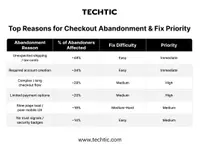
The reasons are consistent and well-documented. Unexpected costs appearing at checkout, shipping fees, taxes, or handling charges not shown earlier, are the single largest driver. Complicated checkout flows with required account creation, excessive form fields, and too many steps add friction that erodes purchase intent. Limited payment options exclude customers whose preferred method isn’t supported. And on mobile, now the majority of eCommerce traffic, poorly optimized flows bleed conversions at every step.

The Solutions
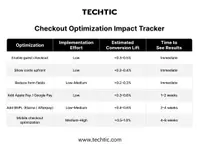
Checkout optimization is one of the highest-leverage investments a Shopify merchant can make, improvements apply to every visitor and compound across all traffic volume.
The most impactful changes consistently include:
- Enable guest checkout — Requiring account creation is one of the most common and costly checkout mistakes. Remove this barrier immediately
- Show total costs earlier — Display shipping and taxes on product pages or in the cart, before the customer reaches checkout
- Reduce form fields — Every unnecessary field is an opportunity to reconsider. Collect only what’s required for fulfillment
- Expand payment options — Digital wallets (Apple Pay, Google Pay) and Buy Now Pay Later (BNPL) options remove the barrier of full upfront payment
Real Merchant Result: A wellness brand selling premium furniture on Shopify saw conversion rates increase from 1.1% to 1.8% after adding Klarna’s Buy Now, Pay in 4 installments option. Removing the upfront payment barrier made a significant difference for high-ticket purchases, and that single change delivered a substantial lift in top-line revenue.
Challenge 4: App Overload Is Slowing Your Store and Draining Your Budget
The Problem
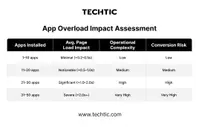
Shopify’s app ecosystem is one of its greatest strengths, and for many growing merchants, one of their biggest operational headaches. As stores grow and new needs emerge, the natural response is to install an app for each new problem. Over time, this accumulates fast.
It is common for an established Shopify store to be running 30 to 50 apps simultaneously. Each app solves a specific problem, but collectively, they create an entirely different set of problems.
The consequences are measurable and expensive. Every app loading scripts or widgets on your storefront adds to page load time. Research shows a one-second delay in page load reduces conversions by up to 7%. Overlapping functionality creates data inconsistencies and makes attribution nearly impossible. Forty-plus app subscriptions add up to significant monthly overhead. And too many tools mean too many dashboards, too much complexity, and too little time actually growing the business.
The Solutions
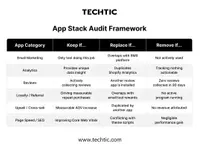
The solution starts with a regular, disciplined technology stack audit, at minimum quarterly for growing stores.
For every installed app, ask three questions: Is it actively being used? Does it duplicate functionality in another tool? What is its measurable impact on page speed?
Practical steps to cut app complexity:
- Remove duplicate functionality — Consolidate to a single solution per function to reduce cost and improve performance
- Audit performance impact — Use Google PageSpeed Insights or Shopify’s built-in tools to identify which apps contribute most to load time
- Leverage Shopify’s native features — Many features that once required third-party apps are now available natively on the platform
- Invest in developer optimization — For stores with significant traffic, developer time spent cleaning the app stack pays back quickly in conversion improvement
Real Merchant Result: A home goods brand on Shopify discovered they had accumulated more than 40 apps over their growth journey. After a systematic audit and removing redundant tools, page load time improved measurably, and conversions followed. A leaner stack is faster, cheaper, and far easier to operate.
How Does Your Store Measure Up? 2026 eCommerce Benchmarks
One of the most valuable exercises any merchant can do is benchmark their store’s performance against industry standards, not to create pressure, but to identify where the biggest gaps exist and prioritize accordingly.
Most merchants are surprised to discover how far below benchmark they sit in one or more of these areas, not because they are doing something wrong, but because they have never had a clear target to optimize toward.
Here is what healthy, well-optimized eCommerce operations look like across each challenge area in 2026:
- Checkout Conversion Rate — Below 1.5% signals an immediate optimization opportunity. Industry average sits at 2.5–3.5%. Best-in-class stores achieve 4% and above
- Cart Abandonment Rate — Industry average hovers around 70%. Stores consistently below 60% are winning on checkout experience
- Blended ROAS — Anything below 1.5x on paid channels is unsustainable long-term. A healthy blended ROAS sits between 2–3x, with best-in-class brands achieving 4x or more through strong retention economics
- Customer Retention Rate — Below 20% signals over-reliance on acquisition. Healthy brands retain 25–35% of customers annually. The best retain 40% or more
- Page Load Time — Above 3 seconds is a conversion killer. The industry average is 2–3 seconds. Under 1.5 seconds is where best-in-class stores operate
- Apps Installed — More than 40 apps is a performance and cost liability. Under 15 well-chosen apps is the operational benchmark worth targeting
If your store is below benchmark on even two of these metrics, the revenue impact of closing that gap is significant, and the path to doing so is exactly what this article covers.

The Bottom Line: Operational Excellence Is the Real Competitive Advantage
Get your Store Audit for FREE, and find out exactly where your store is leaving revenue on the table.
Building a successful eCommerce brand in 2026 requires much more than a great product and a live Shopify store. The merchants who build sustainable, profitable businesses are the ones who treat operations as a competitive advantage, constantly optimizing acquisition efficiency, inventory intelligence, checkout conversion, and technology performance.
Platforms like Shopify provide an exceptional foundation. But the brands that truly win are those that go beyond the platform, solving the everyday operational challenges that quietly drain revenue, compress margins, and limit growth potential.
Sustainable eCommerce growth comes from mastering the fundamentals: understanding customer behavior deeply, managing inventory with data-driven precision, creating frictionless shopping experiences, and running a lean, high-performance technology stack. These aren’t glamorous disciplines, but they are the ones that determine whether a brand builds lasting value or stalls out chasing growth it can’t sustain.
The operational reality of modern eCommerce is demanding. The merchants who face it clearly, and act on it systematically, are the ones who build brands worth building.
FAQs
Q. What are the biggest operational challenges for eCommerce brands in 2026?
The four most critical challenges are rising customer acquisition costs, inventory forecasting pressure, high checkout abandonment rates, and app overload. Each directly impacts profitability and growth for Shopify merchants at every stage of scale.
Q. How can eCommerce merchants reduce customer acquisition costs?
The most effective approach is investing in retention and owned channels, email and SMS marketing, referral programs, organic content, and subscription models. Retaining an existing customer costs 5–7x less than acquiring a new one, and retained customers convert at higher rates and spend more per order.
Q. How does technology complexity affect eCommerce operations?
As eCommerce businesses grow, they accumulate tools across marketing, analytics, fulfillment, and customer experience. Too many overlapping tools slow site performance, inflate operational costs, and create data inconsistencies, all of which reduce efficiency and directly impact revenue.
Q. What is the most cost-effective way to grow an eCommerce brand in 2026?
Retention consistently outperforms paid acquisition in cost efficiency. Building owned audiences through email and SMS, launching referral programs, investing in organic content, and introducing subscription models all reduce dependence on expensive paid channels while improving customer lifetime value over time.
Q. Why are customer acquisition costs so high for eCommerce brands in 2026?
Digital ad CPMs have risen 50–60% since 2020 due to increased competition, privacy-driven targeting limitations, and platform saturation. Brands that rely solely on paid advertising are seeing ROAS shrink significantly, making it harder to scale profitably without diversifying into owned and retention channels.