Shopify vs Shopify Plus: Which Plan Does Your eCommerce Business Actually Need? (2026 Guide)
Sector: Digital Commerce
Author: Nisarg Mehta
Date: 06/11/2026
Shopify now powers over 5.6 million eCommerce stores across 175 countries, and the gap between what standard Shopify and Shopify Plus can do has never been wider.
If you’re reading this, you’re likely at a decision point, either you’re starting fresh and want to choose the right plan, or your business has outgrown standard Shopify and you’re evaluating whether the Plus upgrade is worth it.
This guide gives you a direct, no-fluff comparison so you can make that call confidently.
What's Actually Different Between Shopify and Shopify Plus?
The short answer: Shopify is built for growing brands. Shopify Plus is built for scaling enterprises. The platform is the same underneath what changes is how much control, automation, and customization you get.
Here’s a practical breakdown.
Shopify Standard: What You Get
Online Store & Theme Editor
Every Shopify plan gives you a fully hosted online store managed through Shopify Admin. You can customize your storefront using the built-in theme editor, no coding required for basic changes.
Blogging Engine
Shopify includes a native blogging tool to publish articles, share promotions, and build organic traffic. It’s simple but functional for most content strategies.
Staff Accounts
Standard Shopify plans allow up to 5 staff accounts with configurable permissions. You can also add Shopify Partner collaborators for development work without using staff account slots.
SSL & Security
All plans include SSL certificates out of the box. Your store runs on HTTPS automatically, no separate setup required.
Analytics & Reports
Shopify’s reporting suite covers the essentials: sales reports, product analytics, customer behaviour, acquisition reports, inventory tracking, and a Live View dashboard for real-time activity.
Shopify Markets (International Commerce)
Available on standard plans, Shopify Markets lets you manage cross-border selling with custom pricing per region, local currencies, import duty collection, and localised content all from a single admin.
Carrier-Calculated Shipping
You can connect third-party carriers to display live shipping rates at checkout. Rates pull directly from providers like FedEx, UPS, and USPS based on the buyer’s location and order specifics.
Shopify Plus: What You Get on Top of Everything Above
Shopify Plus includes all standard features, then layers enterprise-grade capabilities on top. Here’s what actually matters for high-growth brands.
Checkout Extensibility (The Biggest Difference)
This is the feature that separates Plus most clearly from standard plans. Checkout Extensibility lets you customise the checkout experience by adding upsells, loyalty reward redemptions, custom fields, PO number inputs, and more without touching Shopify’s core checkout code. Standard Shopify doesn’t allow this. On Plus, it’s the foundation of conversion optimisation at scale.
Note: The legacy Script Editor has been deprecated in favour of Checkout Extensibility and Shopify Functions as of 2024.
Shopify Functions
Where Checkout Extensibility handles the UI, Shopify Functions handle the logic. You can write custom backend logic that runs natively within Shopify’s infrastructure with custom discount rules, shipping logic, payment conditions, and order routing without external apps or middleware.
Shopify Flow (Automation)
Flow is Plus’s automation engine. You can build no-code workflows that trigger actions based on store events: auto-tag high-value customers, pause inventory below a threshold, flag high-risk orders for review, send internal Slack alerts on specific order conditions, and hundreds more. Standard Shopify has no equivalent.
Organisation Admin (Multi-Store Management)
If you run multiple storefronts that are different regions, brands, or B2B vs DTC the Organisation Admin lets you manage all of them from a single dashboard. User permissions, workflow settings, and performance tracking across every store in one place.
Native B2B Commerce
Shopify Plus includes built-in B2B selling tools as of 2026, and they’ve matured significantly. You can create company accounts with buyer roles and permissions, assign customer-specific catalogs and pricing, set Net 30/60/90 payment terms, and manage minimum order quantities natively, without third-party apps. This alone replaces what used to require expensive B2B app stacks.
Headless Commerce Support
Plus gives you full access to the Storefront API and Customer Account API for headless builds. You can decouple the frontend entirely by using Next.js, Hydrogen, or any custom stack while Shopify handles commerce logic on the backend. Standard Shopify has limited headless support.
Launchpad
Launchpad lets you schedule and automate complex campaign launches with price changes, product drops, flash sales, theme updates with a single event configuration. Set your start and end times, define every automated action, and let it run. Particularly valuable for seasonal peaks like Black Friday.
Expanded API Access
Plus unlocks additional API resources including GiftCard, Multipass, and User APIs. Multipass is particularly useful for brands with existing customer login systems, it creates a seamless SSO experience between your platform and Shopify without requiring database synchronisation.
Dedicated Merchant Success Manager
Beyond the standard support tiers, Shopify Plus assigns you a Merchant Success Manager, a dedicated point of contact for platform guidance, feature roadmap access, and strategic recommendations. Standard plans rely on general support channels.
Lower Transaction Fees
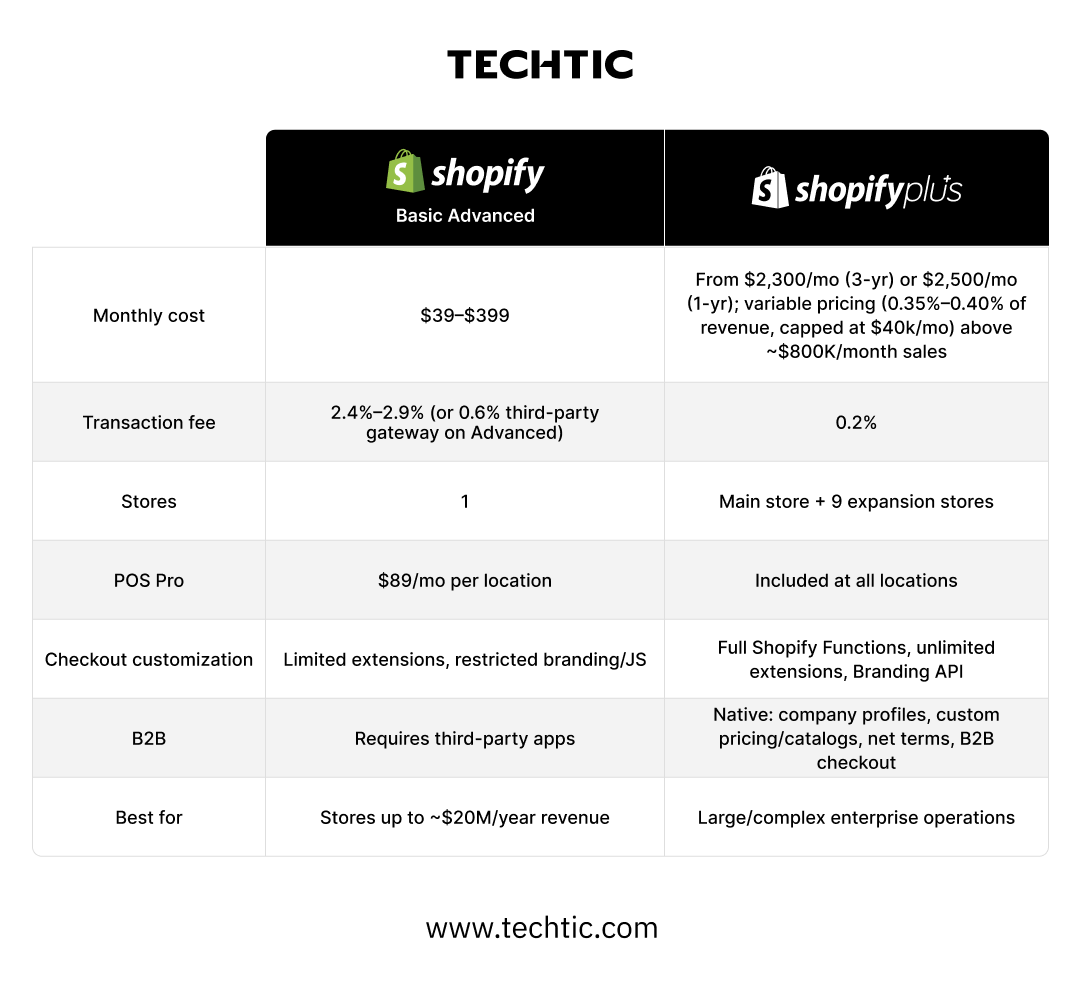
Shopify Plus charges 0.2% per transaction (when not using Shopify Payments), compared to 0.6% on standard Advanced Shopify. At high volumes, this difference more than covers the platform cost.
Which Plan Is Right for You?
Choose standard Shopify if:
- You’re under $1M-$2M in annual revenue
- Your checkout and fulfilment workflows are straightforward
- You don’t need B2B selling, multi-store management, or custom automation
- You want low overhead and fast setup
Choose Shopify Plus if:
- You’re approaching or past $1M-$2M in annual GMV
- You need custom checkout logic, B2B capabilities, or multi-store management
- Transaction volume means the lower fee tier pays for itself
- You’re replatforming from Magento, WooCommerce, or BigCommerce
- You need ERP, CRM, or PIM integrations at scale
A quick way to check: if the 0.2% vs 0.6% transaction fee difference on your current volume equals $1,500/month or more, Shopify Plus pays for itself on fees alone before counting any of the capability gains.
Here’s the full breakdown:-
How the Development Approach Differs
This is important to understand before committing to either plan.
Standard Shopify is largely a self-service platform. You can set up a store, choose a theme, add products, and go live without a development team. Shopify’s ecosystem of themes and apps handles most common requirements.
Shopify Plus is a different story. The features that justify the cost like Checkout Extensibility, Shopify Functions, headless architecture, ERP integrations, B2B workflows which require experienced developers and commerce architects to implement correctly. This isn’t a limitation of the platform; it’s a reflection of what enterprise commerce actually involves.
Most brands getting the full value from Shopify Plus work with a certified Shopify Plus development agency rather than managing it purely in-house. The platform expertise, integration depth, and performance optimisation that specialist agencies bring typically translates directly into faster time-to-revenue and fewer costly mistakes post-launch.

Working with a Shopify Plus Development Agency
If you’ve decided Shopify Plus is the right move, the next question is how to implement it well.
Techtic is a certified Shopify Plus development agency that has built and scaled over 200 brands managing $800M+ in annual GMV. Our work spans custom theme development, B2B commerce builds, platform migrations from Magento and WooCommerce, ERP and CRM integrations, and headless Shopify Plus architectures.
What that means in practice: we’ve seen what works and what fails across hundreds of Shopify Plus engagements, and we bring that directly to every project.
If you’re evaluating a move to Shopify Plus whether that’s a new build, a migration, or unlocking features you’re currently not using, talk to our team and we’ll give you a straightforward assessment of what makes sense for your situation.
Final Thoughts
Shopify and Shopify Plus serve genuinely different purposes. Standard Shopify is an excellent platform for brands building and growing. Shopify Plus is the infrastructure for brands operating at scale where checkout conversion, automation, B2B selling, and multi-market management have direct, measurable impact on revenue.
The upgrade decision comes down to two things: whether your current volume and complexity justifies the cost, and whether you have the implementation capability to actually use what Plus offers.
If you’re at that inflection point and want a straightforward conversation about which direction makes sense, get in touch with our team.
FAQs
Q. Can I switch from Shopify to Shopify Plus without rebuilding my store?
Yes. Upgrading to Shopify Plus doesn’t require a full rebuild. Your existing theme, products, and customer data stay intact. What changes is your access to Plus-only features. That said, many brands use the upgrade as an opportunity to improve their theme and checkout setup, which is where an experienced Shopify Plus agency adds the most value.
Q. Is Shopify Plus worth it at $2,500/month?
It depends on your volume and requirements. For most brands, the break-even calculation on transaction fees alone puts it around $500K–$1M in annual GMV. Above that, the automation, B2B tools, and checkout customisation capabilities typically drive enough conversion and operational efficiency to justify the cost multiple times over.
Q. What's the difference between a Shopify Partner and a Shopify Plus Partner?
Any developer can become a Shopify Partner. Shopify Plus Partners are agencies that Shopify has specifically vetted and certified for enterprise-level Plus delivery; they’ve demonstrated technical depth, delivery track record, and platform expertise at a higher standard. When you’re investing in a Plus build, working with a certified Shopify Plus agency partner gives you access to deeper platform support and more reliable delivery.
Q. How long does a Shopify Plus build take?
A standard Shopify Plus store with a custom theme, third-party integrations, and B2B setup typically takes 12-20 weeks. A migration from another platform adds complexity depending on catalogue size and data volume. Simpler engagements with a pre-existing theme and straightforward setup can move faster.