RAG Architecture: How to Build Enterprise AI Applications Using Your Business Data
Sector: AI + Data
Author: Nisarg Mehta
Date: 11/06/2026
Large Language Models (LLMs) are great for summarising, explaining and writing text. The issue comes when you want to apply LLMs to your own data. For example: product catalogues, policy documents, support tickets or contract storage. General purpose models will not have been trained on your data.
Retrieval Augmented Generation (RAG) is the solution. RAG systems allow you to search for relevant information from validated business data. The LLM is then provided with this context to provide answers based on your information.
For teams moving generative AI beyond simple chat interfaces, RAG is often the first architecture worth understanding. This guide covers how it works, its core components, how agentic RAG extends it, and what production use requires, from organizing your business data to monitoring answers once people rely on them.
What Is RAG Architecture?
RAG architecture is used to create AI applications that include an information retrieval stage. This means that when an answer is generated by the LLM, it will use verified information from external sources (such as company documents, databases and product information). Microsoft state that RAG is a design pattern that can be used to improve the capability of LLMs by using your own content to provide answers.
The architecture consists of two parts:
Retrieval: This part finds the most relevant information to answer the question. It does this by searching through an index of your information.
LLM: This part uses the information retrieved along with the question to generate a natural language response.
This means that the LLM will not search through your systems. It provides businesses with the ability to keep their knowledge up to date, ensure access is controlled and provides traceability for answers.
For example, an employee could ask their internal assistant how much they can claim back for travelling to see clients. The retrieval part would find the relevant section of the latest expense policy. The LLM would then use this to provide an answer with a link to where the information was taken from. If the policy changes, the team would simply update the document in the index. The model remains unchanged.
This makes RAG a common foundation for enterprise artificial intelligence applications built on private, changing information.
How Does RAG Architecture Work?
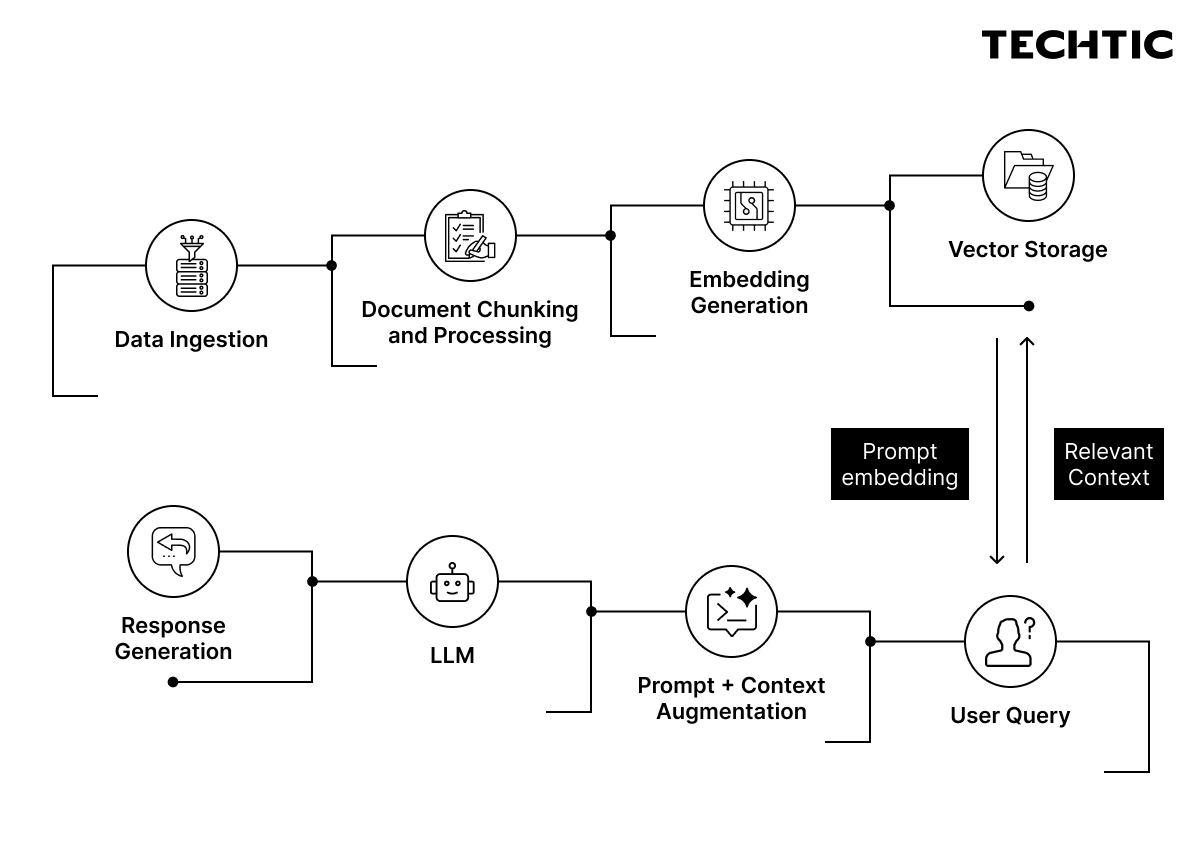
A RAG pipeline works in two connected phases: business content is prepared and indexed ahead of time, and then each user question triggers retrieval, context assembly, and LLM generation. Here is the sequence.
Step 1: Data Ingestion
The pipeline collects approved content: documents, product catalogs, knowledge bases, databases, CRM and enterprise systems, and selected web pages. Source quality sets the ceiling for answer quality; outdated or contradictory documents get retrieved as readily as good ones.
Step 2: Document Chunking and Processing
Documents are split into smaller chunks so retrieval returns a focused passage, not a 60-page manual. Chunks that are too small lose context; chunks that are too large dilute relevance. Metadata such as title, date, product line, and access level travels with each chunk.
Step 3: Embedding Generation and Vector Storage
An embedding model converts each chunk into a vector, a list of numbers representing its meaning. Vector databases such as Pinecone, Weaviate, and Qdrant index these vectors for fast similarity search, with metadata filters such as region or department.
Step 4: User Query and Information Retrieval
The question is embedded with the same model and compared against the index. Semantic search finds similar meaning; keyword search finds exact terms such as part numbers. Hybrid search combines both for queries that mix natural language with precise identifiers.
Step 5: Context Augmentation and LLM Response Generation
The top passages are inserted into a prompt with the question and instructions to answer only from that context, cite sources, and say when information is missing. The LLM, whether hosted or integrated through services such as Claude AI development, then generates a grounded, traceable response.
Core Components of Enterprise RAG Architecture
An enterprise RAG architecture combines seven components: ingestion, chunking and metadata, embedding models, a vector or search index, retrieval and reranking, the LLM, and security controls. A vector database alone does not make a production system; each layer affects answer quality.
Data Sources and Ingestion Pipeline
Connectors pull content from systems such as SharePoint, cloud storage, CMS, ERP, or PIM tools. The pipeline extracts text (including OCR for scans), cleans it, and keeps the index synchronized, including deletions.
Chunking and Metadata Management
Each chunk carries a document ID, source link, version, date, and permission tags, which later enable filtering, citations, and access control. Structure-aware chunking (by headings or table rows) usually preserves meaning better than fixed character counts.
Embedding Models
The embedding model decides whether “cancel my subscription” matches a passage titled “Ending your plan.” Choose based on languages, domain vocabulary, cost, and hosting needs; switching later means re-embedding everything.
Vector Database and Search Infrastructure
The vector store indexes embeddings for fast similarity search with metadata filtering. Pinecone, Weaviate, Qdrant, and platforms like Azure AI Search all fill this role; the right choice depends on scale, hosting, and existing infrastructure.
Retrieval, Hybrid Search, and Reranking
Retrieval casts a wide net; reranking decides what reaches the model. A first stage gathers candidates through semantic, keyword, or hybrid search. A reranking model then scores each candidate against the query and reorders them by relevance, so only the most precise passages are sent to the LLM.
LLM and Response Generation
The LLM receives the question, instructions, and retrieved passages within its context limit. The prompt controls grounding, citations, and what happens when evidence is missing.
Security and Access Control
Users must only retrieve content they are authorized to see; Microsoft notes that opening private content to LLMs requires granular access control. That means authentication, role-based permissions stored as metadata, query-time filters, encryption, and audit logs.
RAG Architecture Diagram: Understanding the Complete Workflow
A RAG architecture diagram shows two connected workflows: an indexing pipeline that prepares business content ahead of time, and a query pipeline that runs for every question.
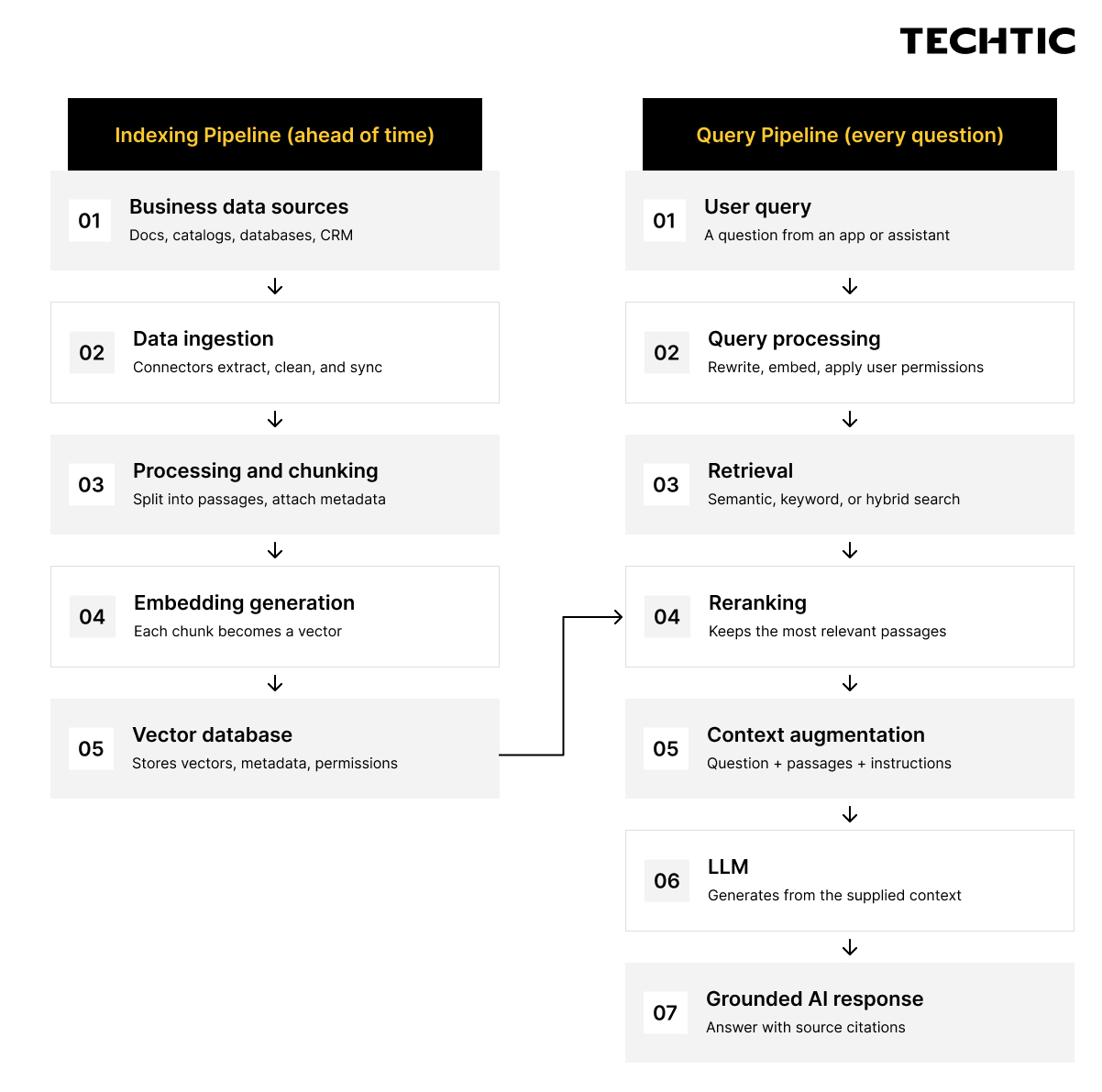
The indexing pipeline makes content searchable before anyone asks a question. At query time, the application applies the user’s permissions, the retrieval layer searches the index, and reranking narrows the results before passages enter the prompt. The LLM never searches the database directly, so retrieval quality shapes the answer as much as the model does.
RAG vs. Fine-Tuning: Understanding Their Different Roles
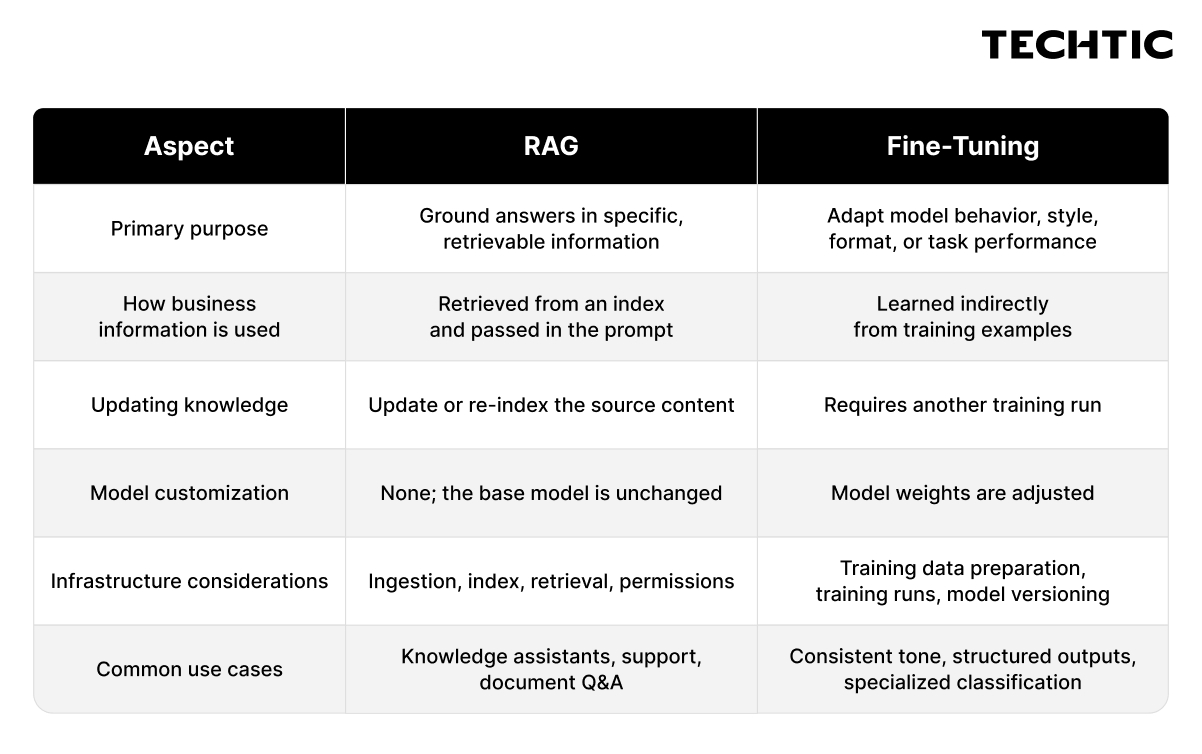
RAG gives an LLM access to external information at query time, fine-tuning changes the model itself by training it further on examples. They solve different problems, so the RAG vs. fine-tuning question is usually about which problem you have.
In the RAG vs. fine-tuning LLM decision, fine-tuning does not reliably give a model complete, current access to a private knowledge base that changes weekly. It also provides no citations or per-user permissions; RAG is built for that.
Fine-tuning fits when the model must behave differently, such as following a strict output format. Some applications use both.
Understanding Agentic RAG Architecture
In the RAG vs. fine-tuning LLM decision, fine-tuning does not reliably give a model complete, current access to a private knowledge base that changes weekly. It also provides no citations or per-user permissions; RAG is built for that.
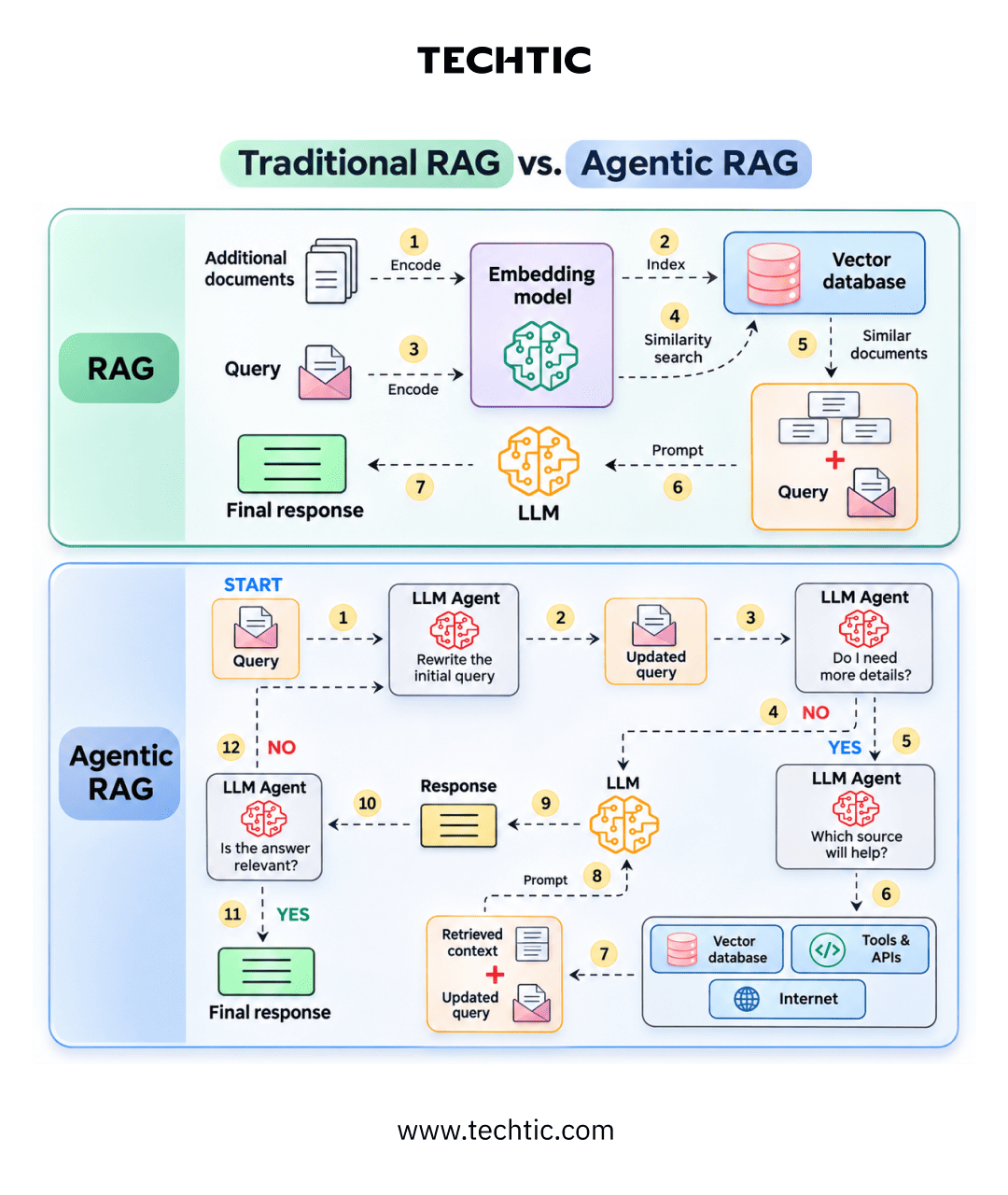
Agentic RAG architecture adds an AI agent that decides how to gather information: which sources to search, which tools to call, and whether it has enough context to answer.
Traditional RAG vs. Agentic RAG
Traditional RAG follows a fixed path: one query, one retrieval, one generation. It is fast, predictable, and sufficient for most document Q&A. Agentic RAG adds planning; Microsoft’s Azure AI Search, for example, offers agentic retrieval that uses an LLM to split complex questions into focused subqueries.
How Agentic RAG Works
For a question like “Which enterprise customers on the legacy plan opened billing tickets last quarter, and what does our migration policy offer them?”, an agent might:
- Decompose the question into parts.
- Query the CRM or a SQL database for customer and ticket data.
- Retrieve the migration policy from the document index.
- Evaluate whether the gathered context is sufficient, and search again if not.
- Generate an answer that cites each source.
Frameworks such as LangChain, LlamaIndex, and AutoGen provide building blocks for tool selection, API calls, multi-step retrieval, and multi-agent coordination.
Enterprise Considerations for Agentic RAG
Production agentic systems need permission-aware tools, human approval for consequential actions, tool guardrails, audit trails, and monitoring for loops and failures. Agentic RAG is not automatically better; it justifies its extra latency and cost only when a workflow spans multiple sources or steps.
How to Build a Production-Ready Enterprise RAG Application
Building a production RAG application means defining a narrow use case, preparing data carefully, designing retrieval deliberately, securing access, and evaluating against real questions before launch.
Step 1: Identify Business Requirements and Data Sources
Define the users, the questions the application must answer, and the approved sources. A focused first use case, such as internal policy Q&A, is easier to evaluate; our guide to AI product development covers scoping a first release.
Step 2: Prepare and Organize Business Data
Extract and clean content, remove outdated versions, choose a chunking strategy, attach source, date, and permission metadata, and sync the index with changes and deletions.
Step 3: Select Embedding Models and Vector Databases
Evaluate options against languages, data volume, latency, hosting and data-residency rules, existing stack, and budget, and test them on your own documents.
Step 4: Design the Retrieval and Generation Workflow
Choose semantic, keyword, or hybrid retrieval, add reranking where precision matters, and limit how many passages reach the prompt. Require grounded answers, citations, and a clear fallback when context is missing.
Step 5: Integrate the RAG Pipeline With Applications
Expose the pipeline through APIs to power websites, internal tools, support platforms, and web or mobile products, returning citations the interface can display.
Step 6: Implement Security and Access Controls
Authenticate users, enforce role-based permissions at retrieval time, encrypt data, mask sensitive fields, and log queries for audit.
Step 7: Test, Evaluate, and Optimize
Build a test set of real questions, including tricky and unanswerable ones. Measure retrieval relevance, accuracy, groundedness, citation quality, latency, cost, and user satisfaction, then tune where answers fail.
Step 8: Deploy, Monitor, and Maintain
Monitor answer quality, latency, and user feedback. Re-index as content changes, re-test when models or embeddings change, and scale infrastructure with usage.
Common Challenges in Enterprise RAG Implementation
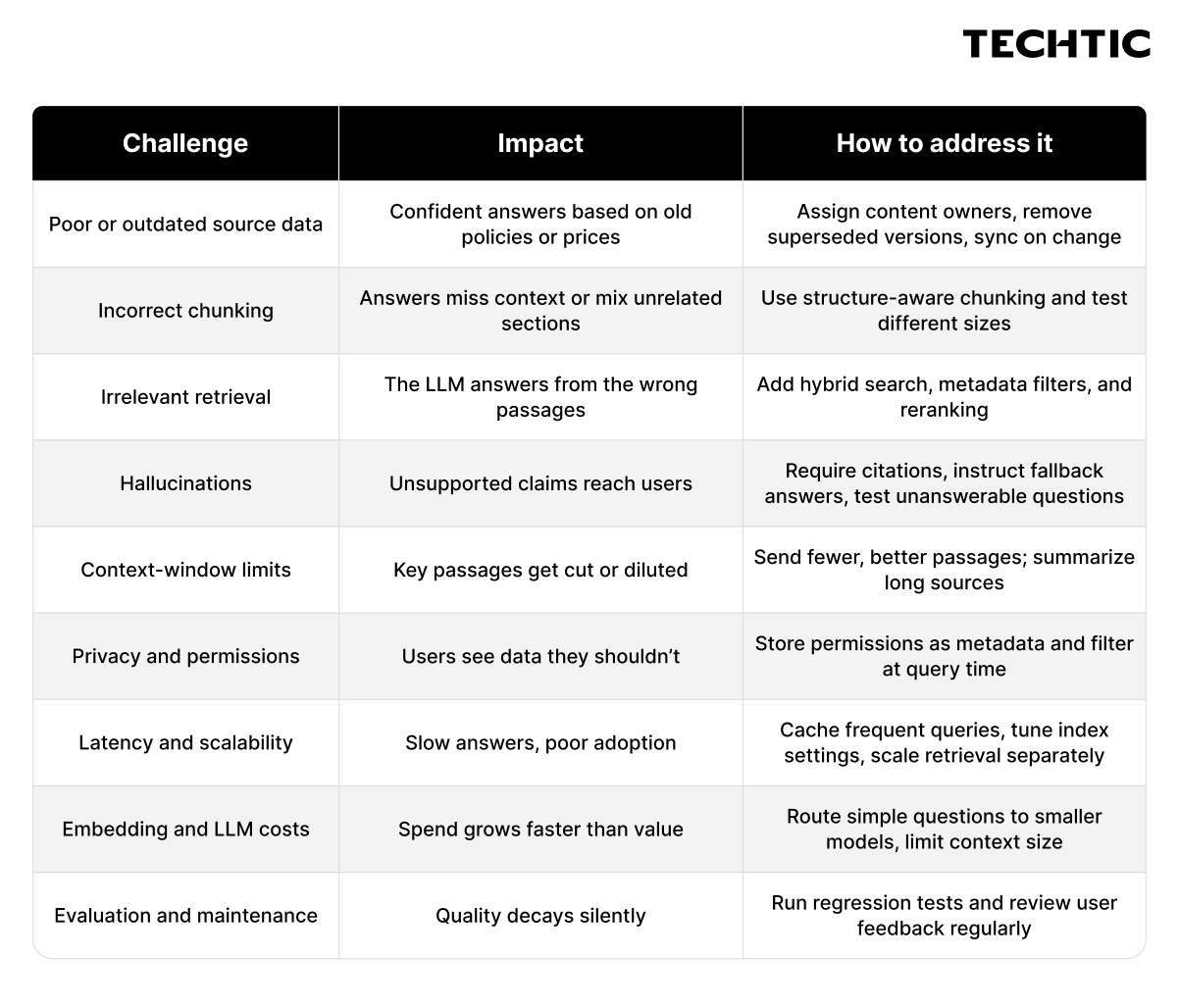
Most RAG problems trace back to data quality, retrieval relevance, or governance rather than the LLM itself.
RAG reduces unsupported answers but does not eliminate them, so evaluation is part of the architecture, not an afterthought.
Enterprise Use Cases of RAG Architecture
RAG fits wherever people need accurate answers from a large, changing body of approved information. The examples below are illustrative, not client results.
eCommerce and Retail
A product assistant retrieves specifications, compatibility notes, and return policies so shoppers can compare items and support agents answer consistently. It works best on a well-structured eCommerce platform with clean product data.
Finance and Banking
Internal assistants help authorized employees search product terms, compliance procedures, and policy manuals, with strict role-based access and audit logs for every query.
Healthcare
RAG can surface approved clinical guidelines, protocols, and administrative information for staff, with strict privacy controls and professional oversight. It supports qualified people rather than replacing their judgment.
SaaS and Enterprise Software
Documentation assistants answer customer questions with links to the right help article, while support and engineering teams search past cases, design docs, and runbooks.
Enterprise Operations
HR, IT, and operations teams use policy assistants and knowledge search so employees find current procedures without hunting through shared drives.

Conclusion
RAG architecture connects LLMs to the proprietary information that makes them useful, retrieving relevant content at query time and grounding answers in it. Results depend on data quality, retrieval relevance, and sound design, and production systems need security, evaluation, monitoring, and maintenance. Agentic RAG adds value when workflows truly span multiple sources and steps.
Looking to build an AI application that works with your business data? Techtic Solutions helps businesses develop AI-powered products, RAG-based solutions, and intelligent automation aligned with their operational requirements. Talk to our team about turning your AI ideas into practical business solutions.
FAQs
Q. What is RAG architecture, and why do AI applications need it?
RAG (Retrieval-Augmented Generation) architecture enables AI applications to retrieve relevant information from trusted data sources before generating a response. It helps businesses build AI systems that deliver more accurate, context-aware answers using their own company data rather than relying solely on an LLM’s training data.
Q. How does RAG architecture work in real-world AI applications?
RAG architecture works by first processing and indexing business data so it can be searched efficiently. When a user asks a question, the system retrieves relevant information, adds it to the LLM’s prompt, and generates a response based on that context. This allows AI applications to answer questions using relevant and up-to-date business information.
Q. What are the key components required to build a RAG system?
A typical RAG system includes data ingestion, document chunking, embedding models, a vector database, retrieval mechanisms, reranking models, and a Large Language Model (LLM). It also requires security controls and evaluation processes to ensure accurate, relevant, and reliable responses.
Q. Is RAG better than fine-tuning for enterprise AI applications?
RAG and fine-tuning serve different purposes. RAG is better suited for applications that need access to frequently updated or organization-specific information, while fine-tuning helps adapt an AI model’s behavior, response style, or performance for specific tasks. Enterprises can also combine both approaches depending on their requirements.
Q. What is Agentic RAG, and how is it different from traditional RAG?
Agentic RAG combines retrieval-augmented generation with AI agents that can plan tasks, select relevant data sources, use external tools, and perform multiple retrieval steps. Unlike traditional RAG, which generally follows a predefined retrieval process, Agentic RAG can dynamically decide how to gather information to answer complex questions.
Q. How can businesses implement RAG architecture in their existing systems?
Businesses can implement RAG by identifying suitable AI use cases, connecting approved internal data sources, preparing and indexing documents, selecting embedding models and vector databases, and integrating an LLM. The system should then be tested with real-world queries, access controls, and performance monitoring before deployment.