AI-DLC vs SDLC: Key Differences in Modern Software Development
Sector: AI + Data
Author: Nisarg Mehta
Date: 09/17/2026

For decades, the software development lifecycle gave engineering teams a shared framework for how software gets planned, built, tested, and maintained. It wasn’t perfect, and different methodologies, Waterfall, Agile, DevOps, each offered their own interpretation of how to execute it. But the underlying concept remained stable: humans define requirements, humans write code, humans test it, humans ship it.
That assumption is now under pressure.
AI coding assistants generate working implementations from natural language prompts. AI agents can autonomously write tests, identify bugs, refactor code, and update documentation. Large language models help teams draft specifications, decompose features, and analyze codebases faster than any individual developer working alone. When AI can meaningfully participate in planning, coding, testing, debugging, documentation, and deployment, does software development still need to follow the same lifecycle structure it always has?
That question has led to growing discussion around AI-DLC, AI-driven or AI-native development lifecycle approaches, as a distinct model from traditional SDLC. The two aren’t necessarily opponents, but they reflect meaningfully different assumptions about how software gets built.
This article compares them directly: what each one is, where they differ, what those differences mean practically, and how teams can think about adopting AI-native development without abandoning the engineering discipline that makes software reliable.
What Is SDLC?
The Software Development Life Cycle (SDLC) is a structured framework that defines how software is conceived, developed, delivered, and maintained. It gives development teams a repeatable process for managing the complexity of building software, from the first conversation about what a product should do to the ongoing work of keeping it running in production.
SDLC isn’t a single methodology. It’s a lifecycle concept that different methodologies implement in different ways.
Traditional SDLC Stages
1. Planning
Define scope, objectives, timeline, and resources. Assess feasibility and identify risks before any development begins.
2. Requirements Analysis
Gather and document what the software needs to do, from both a functional and non-functional perspective. This involves stakeholders, product managers, business analysts, and technical leads.
3. Design
Translate requirements into technical architecture: system design, database schema, API design, UI/UX, and technology stack selection.
4. Development
Developers write the actual code. This is typically the longest and most resource-intensive stage.
5. Testing
QA engineers test the software against requirements. Unit tests, integration tests, performance tests, and user acceptance testing all happen here.
6. Deployment
The software is released to production, either incrementally or in a full release, depending on the methodology.
7. Maintenance
Ongoing bug fixes, performance monitoring, feature updates, and technical debt management.
Methodology Variations
How teams move through these stages depends on the methodology they follow:
- Waterfall executes stages sequentially with formal handoffs between each
- Agile works in short iterative cycles, revisiting planning and development continuously
- Scrum applies Agile principles through structured sprints and ceremonies
- DevOps collapses the boundary between development and operations, emphasizing automation, continuous integration, and continuous delivery
SDLC is the framework. Methodology is how the framework gets executed. Agile SDLC and Waterfall SDLC are both SDLC, the lifecycle stages are similar, the execution philosophy differs substantially.
What Is AI-DLC?
AI-DLC, the AI-driven or AI-native development lifecycle, is an approach to software development where artificial intelligence actively participates in the development process itself, not just as a background tool but as a collaborative participant across the lifecycle.
The clearest way to understand what makes AI-DLC distinct: in traditional SDLC, AI might be a tool a developer uses occasionally, the way they might use a search engine or a linter. In AI-DLC, AI is a participant in the workflow, generating specifications, producing code implementations, writing tests, analyzing output, suggesting refactors, and flagging issues, while humans focus on intent, architecture, review, judgment, and governance.
A concise definition: AI-DLC is a software development lifecycle model where AI systems actively contribute to specification, implementation, testing, documentation, and iteration, with humans providing direction, oversight, architectural decision-making, and validation throughout.
This is different from simply adding GitHub Copilot to an existing SDLC. AI-DLC involves rethinking workflows, responsibilities, feedback loops, and quality control to reflect what AI can and can’t reliably contribute.
What Changes in an AI-Native Lifecycle
- Workflow shifts from sequential human handoffs to tighter human-AI collaboration loops
- Responsibilities change as developers move from writing every line to directing, reviewing, and validating AI output
- Development artifacts like specifications and prompts become first-class engineering inputs
- Feedback loops compress, AI can generate, test, and iterate in cycles that take hours rather than sprints
- Automation extends beyond CI/CD into code generation, test creation, and documentation
- Human oversight becomes more critical, not less, as AI output requires validation at each stage
- Governance needs to expand to cover model behavior, output auditability, and intellectual property considerations
AI-DLC vs SDLC at a Glance
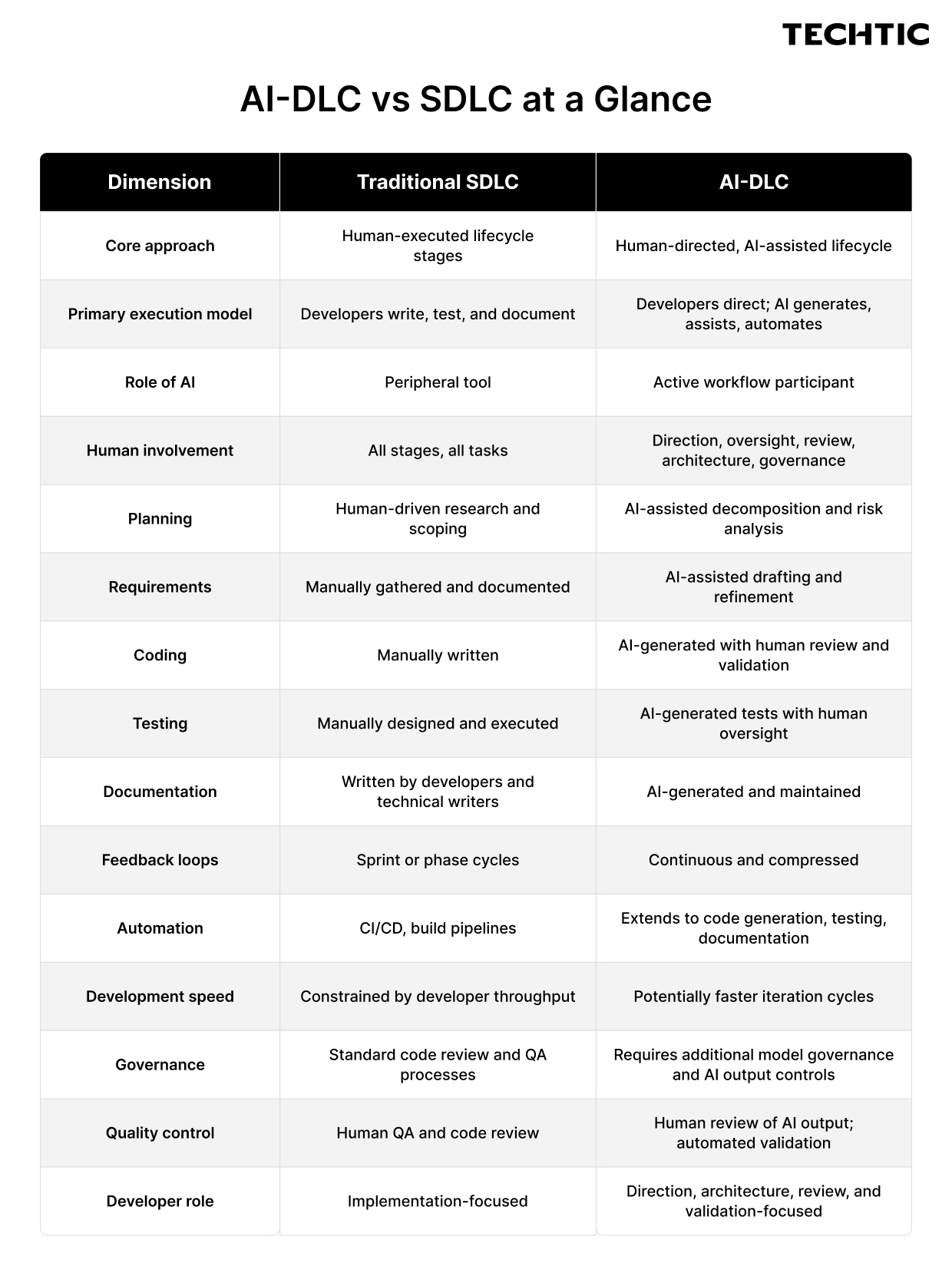
AI-DLC vs SDLC - Key Differences
1. Development Approach
Traditional SDLC organizes software development into defined stages with clear handoffs. Even in Agile implementations, where stages overlap across short sprints, the fundamental model is human execution at each step.
AI-DLC introduces a different dynamic. AI can generate a working implementation from a specification, produce tests for that implementation, analyze the output, and suggest revisions, all within the same session. This creates development loops that don’t map cleanly onto traditional stage boundaries.
The practical implication is a shift in pacing. Traditional SDLC speed is largely constrained by how fast developers can write and review code. AI-DLC speed is increasingly constrained by how well humans can specify intent, review output, and maintain architectural coherence, different bottlenecks than before.
2. Role of AI
In conventional SDLC, AI is a supporting tool. A developer might use an AI assistant to autocomplete code, generate a function, or explain an error. The developer remains the primary producer of every artifact.
In AI-DLC, AI moves from supporting role to active participant. AI agents can receive a specification, generate an implementation, write the associated tests, update documentation, and flag edge cases, producing artifacts that require human review and validation rather than human creation.
The shift is significant, but it requires clear thinking: AI participation without strong human oversight is where most AI-DLC failures originate.
3. Human Role
This is where the clearest misunderstanding about AI-DLC tends to appear. AI-native development doesn’t reduce the importance of engineering skill, it redirects where that skill is applied.
Developers in AI-DLC workflows spend less time on repetitive implementation tasks and more time on:
- Specification – writing precise intent that AI can act on reliably
- Architecture – making system-level decisions that AI shouldn’t make autonomously
- Prompting and instruction – directing AI agents toward the right output
- Review and validation – evaluating AI-generated code for correctness, security, and maintainability
- Testing – ensuring AI-generated code is actually tested, not just assumed to work
- Governance – managing how AI tools are used, what they can access, and how outputs are audited
4. Requirements and Specifications
Traditional SDLC requirements gathering involves stakeholders, business analysts, product managers, and developers working to document what software needs to do. The output is a requirements document or a backlog of user stories, clear enough for a human developer to implement.
AI-DLC raises the stakes on specification quality. When AI agents generate implementation from specifications, ambiguous requirements produce inconsistent or incorrect output. The precision required to direct AI effectively is often higher than what’s needed to communicate intent between human team members.
Specifications in AI-native development start functioning as technical inputs, closer to contracts than conversations. This isn’t a disadvantage, but it requires teams to invest in specification quality in ways that traditional SDLC sometimes allows them to skip.
5. Coding and Implementation
Traditional SDLC: developers write code, line by line, using their knowledge of the codebase, the architecture, and the requirements. Code review catches errors. Testing catches what review misses.
AI-DLC: developers direct AI systems to generate code, review and validate the output, integrate it into the broader codebase, and verify it works as expected. AI can also assist with refactoring, debugging, and explaining existing code.
The important nuance here is that AI-generated code isn’t automatically good code. It can contain logic errors, security vulnerabilities, inefficiencies, or inconsistencies with the rest of the codebase. Code review and testing don’t become less important in AI-DLC, they become more important, because the volume of generated code increases faster than institutional knowledge about what it does.
Agentic development tools, systems where AI agents autonomously take sequences of development actions, amplify both the productivity potential and the review burden.
6. Testing and Quality Assurance
AI can generate unit tests, create test cases from specifications, analyze code for common vulnerabilities, and run automated regression suites. This makes test coverage faster to achieve and easier to maintain.
What it doesn’t do is eliminate the need for rigorous testing. AI-generated tests reflect what the AI understood about the code’s intent, which may or may not match what the code should actually do. Tests written against incorrect AI assumptions validate incorrect behavior.
The practical approach in AI-DLC: use AI to accelerate test generation and increase coverage breadth, while maintaining human judgment over test design for critical paths, edge cases, and security-sensitive flows.
7. Documentation
Traditional SDLC documentation is often the casualty of development pressure, written late, maintained inconsistently, and out of date before the sprint is finished.
AI-DLC can change this by generating documentation as a natural byproduct of development: inline comments, API references, architectural decision records, and user-facing guides generated from the actual code and specifications. AI can also keep documentation updated as the codebase changes.
The practical benefit is real. The limitation is that AI-generated documentation reflects AI’s understanding of the code, which requires human review to ensure it’s accurate and complete.
8. Feedback Loops
Traditional SDLC feedback loops operate at the cycle level: sprint retrospectives, QA cycles, user acceptance testing, production monitoring. Feedback travels through people, meetings, and handoffs.
AI-DLC compresses feedback loops significantly. AI can generate code, test it, identify issues, and suggest corrections in cycles measured in minutes rather than days. This faster iteration capability is one of the clearest practical advantages of AI-native development for prototyping, experimentation, and iterative refinement.
Shorter feedback loops only help when the feedback is accurate. Rapid iteration on incorrect AI output just produces more incorrect output faster, which is why validation at each cycle matters.
9. Developer Productivity
AI coding tools consistently show meaningful productivity improvements for specific tasks, generating boilerplate, writing routine functions, explaining unfamiliar code, generating test cases, and drafting documentation. GitHub’s research on Copilot, for example, showed developers completing certain tasks faster when using AI assistance.
What’s harder to generalize is whether productivity improvements on individual tasks translate directly into faster software delivery. Code generation speed and software delivery speed are related but not equivalent. If AI generates code faster but review, testing, integration, and debugging become bottlenecks, overall cycle time doesn’t compress proportionally.
The organizations seeing the strongest productivity gains from AI-native development tend to have strong foundations: good test coverage, clear specifications, mature CI/CD pipelines, and experienced engineers who can review AI output effectively.
10. Governance and Oversight
AI-DLC requires governance frameworks that traditional SDLC wasn’t designed to address:
- Code review becomes more essential as AI generates more code with less developer context
- Security scanning needs to catch vulnerabilities that AI code generation can introduce
- IP and licensing considerations apply to AI-generated code in ways that vary by jurisdiction and tool
- Data privacy matters when AI tools process proprietary codebases or customer data
- Model governance, understanding which AI models are being used, how, and with what data, becomes an engineering operations concern
- Auditability, knowing what was AI-generated versus human-written, may be relevant for compliance in regulated industries
None of these governance requirements are optional. They’re the engineering discipline that makes AI-DLC viable rather than risky.
AI-DLC vs SDLC Process Comparison
Traditional SDLC Workflow
Requirements → Design → Development → Testing → Deployment → Maintenance
Each stage is primarily human-executed, with defined artifacts, approvals, and handoffs between phases. Iteration happens at the methodology level (sprint cycles in Agile, phase gates in Waterfall).
AI-Native Development Workflow
Intent/Specification → AI-Assisted Planning → AI-Driven Implementation → Automated Validation → Human Review → Deployment → Continuous Feedback
The stages aren’t fundamentally different, software still needs to be planned, built, tested, and deployed. What changes is the execution model within each stage: AI participates in generation and analysis, while humans provide direction, oversight, and judgment.
It’s worth noting that AI-DLC implementations vary significantly depending on the tools, frameworks, organizational maturity, and development methodology in use. There’s no single universal AI-DLC process, the concept describes an approach more than a specific sequence.
How AI Changes Each Stage of the Software Development Lifecycle
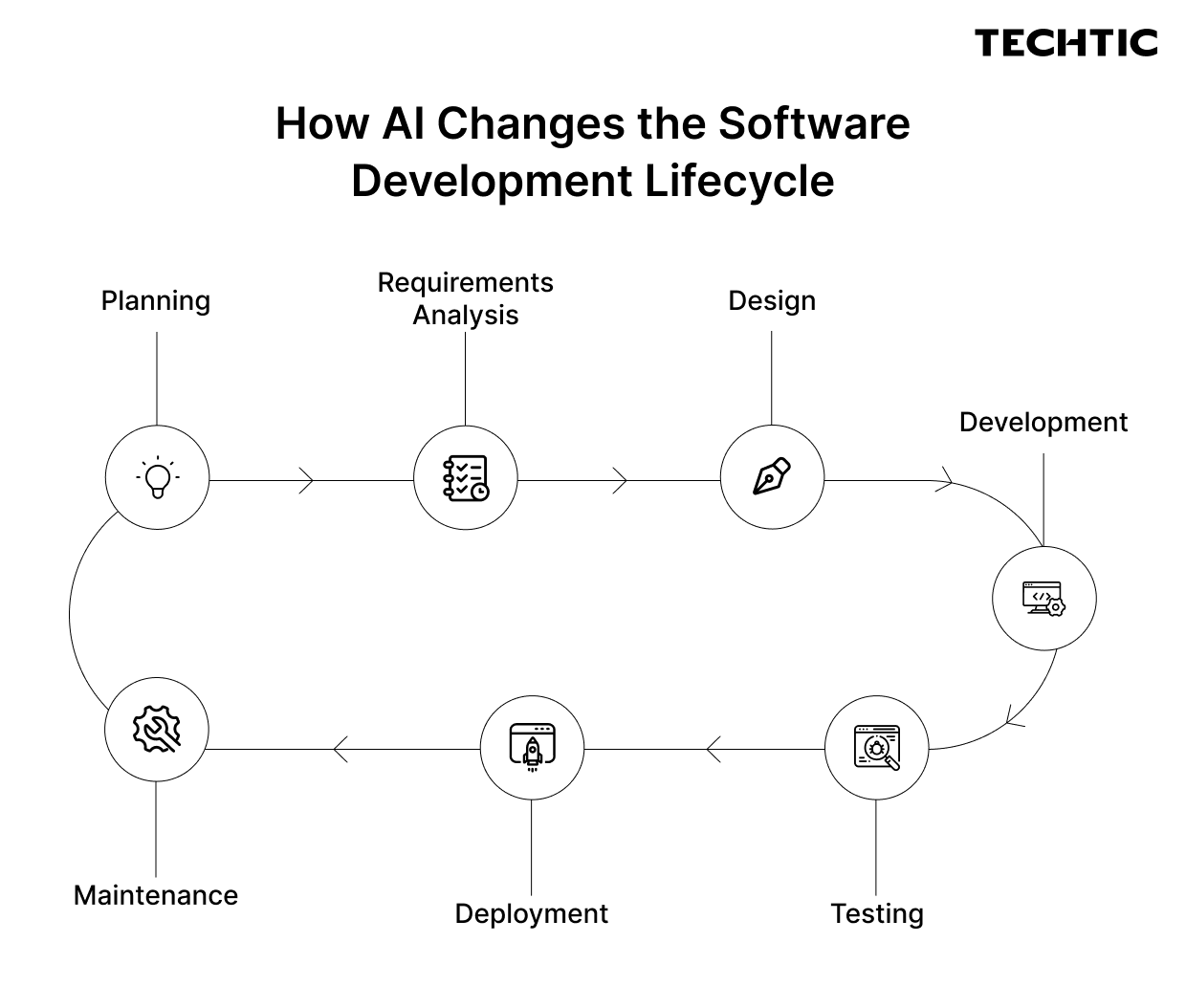
Planning
AI assists with requirement decomposition, technical research, risk identification, effort estimation, and project breakdown. Teams can analyze similar past projects, identify potential blockers, and surface dependency considerations faster than manual research allows.
Requirements
AI can help draft user stories from rough feature descriptions, generate acceptance criteria, identify ambiguous requirements, and refine specification language. The output still requires human review and stakeholder validation, AI can draft, not decide.
Design
AI tools can suggest architectural patterns, generate initial API designs, produce UI component concepts, and create technical design documentation. Architectural decisions still require experienced human judgment, AI suggestion is useful input, not a replacement for design expertise.
Development
Code generation, code completion, debugging assistance, refactoring suggestions, and inline documentation are all areas where AI provides meaningful productivity support. AI agents can handle routine implementation tasks autonomously with appropriate oversight. Complex logic, critical systems, and security-sensitive code deserve closer human attention regardless of how the initial implementation is generated.
Testing
AI can generate unit tests from function signatures, create test cases from specifications, analyze code for common vulnerability patterns, and run automated regression suites. Test coverage improves faster. The limitation is that AI-generated tests are only as good as AI’s understanding of intended behavior.
Deployment
AI supports CI/CD pipeline configuration, infrastructure-as-code generation, deployment script creation, and release note drafting. Deployment decisions, especially in production, still require human authorization and oversight.
Maintenance
AI can analyze existing codebases to identify technical debt, suggest optimizations, investigate reported bugs, generate updated documentation, and monitor performance patterns. For large legacy codebases, AI assistance in understanding and navigating unfamiliar code can be particularly valuable.
Is AI-DLC Replacing SDLC?
The direct answer: no, but it’s changing how SDLC is executed.
SDLC is a lifecycle framework, not a set of specific practices. The underlying engineering responsibilities it describes, planning, requirements, design, implementation, testing, deployment, maintenance, don’t disappear because AI tools become more capable. They change in how they’re performed.
What AI-DLC represents is an evolution in execution model, not an elimination of the engineering discipline behind the lifecycle. Planning still happens. Requirements still need to be defined. Architecture still needs to be designed. Testing still needs to happen. Code still needs to be reviewed. Production still needs to be monitored.
The difference is in who does what. AI does more of the generation, analysis, and automation work. Humans do more of the direction, judgment, and validation work. The lifecycle framework remains structurally valid, the execution changes significantly.
Organizations that adopt AI-DLC as a complete replacement for structured software lifecycle management, assuming that AI handles everything, typically produce software that’s faster to generate but harder to maintain, secure, and scale.
Benefits of AI-DLC
Faster iteration cycles. AI can generate implementations, run tests, and suggest refinements in compressed timeframes that traditional development cycles can’t match. Prototyping and experimentation become faster.
Reduced time on repetitive tasks. Boilerplate code, routine functions, test generation, and documentation drafting are tasks AI handles well. Freeing developers from these tasks shifts their attention toward higher-value work.
Increased development throughput. Teams can handle more in parallel when AI assists with implementation. The ceiling on what a given team can produce in a sprint rises.
Automated documentation maintenance. Documentation that updates with the codebase rather than lagging behind it is a practical operational improvement.
Faster debugging and code analysis. AI can analyze stack traces, suggest fixes, and explain unfamiliar code faster than manual research, particularly valuable in large or legacy codebases.
Improved developer focus. When routine implementation is handled by AI, developers can spend more time on architecture, edge cases, security, and the problems that genuinely require human judgment.
None of these benefits are automatic. They depend on having the right engineering foundations, clear specifications, strong testing practices, mature CI/CD, and experienced engineers who can direct and validate AI output effectively.
Challenges and Limitations of AI-DLC
Hallucinations and incorrect output. AI models can generate code that looks correct but contains logic errors, uses deprecated APIs, or subtly misunderstands requirements. Review catches these, but only if review is rigorous.
Security vulnerabilities. AI code generation can introduce common vulnerability patterns, SQL injection, insecure deserialization, improper input validation, if security review isn’t part of the workflow. AI doesn’t have a security conscience; humans need to provide one.
Technical debt accumulation. Faster code generation can produce technical debt faster too, if architectural consistency and code quality standards aren’t actively maintained. Volume of code isn’t the same as quality of code.
Context limitations. AI models have context window limitations that affect their ability to understand and maintain consistency across a large codebase. AI that can’t “see” the full codebase can produce implementations that conflict with existing patterns.
Inconsistent outputs. AI-generated code quality varies depending on specification clarity, prompt quality, model choice, and the complexity of the task. Outputs aren’t uniformly reliable.
Overreliance and skill atrophy. Teams that rely on AI for implementation without maintaining engineering fundamentals may find their ability to evaluate, debug, and improve AI output degrading over time.
IP and licensing considerations. The intellectual property status of AI-generated code varies by jurisdiction, tool, and organizational policy. This is an evolving legal area that requires organizational awareness.
Governance complexity. Managing which AI tools are used, what data they access, how outputs are tracked, and how compliance is maintained adds operational overhead that needs to be designed into the development process.
Review bottlenecks. If AI generates code faster than engineers can meaningfully review it, the productivity gain at the generation stage transfers into a backlog at the review stage. Speed at one step doesn’t automatically accelerate the whole pipeline.
AI-DLC and the Changing Role of Developers
The most accurate framing of how AI-DLC affects developers is task reallocation, not role elimination.
Traditional software development requires developers to produce every implementation detail manually. This means significant time spent on tasks that are repetitive, well-defined, and don’t particularly require creative problem-solving, writing boilerplate, generating test cases, drafting documentation, explaining straightforward logic.
AI can handle much of that. Which means developers in AI-DLC environments spend more of their time on:
- Specification and intent definition – articulating what software should do precisely enough for AI to act on
- Architecture and system design – making the structural decisions that AI shouldn’t make autonomously
- Code review and validation – evaluating AI output for correctness, security, maintainability, and architectural fit
- Testing strategy – designing test approaches for critical paths and edge cases, beyond what AI generates automatically
- AI orchestration – selecting, directing, and managing AI tools and agents within the development workflow
- Debugging complex problems – the genuinely hard bugs that require deep system understanding and human reasoning
What this requires is engineering depth, not less of it. A developer who doesn’t understand security well can’t catch security issues in AI-generated code. An architect who can’t evaluate AI-suggested patterns can’t maintain architectural integrity. Strong fundamentals matter more in AI-DLC, not less, because the human role increasingly involves judgment over AI output rather than production of every implementation detail.
AI-DLC Tools and Technologies
AI-native development draws on several categories of tools:
AI coding assistants such as GitHub Copilot, Cursor, and Amazon CodeWhisperer provide real-time code suggestions, completions, and generation within the development environment.
Large language models like GPT-4, Claude, and Gemini serve as reasoning and generation engines that power both coding assistants and agentic development tools.
AI coding agents, including tools like Devin, Claude Code, and emerging agentic frameworks, can autonomously execute multi-step development tasks: researching a problem, writing an implementation, running tests, and iterating on output.
Automated testing platforms with AI integration can generate test cases, identify coverage gaps, and analyze test results with greater speed than manual approaches.
CI/CD systems like GitHub Actions, GitLab CI, and CircleCI integrate AI assistance for pipeline configuration, deployment automation, and infrastructure management.
Code review tools with AI capabilities can analyze pull requests, identify potential issues, and suggest improvements during the review process.
Observability platforms with AI-powered anomaly detection support the maintenance and monitoring stages of the lifecycle.
The tooling landscape is evolving rapidly. What’s available and reliable shifts frequently, evaluation should focus on current capabilities and integration with existing workflows rather than marketing positioning.
AI-DLC, DevOps, Agile, and SDLC - How They Relate
These terms describe different things and operate at different levels. Conflating them creates confusion.
- SDLC is the lifecycle framework, the sequence of activities through which software moves from concept to production to maintenance
- Agile is a development philosophy emphasizing iterative delivery, collaboration, and responsiveness to change
- Scrum is an Agile framework that implements these principles through sprints, ceremonies, and defined roles
- DevOps is a set of practices and cultural principles that connect development and operations, emphasizing automation, continuous integration, continuous delivery, and shared responsibility
- AI-DLC is an AI-native approach to executing development activities, changing who does what within the lifecycle, not replacing the lifecycle itself
None of these are mutually exclusive. An organization can practice Agile development with Scrum ceremonies, DevOps automation practices, and AI-native development tools simultaneously. AI-DLC doesn’t require abandoning Agile or DevOps, it extends them by changing the execution model within sprints and pipelines.
The practical integration: AI-DLC works well layered onto mature DevOps and Agile foundations. Teams without those foundations often struggle to capture the benefits of AI-native development because the surrounding infrastructure, automated testing, CI/CD, clear specifications, isn’t in place.
When Should a Business Consider AI-DLC?
AI-native development is most productive when certain conditions are in place:
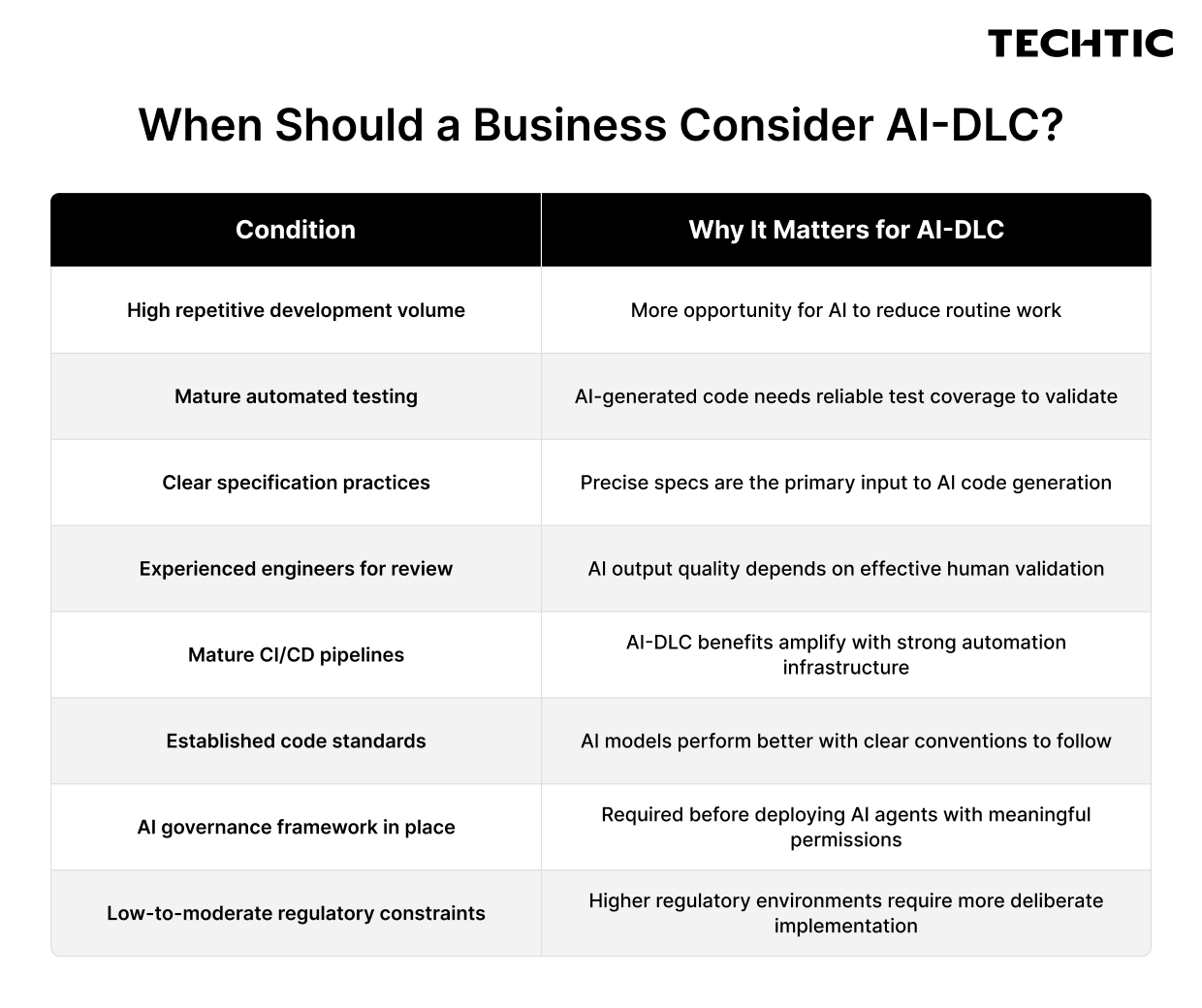
Conversely, teams that lack test coverage, have unclear specifications, don’t have strong code review practices, or are working in heavily regulated environments without AI governance controls should invest in those foundations before expecting AI-native development to deliver its potential benefits.
How to Transition From SDLC to AI-Native Development
A gradual, measured approach consistently outperforms a wholesale transformation attempt.
1. Assess your current lifecycle honestly. Identify where the actual bottlenecks are, specification clarity, development speed, test coverage, deployment automation, or something else. AI-DLC addresses some of these better than others.
2. Identify AI-suitable workflows. Start with the tasks AI handles reliably: boilerplate generation, test creation, documentation drafting, code explanation. These create immediate value with manageable risk.
3. Establish AI coding policies. Define which tools are approved, what data they can access, how AI-generated code is labeled, and what review process applies to AI output before it merges.
4. Invest in specification quality. Write clearer, more precise requirements and user stories. This improves AI output quality and benefits human developers simultaneously.
5. Introduce AI-assisted development tools. Start with coding assistants in individual developer workflows before introducing agentic tools with broader permissions.
6. Strengthen automated testing. Higher AI code generation volume requires stronger automated test coverage. Invest in test infrastructure before expanding AI code generation.
7. Establish human review checkpoints. Define where human review is mandatory in the AI-DLC workflow, particularly for security-sensitive code, critical paths, and architectural changes.
8. Introduce AI agents gradually. Start with narrow, well-defined tasks. Expand agent autonomy based on observed reliability and with appropriate oversight controls.
9. Monitor quality metrics, not just speed metrics. Track bug rates, security findings, technical debt indicators, and system reliability alongside development throughput. Speed that produces fragile software isn’t a net gain.
10. Expand based on demonstrated results. Let evidence drive adoption pace. Workflows where AI-DLC is measurably improving outcomes warrant expansion. Workflows where it’s creating review bottlenecks or quality problems need adjustment first.
Common Mistakes When Adopting AI-DLC
Treating AI-DLC as just using ChatGPT for coding. Asking an AI to write functions on request is a different thing from redesigning your development workflow to incorporate AI as a structured participant. The latter requires planning; the former is just a tool habit.
Skipping code review for AI-generated output. AI-generated code isn’t reviewed code. Review is not optional, it’s the primary quality control mechanism in AI-native development.
Poor specification quality. Vague prompts produce vague code. If your team can’t write precise specifications, AI code generation amplifies the ambiguity into working-but-wrong implementations.
No governance before agents. Deploying AI agents with broad codebase access, external API permissions, or production system access without clear governance controls is a security risk. Governance design should precede agent deployment.
Measuring lines of code instead of outcomes. AI makes it trivially easy to generate large volumes of code. Volume isn’t quality, and it isn’t delivery. Measure what the software actually does and how reliably it does it.
Ignoring security review. AI code generation can introduce vulnerabilities. Adding AI to your development workflow without adding security scanning and security-focused code review is a net negative for your security posture.
Attempting wholesale transformation. Teams that try to change everything simultaneously, tools, workflows, roles, processes, tend to produce confusion rather than efficiency. Incremental adoption with measurable checkpoints works better.
Underestimating developer training. Effective use of AI coding tools is a skill. Deploying tools without training developers how to use them effectively, review output critically, and maintain architectural oversight produces underwhelming results.
AI-DLC vs SDLC: Which Approach Is Right for Your Organization?
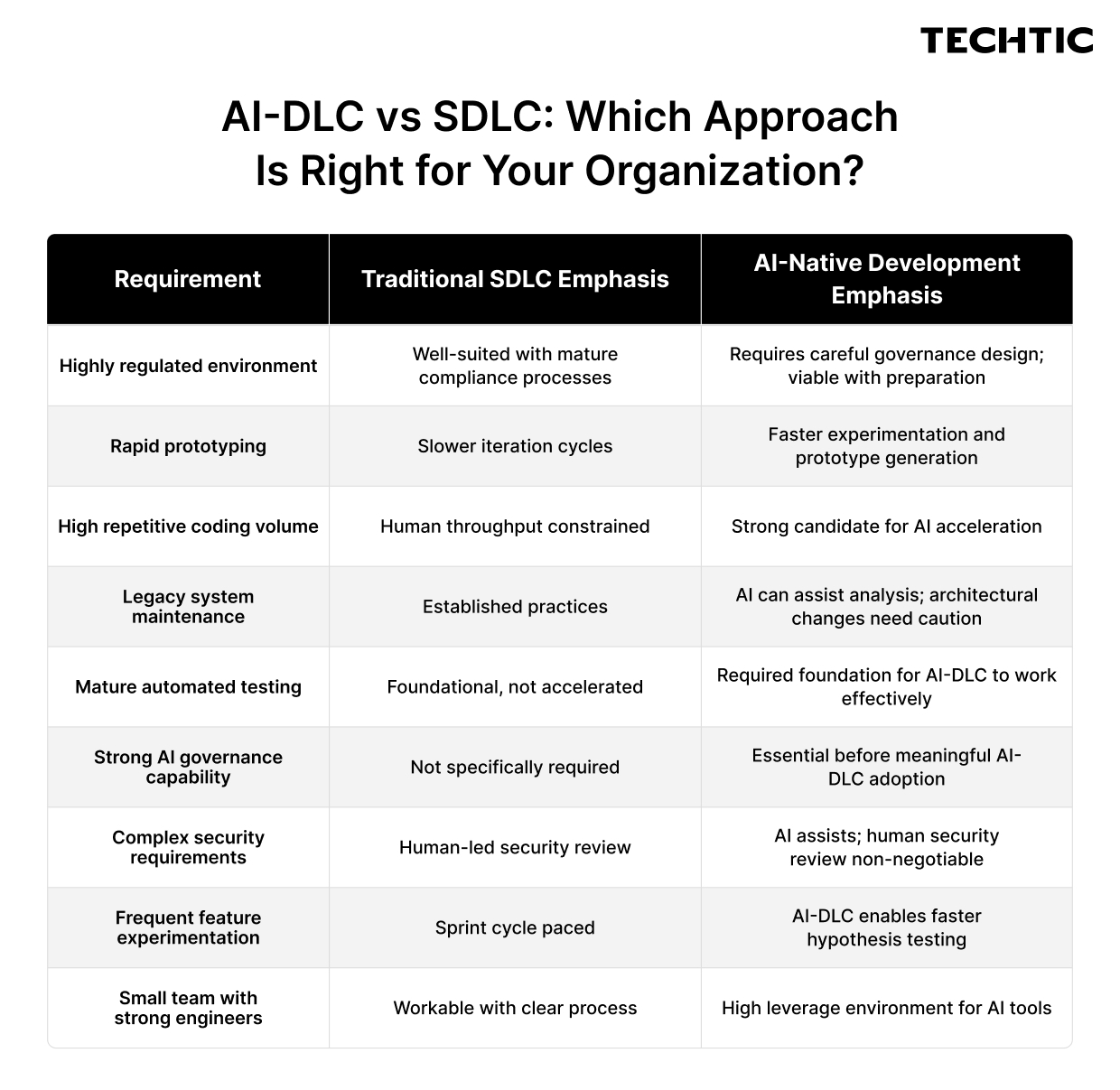
The honest assessment: most organizations will adopt a hybrid model rather than choosing exclusively between traditional SDLC and fully AI-native development. Mature teams apply AI-native approaches to workflows where they add clear value, maintain traditional rigor where the stakes demand it, and build toward deeper AI integration as governance and tooling mature.
The Future of Software Development With AI-DLC
The direction of travel is clear: AI’s participation in software development will increase. AI coding agents are becoming more capable. Context windows are expanding. Agentic frameworks are becoming more sophisticated. The proportion of implementation work that AI can perform reliably will grow.
What this means for software development teams is a gradual shift in the center of gravity, from execution toward direction, from implementation toward architecture and judgment, from writing every line toward specifying intent and validating output.
This isn’t a sudden transformation. The teams navigating it well are the ones investing in engineering foundations, test coverage, clear specifications, strong review practices, security controls, rather than chasing AI tool adoption for its own sake.
The SDLC won’t disappear. The underlying lifecycle logic, plan, build, test, deploy, maintain, reflects the structure of software development, not a historical artifact of pre-AI technology. What changes is how each stage gets executed and who does what within it.
AI-DLC is less a replacement for SDLC and more an AI-native implementation of it, one that will likely become the default model for software development teams over the next decade, as the tools mature and the governance frameworks catch up with the capabilities.
Conclusion
The difference between AI-DLC and traditional SDLC isn’t about whether software needs to be planned, built, tested, and maintained, it does. The difference is in how those activities happen and who does what within them.
AI-DLC is most valuable when it’s adopted with engineering discipline rather than as a shortcut around it. Faster code generation matters when it’s paired with strong review, solid testing, and clear specifications. AI agents create leverage when they operate within defined governance controls. Developer productivity improves when AI handles routine work and experienced engineers focus on the judgment that AI can’t reliably provide.
For organizations evaluating where AI-native development fits in their engineering practice, whether that’s introducing AI coding assistants, implementing RAG-based development tools, or designing agentic development workflows, the starting point is understanding your current lifecycle clearly and identifying where AI adds genuine value rather than just speed.
If you’re working through that evaluation and want to discuss how AI-native development approaches could apply to your specific engineering context, an experienced AI development partner can help you design an adoption path that captures the benefits without compromising the engineering standards your software depends on.
Featured Snippet Opportunities
Q. What is AI-DLC?
AI-DLC is an AI-driven or AI-native software development lifecycle where artificial intelligence actively participates in specification, code generation, testing, documentation, and iteration. Humans provide direction, architecture, oversight, and validation throughout. It differs from traditional SDLC in how development activities are executed, not in the underlying lifecycle structure.
Q. What is the difference between AI-DLC and SDLC?
SDLC is a lifecycle framework where humans execute all development stages, planning, coding, testing, deployment, and maintenance. AI-DLC applies AI as an active participant in those stages, generating code, tests, and documentation while humans direct, review, and validate output. The lifecycle stages remain similar; the execution model changes significantly.
Q. Is AI-DLC replacing SDLC?
No. AI-DLC evolves how SDLC stages are executed rather than eliminating them. Planning, requirements, design, testing, and deployment remain necessary. AI changes who performs which tasks within each stage, generating and analyzing where humans previously wrote and reviewed everything manually. The lifecycle framework remains structurally valid.
Q. What is AI-native software development?
AI-native software development is an approach where AI tools and agents participate throughout the development lifecycle, generating code, writing tests, drafting documentation, and supporting iteration, while human engineers provide direction, architectural oversight, code review, and governance. It differs from simply adding AI tools to an existing workflow by rethinking how development activities are structured.
Q. How does AI change the software development lifecycle?
AI accelerates specific lifecycle activities: code generation, test creation, documentation drafting, bug analysis, and deployment configuration. It compresses feedback loops and reduces repetitive implementation work. It doesn’t eliminate the need for planning, architecture, security review, testing strategy, or human judgment, it changes how those activities are performed.
Q. What are the benefits of AI-DLC?
Key benefits include faster iteration cycles, reduced time on repetitive development tasks, increased development throughput, automated documentation maintenance, faster debugging assistance, and greater developer focus on architecture and judgment. These benefits depend on strong engineering foundations, clear specifications, mature testing, and experienced engineers who can effectively review AI output.