The Marketing Intelligence Shift: How Generative AI Is Redefining How Brands Understand Their Customers
Sector: AI + Data
Author: Nisarg Mehta
Date: 06/15/2026

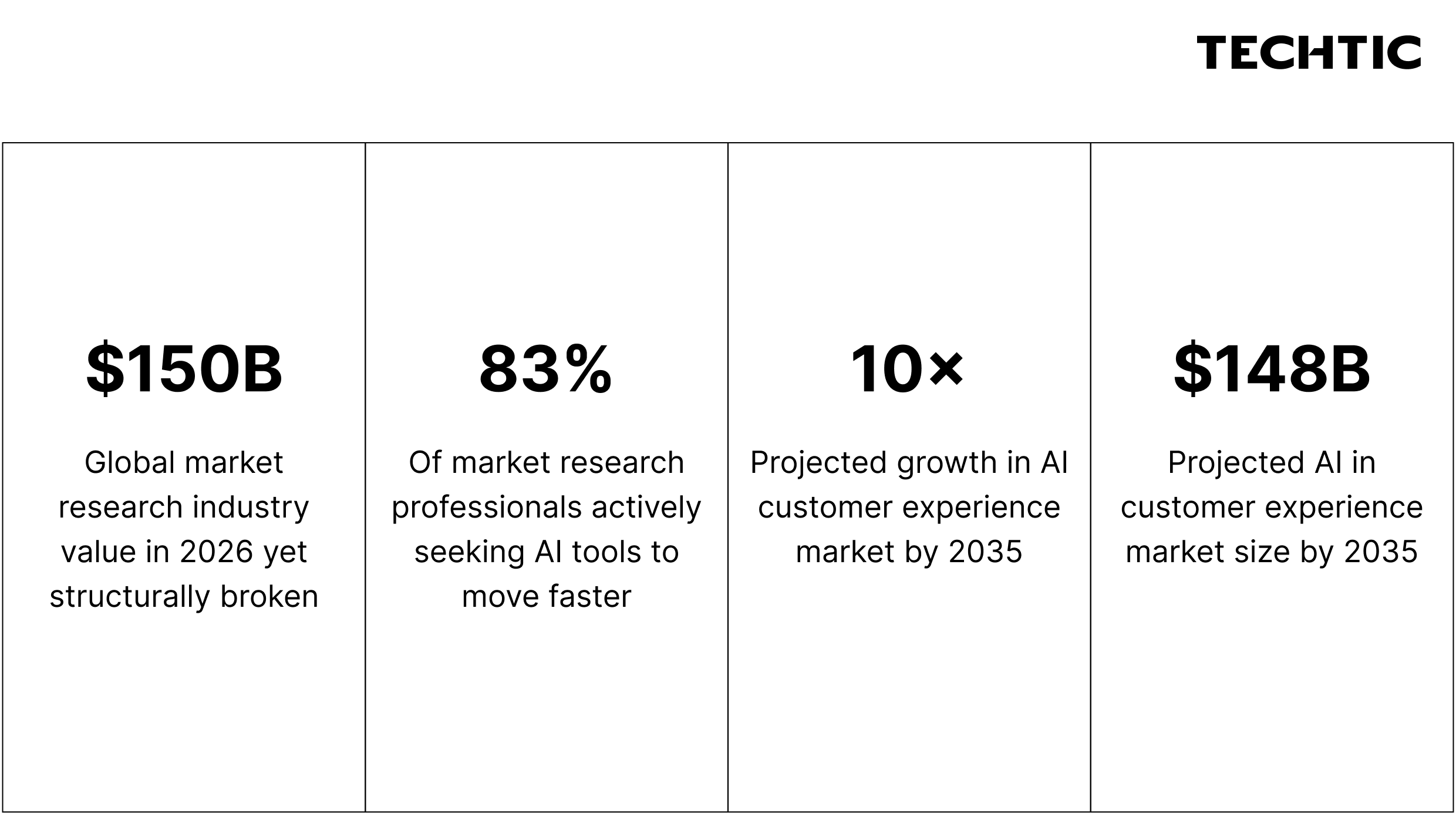
The $150 billion market research industry is broken, and 83% of its own professionals know it. Focus groups take months. Surveys flatten nuance into percentages. Insights expire before campaigns launch. Generative AI is not just making research faster. It is replacing research-as-event with intelligence-as-infrastructure, and the brands moving first are compounding an advantage that will be very difficult to close later.
For decades, marketing has operated on a fundamental tension: brands need to deeply understand their customers before spending a dollar on messaging, yet the tools built to generate that understanding, focus groups, surveys, ethnographic research are slow, expensive, and nearly impossible to scale. A campaign couldn’t move until research was done. And by the time research was done, the market had often already moved on.
That tension is now breaking. Generative AI in marketing is not just changing how marketers execute campaigns, it is changing how they think about customers entirely. It is compressing the customer research cycle from months to minutes. It is replacing static customer personas with living, versioned, queryable intelligence layers. And it is giving marketing teams the ability to pressure-test creative decisions against realistic simulations of their actual audience, before a dollar of media spend is committed.
At Techtic, we have been building at the center of this transformation, developing AI-powered marketing intelligence platforms that give brands the kind of deep, nuanced customer intelligence that once required months and significant research budgets to produce. This article explains how the technology works, why the traditional research model is structurally broken, and what the shift from episodic research to always-on AI customer intelligence means for marketing organizations operating at scale.
The Problem With Traditional Market Research - Four Structural Failures No Budget Can Fix
The market research industry crossed $150 billion in 2026, yet ironically, 83% of professionals in the field were actively looking for AI tools to help them move faster and spend less. That is a striking number. It reflects an industry that knows its own limitations but has not yet found a clear path forward. The problem is not a lack of investment or talent. It is structural, built into the fundamental design of how traditional customer research works.
These four failure modes are why incremental improvements to existing research tools cannot solve the problem. They require a fundamentally different approach to how customer intelligence is generated, stored, and used.
Speed vs. depth tradeoff
Meaningful qualitative research, the kind that surfaces real motivations, not just stated preferences, takes time. Recruiting participants, running sessions, synthesizing findings, and translating them into actionable guidance stretches across weeks or months. By then, market windows have narrowed or closed entirely. The insights arrive after the decision was already made by gut feeling.
Business cost: Campaigns launch on assumption, not evidence. Misfires are discovered after spend, not before.
Scale vs. fidelity tradeoff
Quantitative surveys can reach thousands of respondents quickly, but they flatten nuance into percentages. You learn what people say they will do, not how they actually think or what truly drives their decisions. The motivations, anxieties, and identity drivers that determine purchase behavior are invisible in a five-point Likert scale response.
Business cost: Messaging built on stated preferences fails to resonate with actual motivations. Conversion rates underperform projections.
Reproducibility problem
Research done in January does not reliably reflect customer sentiment in June. Yet re-running studies to track how audiences are evolving is prohibitively expensive for most marketing teams. The result: organizations make decisions based on research that is silently outdated, without any mechanism to detect the drift.
Business cost: Strategy built on stale audience understanding. No visibility into how customers are changing until campaign performance data reveals it too late.
Governance gaps
As AI entered the research workflow in fragmented ways, many organizations found themselves with inconsistent outputs, no version history, and no clear audit trail, making it hard to compare insights over time or demonstrate rigor to compliance teams. AI tools that produce outputs no one can defend are AI tools that do not get adopted.
Business cost: Enterprise adoption blocked by compliance risk. Research outputs that cannot be audited cannot be trusted at scale.
“These weren’t problems that incremental improvements to existing research tools could solve. They required a fundamentally different approach, not faster research, but a different architecture for how customer intelligence is generated and used.”
— Techtic GenAI Marketing Intelligence Framework, 2025
What Techtic Built: AI-Powered Customer Intelligence at Scale
Techtic’s approach to generative AI for marketing intelligence centers on a core insight: if you can create deeply realistic, richly detailed customer personas, grounded in real brand context, behavioral data, and psychographic depth, and then simulate how those personas would respond to marketing stimuli, you effectively compress the customer research cycle from months to minutes without sacrificing the qualitative richness that makes insights actually useful.
This is not prompt engineering applied to generic AI models. It is a purpose-built platform architecture with five interconnected capabilities, each designed to solve a specific failure mode of traditional research, and each building on the output of the stage before it.
01. Brand discovery and contextual grounding
The system begins with guided onboarding that ingests everything meaningful about a brand, website content, product documentation, brand positioning materials, customer data. This is not metadata storage. It is active enrichment: the platform builds a structured brand memory that grounds every subsequent AI interaction in the specific context of that business, its category, and its competitive landscape.
- Ingests website content, product documentation, and brand positioning materials
- Builds a queryable brand context layer, not a static knowledge base
- Grounds all downstream AI outputs in brand-specific rather than generic context
- Solves the contextual shallowness problem that makes generic AI deployments unreliable for marketing
This step solves the most common failure of generic AI in marketing: technically coherent but contextually shallow outputs. When a persona is generated from brand-specific context, it reflects the actual nuances of that brand’s customer base, not a statistical average of all consumers everywhere.
02. Ideal Customer Profile generation with depth and differentiation
From this grounded context, the platform generates multiple distinct AI-powered Ideal Customer Profiles (ICPs), typically three per brand, each representing a meaningfully different audience segment. These are not the flat demographic sketches that have populated marketing decks for years (“Sarah, 34, suburban, values convenience”). They are multi-dimensional profiles engineered to capture what actually drives purchase decisions.
- Demographic and behavioral attributes, who these customers are and how they act
- Psychographic depth, motivations, values, anxieties, and identity drivers
- Pain points and decision triggers, what problems they are solving and what finally moves them to act
- Channel preferences and media behaviors, where they spend attention and how they prefer to engage
- Objection profiles, what would stop them from converting and precisely why
Each persona is displayed side-by-side with others, enabling marketers to immediately see differentiation across segments and understand where messaging needs to flex. A human validation step confirms relevance before profiles are used in downstream analysis, keeping human judgment in the loop without slowing the process.
03. Version-controlled intelligence, the governance layer that changes everything
One of the most consequential and least visible innovations in this platform is version control for customer personas. Every time a persona is updated or enriched, a snapshot is created. Changes are tracked. The system maintains a complete, auditable history of how each ICP has evolved over time. This sounds like an infrastructure detail. Its practical implications are profound.
- Marketing teams can test messaging against the current version of a persona and compare results to testing done six months earlier, tracking not just what works, but how customer receptivity is changing
- Compliance and governance teams have an audit trail demonstrating that AI-generated insights were produced systematically and reproducibly
- Experimentation risk is reduced because snapshot-gated enrichment prevents uncontrolled drift, personas only update when humans deliberately authorize it
For enterprise marketing organizations, this is the difference between AI tools they can trust and AI tools that produce outputs they cannot defend. Version control is what makes AI-generated customer intelligence enterprise-grade.
04. AI-powered focus group simulation
The most visible capability is the AI focus group simulation engine. Marketers can run structured, moderated conversations with their AI personas, individually or as a group, testing everything from campaign concepts and messaging frameworks to product positioning and pricing rationale. These are not simple Q&A interfaces. The system maintains persona consistency throughout a conversation, grounding every response in that persona’s defined attributes and the brand’s accumulated context.
- Responses are traceable, each output links back to the underlying reasoning and persona attributes that shaped it
- Research questions are AI-generated and structured to surface what resonates, what falls flat, and what creates friction
- Moderation logic identifies unintended reactions in adjacent audience segments that qualitative human research often misses
- Full documentation and synthesis are generated automatically, eliminating the most time-consuming part of traditional qualitative research
A moderated insight session that previously required weeks of recruiting, scheduling, and synthesis can now be run in hours, with richer documentation and better reproducibility than a traditional focus group costing 50 times as much.
05. Persona enrichment and market alignment
Personas are not static. As brands evolve, enter new markets, or respond to competitive shifts, their audience understanding needs to evolve too. The platform supports ongoing Artificial Intelligence persona enrichment, feeding in new brand inputs and live public information to refine persona attributes over time. Progress is tracked, changes are versioned, and a readiness summary confirms that personas are fully updated before they are used in new research cycles.
- New brand inputs, product launches, repositioning, competitive responses, trigger persona enrichment workflows
- Live market signals can be incorporated to keep audience understanding current
- Readiness scoring ensures no outdated persona is accidentally used in live research
This is the capability that converts AI customer intelligence from a project tool into infrastructure. The intelligence layer doesn’t expire, it evolves continuously alongside the brand it serves.

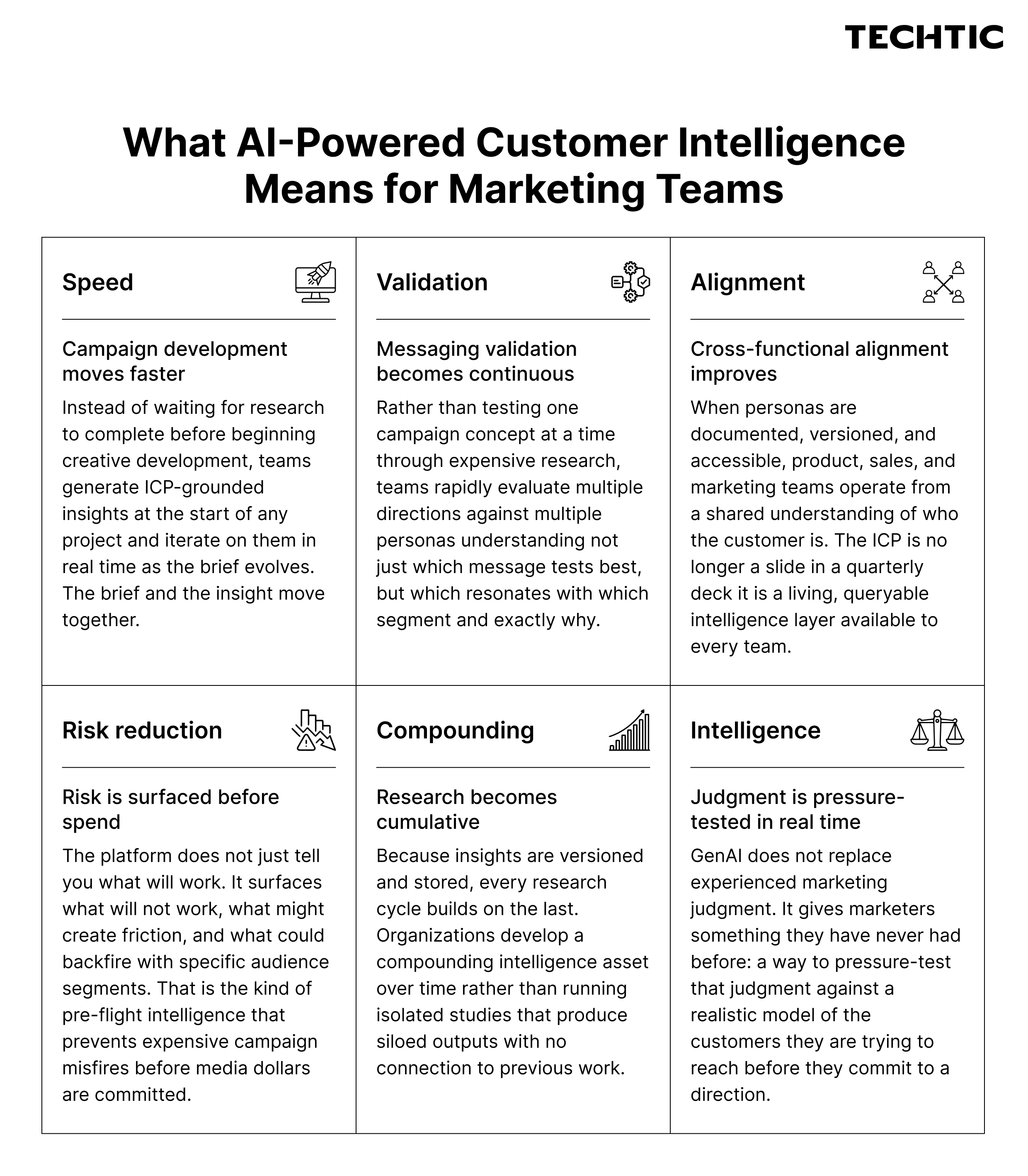
What AI-Powered Customer Intelligence Means for Marketing Teams
The practical impact for marketing organizations is significant across every function that touches customer understanding. The capabilities described above do not just make individual research tasks faster, they change the operating model for how customer intelligence flows through the organization and how decisions get made.
From Research as Event to Research as Infrastructure: The Fundamental Shift
What Techtic is building is not just faster market research. It is a rethinking of where AI-driven customer intelligence lives in the marketing organization, and what changes when it lives somewhere permanent rather than somewhere episodic.
Traditionally, research was an event. A project with a start date, an end date, and a deliverable. It was initiated when needed, completed, and filed. The insight it produced had a shelf life, and when that shelf life expired, a new research event had to be initiated, which required budget, approval, time, and a team willing to wait for findings before moving.
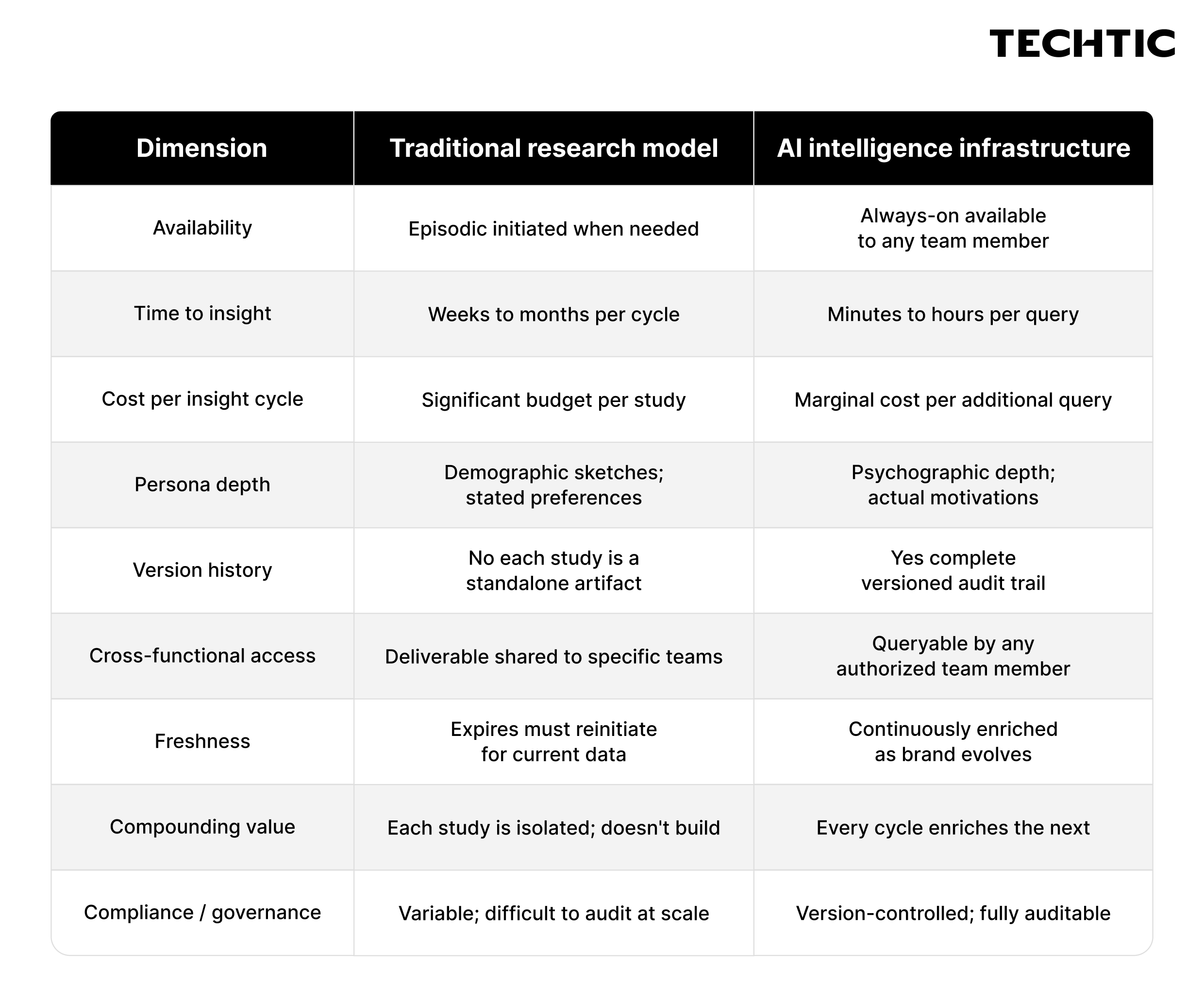
The AI-powered approach treats customer intelligence as infrastructure, a living system that is always on, always current, always available to any team member who needs to make a decision grounded in customer understanding. This shift has compounding returns. The more a brand uses the system, the richer its accumulated context becomes. The more refined the personas are, the more accurate the simulation outputs are. The more research cycles are run through versioned infrastructure, the better the organization’s ability to track how its market is evolving.
“The brands moving fastest aren’t the ones with the biggest research budgets. They’re the ones that have replaced their dependency on slow, episodic research with always-on customer intelligence, and used that foundation to make faster, more confident decisions at every stage of the marketing process.”
— Techtic GenAI Marketing Intelligence, 2025
The practical calendar implication is significant. A brand running on traditional research infrastructure might complete four major insight cycles per year, one per quarter, if they are disciplined. A brand running on AI customer intelligence infrastructure can run dozens of insight cycles per month: testing campaign concepts, exploring new audience hypotheses, evaluating competitive messaging, and tracking sentiment shifts in near real time. The compounding advantage of that research velocity, applied consistently over 12 to 18 months, is nearly impossible to close for a competitor still waiting for the next quarterly research cycle to complete.

Where This Is Heading: The Market Opportunity and What It Means for Brands
The market opportunity in AI-powered customer experience intelligence is substantial and still in its early stages. AI in customer experience is projected to grow from $14.78 billion in 2025 to $147.62 billion by 2035, a tenfold expansion driven by exactly the kind of applied intelligence infrastructure Techtic is building. This growth is not driven by automation for its own sake. It is driven by the documented business outcomes that organizations with always-on customer intelligence are already generating.
The compounding intelligence advantage
What Techtic’s clients are discovering is that the advantage of AI customer intelligence is not linear, it compounds. The first research cycle produces better insight than a traditional study. The tenth research cycle produces dramatically better insight than the first, because the system has accumulated twelve months of brand context, versioned persona evolution, and validated simulation outputs. The brands that start building this intelligence layer today are twelve months ahead of the brands that start tomorrow, and that gap grows with every research cycle run.
What we are seeing in our work with clients is that the brands moving fastest are not the ones with the largest research budgets or the most sophisticated marketing stacks. They are the ones that have replaced their dependency on slow, episodic research with always-on customer intelligence, and used that foundation to make faster, more confident decisions at every stage of the AI-powered marketing workflow.
This technology does not replace the judgment of experienced marketers. It gives them something they have never had before: a way to pressure-test that judgment against a realistic model of the customers they are trying to reach, in real time, before they commit budget, creative energy, or brand equity to a direction that might not resonate. That is what marketing transformation actually looks like. Not automation. Intelligence.
FAQs
Q. What is generative AI marketing intelligence?
Generative AI marketing intelligence is the use of AI systems to continuously analyze brand context, customer behavior signals, psychographic patterns, and market information to produce actionable customer insights. Instead of relying only on periodic surveys or focus groups, it creates a living intelligence layer that can generate, update, and query customer understanding in near real time.
Q. How does AI customer intelligence help improve marketing performance?
AI customer intelligence helps marketing teams create more relevant messaging, improve audience targeting, reduce campaign risk, identify customer objections earlier, and make faster decisions. By understanding customer motivations more deeply, brands can improve engagement, conversions, and marketing efficiency.
Q. What types of brands benefit most from AI-powered marketing intelligence platforms?
The highest-impact applications are in brands that make frequent creative decisions across multiple audience segments, where the cost of misaligned messaging is high and the traditional research cycle is too slow to keep pace with the decision frequency. This includes DTC brands launching multiple products per year, enterprise B2B companies selling complex solutions across diverse buyer personas, multi-brand portfolios where each brand requires distinct audience intelligence, and fast-growing scale-ups entering new markets where deep customer understanding needs to be built quickly without the budget for extensive traditional research programs.
Q. How does version control for personas actually help enterprise marketing teams?
Version control for customer personas solves three enterprise problems simultaneously. First, longitudinal tracking: teams can compare how a persona’s receptivity to specific messaging has changed over six months, detecting audience drift before it shows up as declining campaign performance. Second, governance and compliance: every AI-generated insight has a documented lineage, making it defensible to compliance teams and demonstrable to leadership as systematically produced rather than arbitrarily generated. Third, experimentation safety: snapshot-gated enrichment prevents uncontrolled persona drift, ensuring that the version of a persona used for a campaign is the version that was validated, not a silently updated one.