Building Autonomous Agents: A Guide for B2B Operations
Sector: AI + Data
Author: Nisarg Mehta
Date: 05/27/2026

The pressure on B2B operations teams has never been greater. Customers expect faster responses, boards expect leaner cost structures, and the complexity of enterprise workflows keeps compounding. Agentic AI is quickly becoming the answer, not as a buzzword, but as a practical architecture that lets software act, reason, and adapt on your behalf. This guide walks through what autonomous agents really are, how to build a credible path toward AI automations, and the hard questions every operations leader needs to answer before they flip the switch.
What Is Agentic AI - and Why Does It Matter for B2B?
Traditional AI models answer questions. Agentic AI takes actions. An autonomous agent perceives inputs, reasons about goals, selects tools, executes steps, and loops back to evaluate results, all without a human approving every move. For B2B operations, that distinction is enormous. It is the difference between a chatbot that summarises a support ticket and an agent that reads the ticket, queries the CRM, drafts a resolution, and routes it to the right team.
Claude Automations, built on Anthropic’s Claude model family, are a leading example: they allow businesses to chain reasoning steps, call external APIs, and maintain context across long, multi-step workflows. The result is an AI automation that can own an end-to-end process rather than just assist with a single moment inside it.
Types of Agentic Models
Not all autonomous agents are the same. Understanding the taxonomy helps you match the architecture to the job.
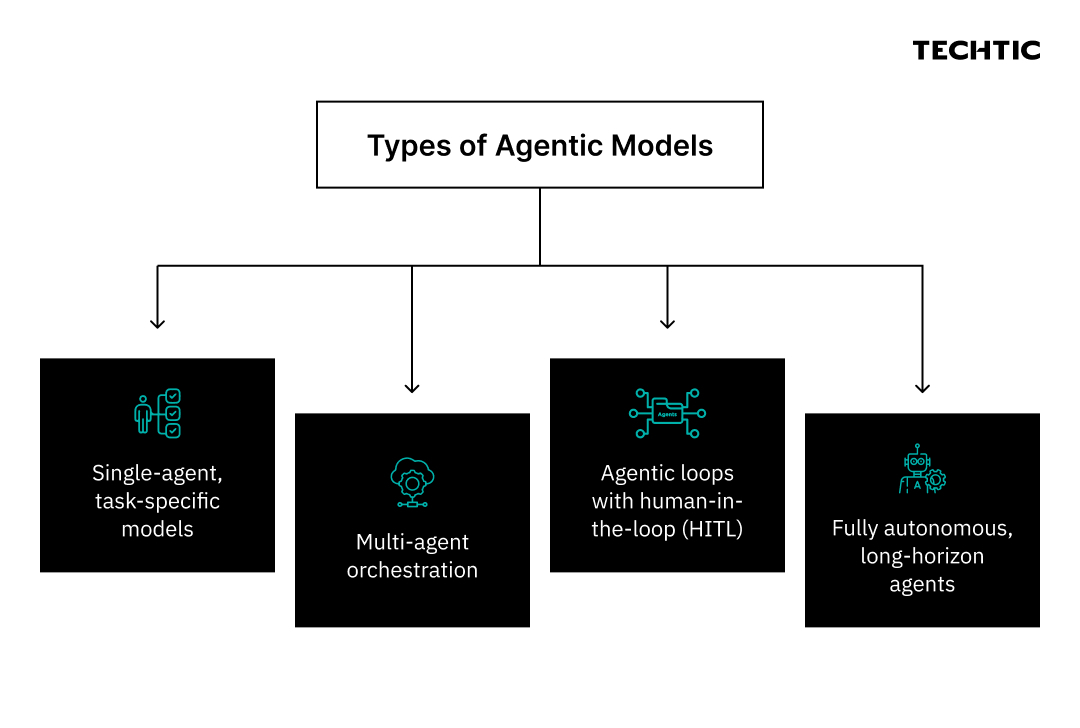
Single-agent, task-specific models handle one well-defined workflow in isolation, think an agent that monitors inbound vendor invoices, extracts line items, and flags exceptions. They are the easiest to deploy and the easiest to govern.
Multi-agent orchestration chains several specialized agents together under a coordinator. One agent gathers data, another reasons over it, a third takes action. This mirrors how human teams actually work and is well suited to complex B2B processes like deal desk approvals or cross-functional onboarding flows.
Agentic loops with human-in-the-loop (HITL) checkpoints keep a human in the decision path for high-stakes steps while automating everything else. This is the most practical starting point for regulated industries or processes where errors are costly.
Fully autonomous, long-horizon agents run extended workflows, sometimes hours or days, with minimal human intervention. These are appropriate only when data quality, system integrations, and trust have been rigorously established.
Starting the Journey: From Zero to AI Automations
The most common mistake organisations make is trying to automate the wrong thing first. Here is a more disciplined approach.
Begin with a process audit. Map your highest-volume, most repetitive operational workflows and score them on two axes: frequency and rule-clarity. Processes that are frequent and
rule-based (order entry, invoice matching, SLA monitoring) are prime candidates for early AI automation. Processes that are infrequent and highly contextual (strategic pricing decisions, complex escalations) should come later.
Next, run a narrow pilot. Pick one process, one team, and one success metric. Claude Automations, for example, can be configured to handle a scoped workflow, say, qualifying inbound partner enquiries, with guardrails that keep outputs reviewable. A focused pilot builds internal confidence and surfaces edge cases before they become production problems.
Finally, instrument everything. Every agentic action should be logged with enough context to reconstruct why the agent made each decision. Audit trails are not optional in B2B, they are how you maintain accountability when an automated action touches a customer or a dollar.
Real-World Example: HuCapital’s AI-Powered Networking Platform
Techtic helped HuCapital build a scalable AI-powered professional networking and discovery platform using Next.js, Node.js, Python, and OpenAI. From intelligent content discovery and AI-assisted networking to “Ask Huey”, a contextual AI assistant built with human-in-the-loop principles, the platform demonstrates how thoughtfully sequenced agentic AI can improve engagement, personalization, and operational scalability in real-world B2B products.

Identifying the Data Layer and Achieving Data Maturity
The most common and most expensive mistake organisations make is trying to automate the wrong thing first. The instinct to start with the most complex, highest-visibility process, to prove the technology on something impressive, is understandable and consistently counterproductive. Here is the disciplined alternative.
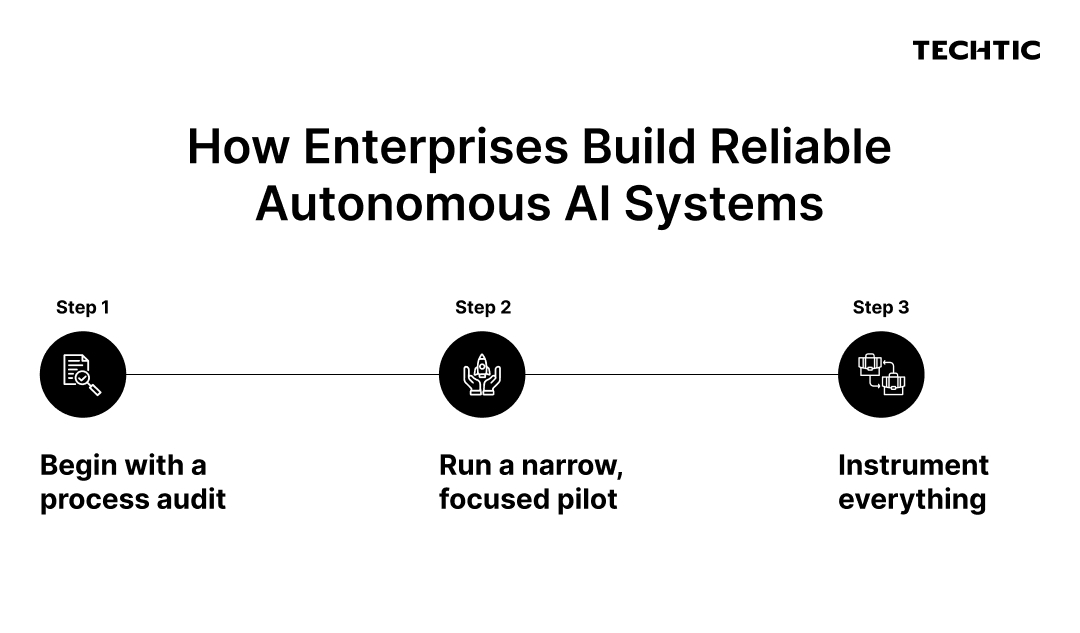
Step 01: Begin with a process audit
Map your highest-volume, most repetitive operational workflows and score them on two axes: frequency and rule-clarity. Processes that are frequent and rule-based order entry, invoice matching, SLA monitoring, are prime candidates for early AI automation. Processes that are infrequent and highly contextual, strategic pricing decisions, complex escalations belong later in the roadmap, after trust has been built and the data layer has matured.
- List every operational workflow that your team performs more than weekly
- Score each on frequency (how often) and rule-clarity (how deterministic the steps are)
- Prioritise workflows in the top-right quadrant: high frequency, high rule-clarity
- Document the edge cases for top candidates, these will define your HITL checkpoints
Step 02: Run a narrow, focused pilot
Pick one process, one team, and one success metric. Claude Automations, for example, can be configured to handle a scoped workflow, qualifying inbound partner enquiries, say with guardrails that keep all outputs reviewable during the pilot window. A focused pilot does two essential things that a broad rollout cannot: it builds internal confidence in the technology, and it surfaces edge cases before they become production problems at scale.
- Define the success metric before the pilot begins, not after accuracy rate, time saved, or error rate reduction
- Set a fixed review cadence: weekly during the pilot, bi-weekly after launch
- Require every agent output to be reviewable during the pilot, even if it takes action automatically
- Document every edge case the pilot surfaces as input to the production design
Step 03: Instrument everything
Every agentic action must be logged with enough context to reconstruct why the agent made each decision. Audit trails are not optional in B2B, they are how you maintain accountability when an automated action touches a customer relationship or a financial transaction. Instrumenting from day one also gives you the data you need to continuously improve the agent’s performance and to respond credibly when something goes wrong.
- Log every action with: input received, reasoning steps, tool called, output produced, confidence score
- Build a dashboard that surfaces the agent’s accuracy rate and escalation frequency in real time
- Define clear escalation paths before go-live, not after the first unexpected output
- Review the audit log weekly for the first 90 days patterns in edge cases reveal systematic gaps
Setting the Right Expectations Around Accuracy
One of the most damaging misconceptions in enterprise AI automation is the expectation of perfection. Agents, like people, make mistakes. The goal is not zero errors, it is a measurable, acceptable error rate with clear escalation paths when those limits are breached. The organisations that get this right define their accuracy requirements before deployment. The organisations that get this wrong discover their requirements after a costly incident.
The key insight is that different workflows require different accuracy thresholds, and those thresholds should be set by the consequence of an error, not by what the technology can theoretically achieve.
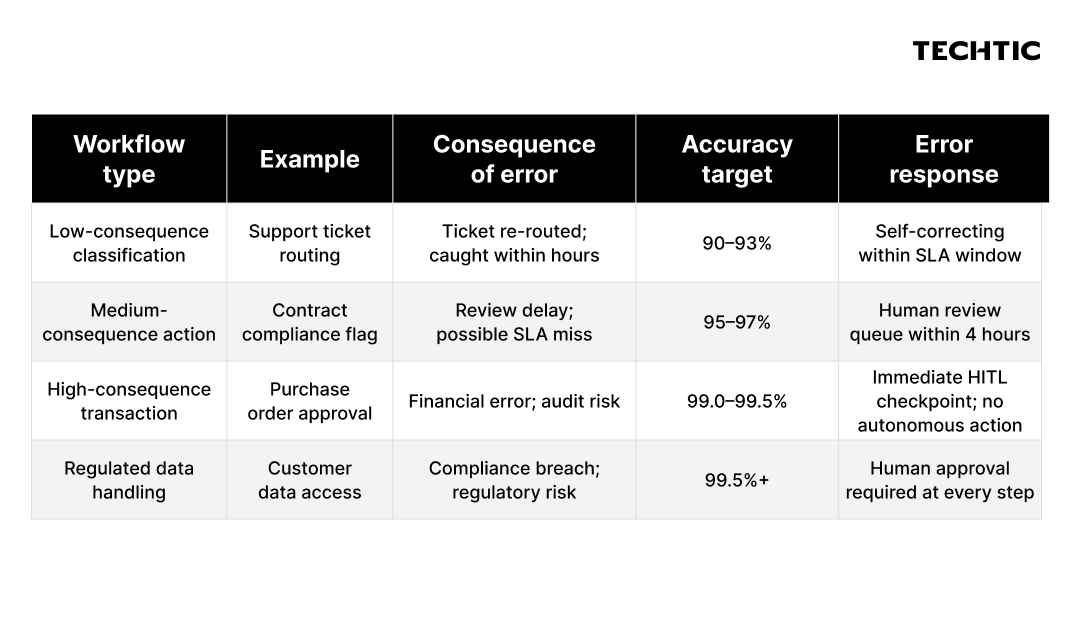
Build confidence scoring into every agent
Well-designed agentic systems, including those built on Automations, can output a confidence level alongside each action. When confidence drops below a defined threshold, the agent pauses and routes to a human rather than proceeding autonomously. This single design pattern, implemented consistently, eliminates a large proportion of costly agent mistakes. It is not a fallback. It is the architecture.
Define your confidence thresholds before go-live. Document them. Review them quarterly as the agent’s performance data accumulates. An agent that was appropriately cautious at launch may earn higher autonomy thresholds six months later, but only if you have the audit trail to make that case with data rather than gut feeling.

Analysis Models vs. Predictive Models: Setting Them Up Right
These two model types serve fundamentally different purposes in a B2B agentic stack, and conflating them is a common source of disappointment.
Analysis models describe what has already happened. They are retrospective, surfacing trends in churn data, summarising pipeline health, or auditing contract compliance against historical records. Setting one up correctly means ensuring the data it reads is complete, consistently structured, and historically deep enough to be meaningful (typically 12–24 months minimum for B2B cycles).
Predictive models forecast what is likely to happen next, which accounts are at risk, which deals are likely to close, where capacity bottlenecks will emerge. These models require not just historical data but labelled historical data, meaning you need past outcomes tagged against past inputs. They also require regular retraining as market conditions and customer behaviour evolve.
The practical sequencing for most B2B operations teams: start with analysis, then layer in prediction. Analysis models generate immediate value and, crucially, produce the clean, labelled data that predictive models need to be reliable. Skipping straight to prediction without this foundation is one of the most frequent causes of AI projects that fail to scale.
The Road Ahead
Agentic AI is not a future possibility, it is a present-tense operational advantage for B2B teams willing to be deliberate about how they build. The organisations that will win are not necessarily those with the largest budgets, but those that start with honest process audits, invest in data quality, set realistic accuracy expectations, and sequence analysis before prediction. Claude Automations and the broader landscape of AI automations have lowered the barrier to entry significantly. The question is no longer whether autonomous agents can help your operations, it is how quickly you can build the foundation to let them.
FAQs
Q. What is agentic AI and how is it different from traditional AI?
Traditional AI models respond to inputs, you ask a question, they produce an answer, the interaction ends. Agentic AI takes actions. An autonomous agent perceives inputs, reasons about a goal, selects tools, executes steps, observes results, and decides what to do next, all in a continuous loop without human approval at every stage. For B2B operations, this means the difference between a chatbot that summarises a support ticket and an agent that reads the ticket, queries the CRM, drafts a resolution, and routes it to the right team, automatically, end-to-end.
Q. What are autonomous AI agents used for in B2B operations?
In B2B operations, autonomous agents are most valuable for workflows that are simultaneously high-volume, rule-rich, and time-sensitive. The most common production use cases include: invoice processing and exception flagging, SLA monitoring and escalation routing, partner enquiry qualification, contract compliance auditing, deal desk approval workflows, and cross-functional onboarding processes. These are workflows where the cost of human attention is highest and the benefit of reliable automation is most immediately measurable on the P&L.
Q. How do I start implementing AI automation in B2B operations?
The most effective approach follows three steps. First, run a process audit: map your highest-volume workflows and score them on frequency and rule-clarity, processes that are both frequent and rule-based are your first automation candidates. Second, run a narrow pilot: choose one process, one team, and one measurable success metric before expanding. Third, instrument everything: log every agent action with enough context to reconstruct its decision-making for audit purposes. The most common expensive mistake is automating the wrong process first, starting with the most complex or impressive-looking workflow rather than the one most ready for automation.
Q. How does agentic AI reduce operational costs in B2B companies?
Agentic AI reduces B2B operational costs across four dimensions simultaneously. First, it eliminates labor cost on high-volume, repetitive workflows, invoice processing, SLA monitoring, ticket routing, that previously required dedicated headcount. Second, it compresses cycle times: tasks that took hours complete in seconds, reducing the cost of delay on revenue-critical workflows. Third, it reduces error-related costs, rework, escalations, compliance penalties, by applying consistent decision logic at scale. Fourth, it frees senior operations staff from routine tasks, redirecting their capacity toward judgment-intensive work that actually requires human expertise. Companies deploying well-governed agentic systems in B2B operations report 30–50% reductions in per-transaction processing costs within the first year of production deployment.