AI Search Optimization: The Complete Guide to Winning Visibility Beyond Google
Sector: AI + Data
Author: Nisarg Mehta
Date: 07/06/2026

Introduction: The Search Landscape Has Permanently Changed
Something fundamental shifted in how people find information, and most marketing teams haven’t fully caught up yet.
For two decades, “search optimization” meant one thing: rank higher on Google. You studied the algorithm, built backlinks, tweaked meta tags, and watched your traffic climb or fall based on one company’s decisions. Google was the internet’s front door.
That door is now one of many.
Today, when someone wants to know the best CRM for a 50-person SaaS company, they might ask ChatGPT. When a CMO needs a competitive analysis, they open Perplexity. When a developer needs a code library recommendation, they consult Claude. When a consumer wants a product suggestion, Google’s AI Overviews summarize five websites before they ever click on one.
The numbers tell the story clearly. ChatGPT surpassed 400 million weekly active users in early 2025. Perplexity is processing over 100 million queries per day. Google’s AI Overviews now appear for roughly 47% of all searches. Bing Copilot has integrated AI into one of the world’s largest search engines. And that’s before accounting for voice assistants, enterprise AI tools, and the next wave of agentic AI systems that will search the web autonomously on behalf of users.
Here’s what this means for your brand: if you’re not visible in AI-generated answers, you’re increasingly invisible to a significant and growing portion of your target audience, even if you rank on page one of Google.
This guide is the most comprehensive resource available on AI Search Optimization. You’ll learn exactly what it is, how it works, what factors influence visibility, and how to build a strategy that earns you citations and mentions across every major Artificial Intelligence search platform, not just Google.
By the time you finish reading, you’ll have a clear picture of:
- The difference between SEO, AEO, GEO, and LLM Optimization
- How AI systems like ChatGPT and Perplexity actually retrieve and surface content
- The specific signals that influence whether your brand gets cited in AI answers
- A step-by-step strategy for winning AI search visibility
Let’s start with the fundamentals.
What Is AI Search Optimization?
AI Search Optimization is the practice of structuring, formatting, and positioning your content so that AI-powered search engines and language models retrieve, reference, and recommend your brand, products, or expertise in their generated responses.
It’s broader than traditional SEO. It’s not just about ranking on a list of blue links, it’s about becoming the source AI systems cite when they synthesize answers for users.
To understand AI Search Optimization fully, you need to understand the related disciplines it encompasses.
Traditional SEO
Search Engine Optimization focuses on improving a website’s visibility in organic search results on engines like Google and Bing. It involves on-page optimization (keywords, titles, meta tags), technical SEO (site speed, crawlability, structured data), and off-page signals (backlinks, brand mentions, authority). The output is a ranked list of URLs that users click to visit.
SEO is still critically important. But it was designed for a world where users always click through to websites. That world is changing.
Answer Engine Optimization (AEO)
AEO is the practice of optimizing content to appear in featured snippets, knowledge panels, and other “zero-click” formats where search engines answer questions directly on the results page, without requiring a click.
AEO became relevant as Google began surfacing direct answers at the top of SERPs. If you’ve ever asked Google “how many ounces in a cup” and gotten the answer immediately without clicking anything, that’s an AEO outcome. The optimization goal is to structure content in a way that answers specific questions so clearly and concisely that search engines extract and display that answer directly.
Generative Engine Optimization (GEO)
GEO is the next evolution. It refers to optimizing content to appear in AI-generated responses, the kind that ChatGPT, Perplexity, Claude, Gemini, and Google AI Overviews produce.
Unlike AEO, which involves extracting existing text, GEO involves being synthesized into new text. The AI reads your content, understands your brand’s authority on a topic, and incorporates your information (sometimes with a citation, sometimes without) into a generated answer.
GEO requires a different mindset: you’re not just trying to rank, you’re trying to be worth citing. Your content needs to be authoritative enough, specific enough, and accurate enough that an AI would choose to reference it when answering a related question.
LLM Optimization
LLM Optimization is the practice of making your brand, content, and entity information recognizable and retrievable by Large Language Models during their training or retrieval processes.
LLMs don’t just search the web, they also have learned information from their training data. If your brand is well-represented in high-quality, widely-cited web content, you’re more likely to be included in the model’s understanding of a topic. LLM Optimization involves ensuring your brand appears in authoritative sources, Wikipedia, industry publications, and contexts that LLMs encounter during training.
AI Search Optimization (The Unified Discipline)
AI Search Optimization brings all of these together. It’s the holistic practice of optimizing for every AI-powered touchpoint in the search journey, from traditional Google rankings, to AI Overviews, to direct queries in ChatGPT, to voice assistant responses, to agentic AI tools that research topics autonomously.
Think of it this way:
- SEO gets you on the list
- AEO gets you at the top of the list
- GEO gets you into the answer
- LLM Optimization gets you into the model’s knowledge
- AI Search Optimization is the strategy that achieves all four simultaneously
The brands winning in 2026 are the ones treating these not as separate channels, but as an integrated visibility strategy.
Why AI Search Matters in 2026 and Beyond
The shift to AI search isn’t a future prediction. It’s happening right now, at scale. Here’s why it matters so much for your brand.
Changing Search Behavior
The way humans search has fundamentally changed. Traditional search was keyword-based, users typed fragmented queries and scanned results. AI search is conversational, users ask full questions, follow up with clarifications, and expect synthesized answers.
A user might now type: “I’m a CFO at a 200-person B2B SaaS company looking to replace our current CRM. We’re heavily Salesforce-integrated but finding it too expensive. What are the best alternatives that maintain Salesforce data compatibility and have strong analytics?”
That’s a query that would have been impossible for Google to answer satisfactorily in 2015. Today, ChatGPT or Perplexity can synthesize a thoughtful, nuanced response that draws on dozens of sources.
The Zero-Click Search Revolution
Google’s AI Overviews have accelerated the zero-click trend to a degree that’s fundamentally challenging the traditional traffic model. When AI summaries appear at the top of search results, click-through rates for organic results below them drop significantly. Studies in 2024 showed CTR reductions of 15–30% for queries where AI Overviews appeared.
For brands, this has a counterintuitive implication: the path to staying visible isn’t just getting to page one, it’s being so authoritative that you’re the source the AI cites in the overview.
Conversational and Contextual Search
AI search is inherently conversational. Users don’t just ask one question, they have multi-turn conversations that refine their intent. “What’s the best project management tool?” becomes “Which of those integrates with Slack?” becomes “How much does that one cost for a team of 25?”
This means optimization for AI search requires thinking in topics and conversation flows, not just individual keywords.
AI-Generated Answers Are Replacing SERP Browsing
For a growing category of queries, especially informational and comparative, users are getting complete answers from AI and never visiting a website. This is especially true for:
- How-to questions
- Product comparisons
- Definitions and explanations
- Research questions
- Decision-support queries
If your content isn’t being cited in those answers, you’re losing awareness at the consideration stage.
The Rise of AI Assistants and Agentic Search
The next wave of AI search won’t require users to even ask questions. Agentic AI systems, tools that can autonomously browse the web, compare options, and take actions on behalf of users, are already emerging. When someone asks their AI assistant to “find the best enterprise SEO tool and schedule a demo,” the AI will search, evaluate, and act. Being visible in that evaluation requires the same AI search optimization disciplines discussed in this guide.
Voice Search Evolution
Voice assistants (Siri, Alexa, Google Assistant) are now powered by much more sophisticated AI. They don’t just pull a featured snippet, they synthesize conversational answers. Optimization for voice means the same things that work in AI search: clear, structured, authoritative content with strong entity signals and conversational phrasing.

How AI Search Engines Actually Work
To optimize for AI search, you need to understand the mechanics behind how these systems retrieve and generate answers. The details vary by platform, but several core concepts apply across all of them.
Retrieval-Augmented Generation (RAG)
Most AI search engines use a technique called Retrieval-Augmented Generation. Here’s the basic process:
- A user asks a question
- The system searches the web (or a document index) for relevant content
- Retrieved content is passed to the language model as context
- The language model synthesizes a new answer using both its trained knowledge and the retrieved content
- The answer is generated, often with citations to the source material
RAG is why fresh, indexed, authoritative content matters for AI search. Even though the AI has trained knowledge, it actively retrieves current web content to inform its answers. If your content is high-quality, well-structured, and relevant, it’s more likely to be retrieved and incorporated.
How ChatGPT Searches the Web
ChatGPT with web browsing enabled (available to Plus and Team users) uses Bing as its search backend. It retrieves relevant pages, reads them, and synthesizes answers. Key factors for ChatGPT citation include:
- Clear, direct answers to specific questions
- Content that appears prominently in Bing search results
- Well-structured pages that are easy for the crawler to parse
- Authoritative domains with strong link profiles
How Perplexity Works
Perplexity is explicitly built as an “answer engine.” It performs real-time web searches, retrieves multiple sources simultaneously, and synthesizes answers with direct citations. Perplexity is arguably the most transparent about its sourcing, it shows exactly which URLs it consulted.
For Perplexity optimization, the citation-worthiness of your content is paramount. Perplexity tends to favor:
- Content with specific data, statistics, and original research
- Well-structured pages with clear headings and summaries
- Sources with strong domain authority
- Content that directly and concisely addresses the query
How Google AI Overviews and AI Mode Work
Google’s AI Overviews use the company’s own web index combined with Gemini’s language model capabilities. Google has a major advantage here, decades of understanding which content is authoritative, accurate, and trustworthy.
For Google AI Overviews, your traditional SEO signals matter significantly. If Google’s algorithm already trusts your content, it’s more likely to be cited in AI Overviews. However, structure matters increasingly: content that is organized around clear questions and answers, uses proper schema markup, and demonstrates E-E-A-T signals (Experience, Expertise, Authoritativeness, Trustworthiness) is favored.
Google AI Mode, the conversational interface that allows multi-turn queries within Google Search, operates similarly but with a stronger emphasis on conversational context and follow-up intent.
How Claude (Anthropic) Approaches Search
Claude uses web search capabilities powered by its own browsing tool or integrated search providers. Claude is known for careful sourcing and a preference for accurate, well-reasoned content. Optimizing for Claude means prioritizing accuracy, depth, and balanced coverage of topics. Sensationalist or superficial content is less likely to be cited.
How Gemini Works
Google’s Gemini powers both Google AI Overviews and the standalone Gemini assistant. It leverages Google’s Knowledge Graph, one of the world’s most comprehensive structured data repositories, alongside web retrieval. For Gemini optimization, having a strong entity presence in Google’s ecosystem (Google Business Profile, structured data, Wikipedia mentions, news coverage) is particularly valuable.
Knowledge Graphs and Entity Understanding
All major AI systems have some form of knowledge graph, a structured understanding of the world’s entities (people, places, organizations, products, concepts) and the relationships between them.
Being a recognized entity in these knowledge graphs significantly increases your chances of appearing in AI-generated answers. Entity recognition is different from keyword ranking, it’s about the AI “knowing who you are” as a concept, not just finding your text as a match.
Embeddings and Semantic Search
Modern AI search systems don’t match keywords, they match meaning. Through a technique called embeddings, AI systems represent the semantic meaning of text as vectors in high-dimensional space. Content that is semantically related to a query, even if it doesn’t use the exact same words, can be retrieved and cited.
This means that comprehensive, topically rich content that covers a subject deeply will outperform thin content stuffed with exact keywords.
Context Windows and Citation Systems
When an AI retrieves content to inform its answer, it has a limited “context window”, the amount of text it can process at once. Well-structured content that puts key information near the top (answer-first formatting) is more likely to have its most important information within the context window when the model generates its answer.
Citation systems vary: Perplexity consistently links to sources, ChatGPT sometimes includes inline citations, and Google AI Overviews may or may not cite specific pages. Optimization should aim for visibility regardless of whether a link is provided.
Traditional SEO vs. AI Search Optimization: A Detailed Comparison
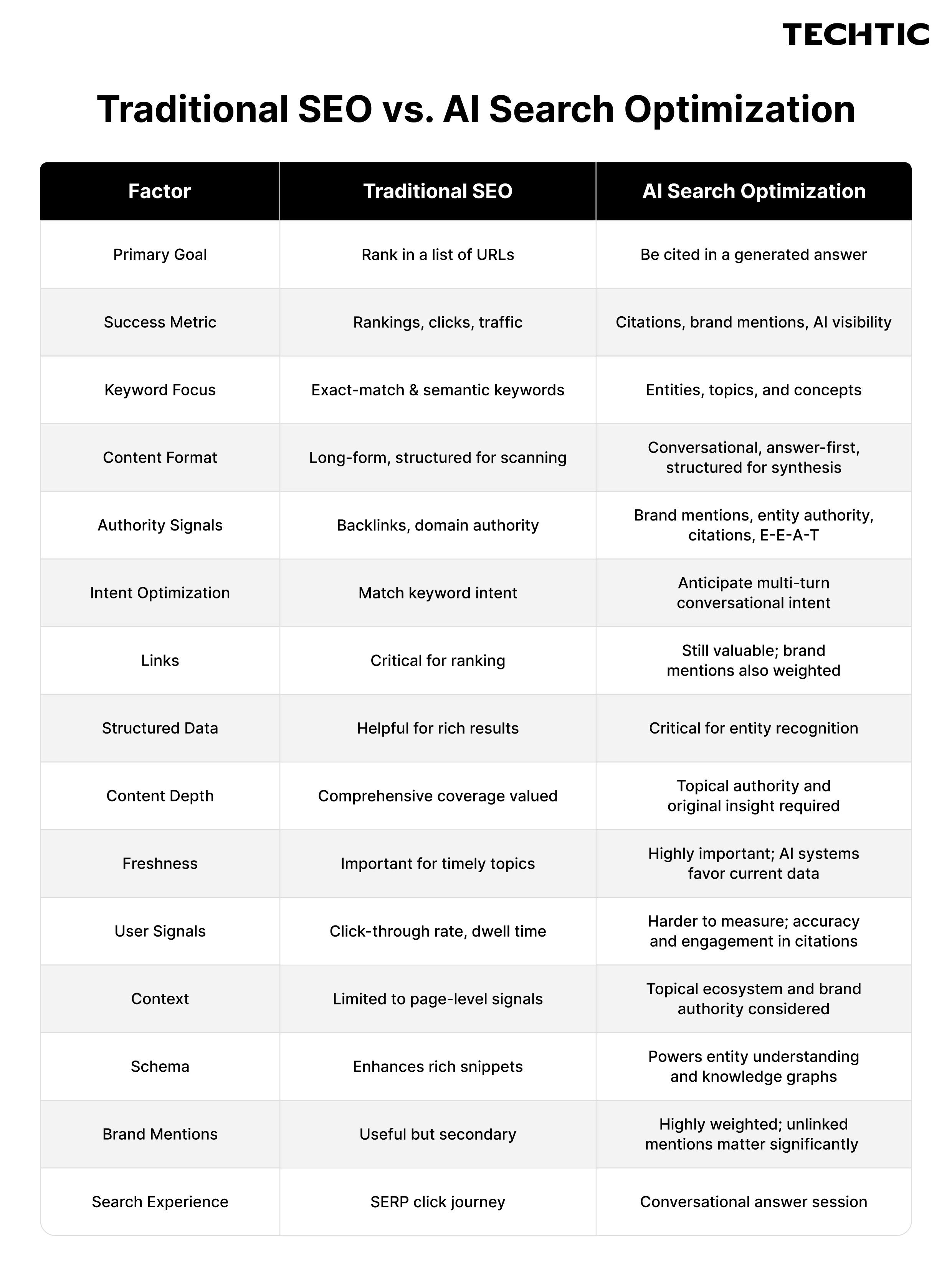
The fundamental shift is this: in traditional SEO, you’re competing for position on a list. In AI search, you’re competing to be worth citing. The criteria for each are related but distinct.
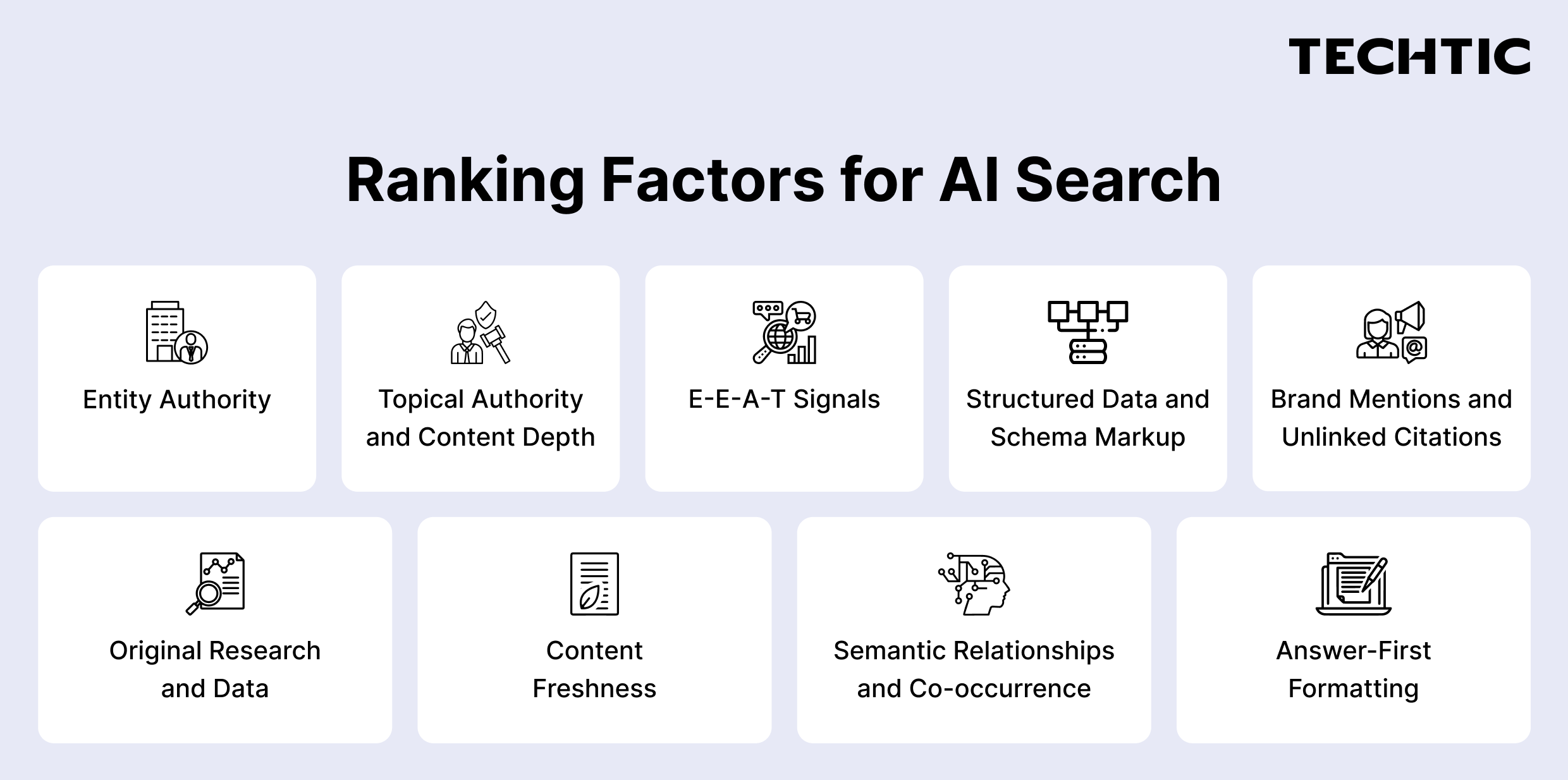
Ranking Factors for AI Search
Understanding what influences AI search visibility is the foundation of effective optimization. Here are the most important factors.
Entity Authority
The single most important factor for AI search visibility is whether the AI “knows” your brand as a recognized entity. Entity authority is built through:
- Consistent brand mentions across authoritative sources
- Wikipedia presence (for established organizations)
- Google Knowledge Panel presence
- Wikidata entries
- Consistent NAP (name, address, phone) data across the web
- Brand mentions in industry publications, news outlets, and authoritative blogs
An AI that has encountered your brand name consistently across thousands of high-quality documents during training or retrieval will treat you as a credible source in its generated answers.
Topical Authority and Content Depth
AI systems strongly favor sources that demonstrate deep expertise on a topic. A single excellent article on a topic is less powerful than a comprehensive content ecosystem, multiple pieces that cover every angle, subtopic, and related question.
This is why content clustering (a hub-and-spoke topic model) is even more valuable for AI search than for traditional SEO. When an AI retrieves content on a topic, encountering the same authoritative domain across multiple relevant subtopics reinforces its perception of that brand’s expertise.
E-E-A-T Signals (Experience, Expertise, Authoritativeness, Trustworthiness)
Google formalized E-E-A-T as a framework, but the underlying signals matter across all AI systems. Factors that signal E-E-A-T include:
- Named, credentialed authors with verifiable professional backgrounds
- Author bylines that link to author bio pages
- Author pages that link to external profiles (LinkedIn, publications, speaking engagements)
- Content accuracy and factual correctness
- References to original research and primary sources
- Transparency about methodology, sources, and potential biases
- Update dates showing content is maintained
Structured Data and Schema Markup
Schema markup directly communicates structured information to both traditional search engines and AI systems. Critical schema types for AI search include:
- Article schema (author, date, organization)
- FAQ schema (question-answer pairs that AI can directly extract)
- HowTo schema (procedural content)
- Organization schema (brand entity information)
- Product schema (for eCommerce)
- Person schema (for author credibility)
- Breadcrumb schema (content hierarchy)
Brand Mentions and Unlinked Citations
Traditional SEO focused heavily on linked mentions (backlinks). For AI search, unlinked brand mentions also carry significant weight. When an AI encounters your brand name in a positive or informational context across dozens of credible sources, even without a hyperlink, it builds a picture of your authority on related topics.
Digital PR campaigns, thought leadership placement, and industry publication features all contribute to this unlinked mention footprint.
Original Research and Data
AI systems are trained to prefer primary sources and original data. Content that includes proprietary research, original statistics, unique frameworks, or first-party case studies is more likely to be cited because it provides information that can’t be found elsewhere.
This is a major opportunity: well-executed original research can earn you citations across thousands of AI-generated answers.
Content Freshness
AI systems retrieving content via RAG strongly favor recently updated content. For time-sensitive topics, market data, technology trends, regulatory changes, product comparisons, freshness can be the deciding factor between two equally authoritative sources.
Build a systematic content refresh schedule into your strategy.
Semantic Relationships and Co-occurrence
AI systems understand topic relationships through co-occurrence patterns, which concepts appear together in authoritative content. By writing content that correctly associates your brand with relevant concepts, technologies, use cases, and adjacent topics, you build semantic authority in the AI’s model of your space.
Answer-First Formatting
Content that answers questions directly at the beginning, before elaborating, is much more likely to be retrieved and cited by AI systems working within context window constraints. This “inverted pyramid” approach puts the most valuable information first.
Step-by-Step AI Search Optimization Strategy
Here’s a practical, implementation-ready strategy for winning AI search visibility.
Step 1: Topic Research with AI Search Intent
Start by identifying what questions your target audience is actually asking AI systems, not just what they’re typing into Google.
Prompt ChatGPT, Claude, and Perplexity with questions your ideal customers might ask. Note:
- What sources do they cite?
- What formats do the answers take?
- What subtopics do they address?
- What gaps or inaccuracies do you notice in the answers?
This research reveals the exact knowledge landscape you need to occupy. Every gap is an opportunity.
Step 2: Intent Mapping for Conversational Search
Map your content to multi-turn conversation flows, not just single keyword intents. For each primary topic, consider:
- What would a user ask first?
- What follow-up question would they logically ask next?
- What decision would they be trying to make at the end of the conversation?
Create content that addresses the full conversational arc, not just a single step in it.
Step 3: Entity Optimization
Establish your brand as a recognized entity:
- Claim and optimize your Google Business Profile
- Create or update your Wikipedia page (if eligible)
- Add a Wikidata entry for your organization
- Ensure your brand appears consistently in industry directories and databases
- Submit your business to authoritative citations relevant to your industry
- Build an organized author bio page system that connects your content creators to verifiable credentials
Step 4: Schema Implementation
Implement structured data comprehensively across your site:
- Organization schema on your homepage and about page
- Article schema on all blog posts and content pieces
- FAQ schema on any Q&A sections
- Author/Person schema on all author pages
- Product schema for all product pages
- BreadcrumbList schema site-wide
- HowTo schema for procedural content
Test all schema using Google’s Rich Results Test and Schema.org validators.
Step 5: Semantic SEO and Content Architecture
Build a content ecosystem that covers your core topics comprehensively:
- Identify 5–10 pillar topics central to your expertise
- Create cornerstone content pieces (3,000+ words) for each pillar
- Build supporting cluster content (800–1,500 words) covering every subtopic and related question
- Link all cluster content back to the relevant pillar
- Ensure your topical coverage is genuinely complete, no major questions left unanswered
Step 6: FAQ and Conversational Content Optimization
Create dedicated FAQ sections and standalone FAQ pages that answer the specific questions users ask AI systems:
- Write question headings in natural language (as a person would speak them)
- Answer each question concisely in the first 2–3 sentences
- Elaborate below if needed, but the core answer must be immediately accessible
- Cover questions at different awareness stages (what is, how to, why, which, best, vs.)
- Implement FAQ schema on every Q&A section
Step 7: Answer-First Content Formatting
Restructure your content to lead with answers:
- Open every section with a direct, declarative statement that answers the implied question
- Use descriptive H2s and H3s that are natural language questions or clear topical statements
- Include a concise summary or TL;DR at the beginning of long articles
- Use definition boxes, callout blocks, or highlighted summaries for key concepts
- Format statistics and data points so they stand alone as citable facts
Step 8: Brand Authority and Digital PR
Build your unlinked mention footprint through strategic PR and thought leadership:
- Secure contributed articles in industry publications (with author byline linking back to your site)
- Get quoted in industry roundup articles and analyst reports
- Pursue awards, rankings, and recognition in your industry
- Publish original research that other publications will reference
- Establish your founders/executives as named experts in media coverage
Step 9: Knowledge Panel Optimization
If you don’t have a Google Knowledge Panel yet, work toward one:
- Ensure your Wikidata entry is complete and accurate
- Build consistent citations across authoritative directories
- Generate mentions in publications that Google crawls frequently
- Maintain a consistent brand name, description, and key facts across all platforms
- Use Organization schema to feed Google the information it needs to create a panel
Once you have a panel, monitor it for accuracy and completeness.
Step 10: Technical SEO for AI Crawler Access
Ensure AI crawlers can access and index your content:
- Check your robots.txt, make sure you haven’t accidentally blocked AI crawlers (GPTBot, ClaudeBot, PerplexityBot, Bingbot)
- Implement proper crawl directives only if you have a strategic reason to limit access
- Ensure fast page load speeds, AI systems penalize slow pages in retrieval
- Fix broken internal links that prevent crawlers from discovering content
- Submit XML sitemaps to Google Search Console (AI systems rely on well-indexed content)
- Ensure your content is accessible to crawlers (not hidden behind login walls or JavaScript paywalls)
Step 11: Content Freshness System
Build a systematic process for keeping content current:
- Audit all major content pieces for date accuracy at least quarterly
- Update statistics, examples, and tool references whenever they become outdated
- Add “last updated” dates to all content pieces
- Create a content maintenance calendar alongside your content creation calendar
- Prioritize freshness for high-traffic, high-visibility pieces in competitive topic areas

Conclusion
The search landscape has changed more in the past two years than in the previous decade. AI-powered search engines aren’t a supplement to Google, they’re becoming primary discovery channels for a growing portion of the population. Brands that treat AI search optimization as optional are making a strategic mistake that will compound over time.
The good news is that the principles of winning AI search visibility are knowable, learnable, and actionable. They build on the same foundation as good SEO, create genuinely valuable content, establish real authority, be technically accessible, and demonstrate trustworthiness, while adding a new layer of entity thinking, structured data, conversational optimization, and AI-specific visibility building.
Here’s what to do next:
Start with an AI search audit. Open ChatGPT, Gemini, Perplexity, and Claude. Ask them the questions your customers ask. See who gets cited. See if your brand appears. That gap analysis will tell you exactly where to focus.
Then prioritize: entity optimization and schema markup deliver relatively fast results. Content depth and topical authority take sustained investment but create compounding visibility over time. Digital PR and original research create citation gravity that benefits you across every AI platform simultaneously.
The brands that are winning in AI search today didn’t start optimizing last month. They built valuable content, real expertise, and genuine authority over years, and the AI era is now rewarding that investment. The best time to start was years ago. The second-best time is now.
FAQs
Q. What is AI Search Optimization?
AI Search Optimization is the practice of structuring and positioning your content so that AI-powered search engines and language models, such as ChatGPT, Gemini, Claude, and Perplexity, retrieve, cite, and recommend your brand in their generated answers. It combines elements of traditional SEO, Answer Engine Optimization (AEO), and Generative Engine Optimization (GEO) into a unified visibility strategy.
Q. How is AI Search Optimization different from regular SEO?
Traditional SEO focuses on ranking in a list of links on a search results page. AI Search Optimization focuses on being cited in a synthesized answer that an AI generates. Success metrics differ (rankings vs. citations), content formats differ (optimized for scanning vs. optimized for synthesis), and authority signals differ (backlinks vs. entity authority and brand mentions).
Q. Does Google SEO still matter for AI search?
Yes, absolutely. Traditional Google rankings and AI visibility are correlated. AI systems that use web retrieval (like Perplexity and ChatGPT’s web browsing) tend to retrieve content that ranks well in search engines. Additionally, Google’s own AI Overviews draw on the same quality and authority signals Google uses for traditional rankings. AI search optimization complements rather than replaces traditional SEO.
Q. How do I know if my brand is appearing in AI search answers?
Regularly prompt major AI systems, ChatGPT, Gemini, Perplexity, Claude, with questions your target audience would ask. Check whether your brand is cited. For Perplexity, you can see exact source citations. For ChatGPT and Gemini, you can note when they mention your brand or content. Purpose-built AI visibility monitoring tools like Profound and Otterly.AI are also emerging for this purpose.
Q. What types of content perform best in AI search?
Answer-first content that directly addresses specific questions, original research with citable data, comprehensive comparisons, clear definitions of key concepts, step-by-step guides, and expert-attributed analysis consistently perform well in AI search citation. Long-form, shallow content that covers topics without genuine depth performs poorly.
Q. What is the future of SEO in a world of AI search?
SEO is evolving, not disappearing. The skills of understanding user intent, creating valuable content, building authority, and ensuring technical accessibility remain fundamental. What changes is the emphasis: from keyword placement to semantic depth, from backlinks alone to comprehensive authority signals, from click-through to citation and brand recognition. The brands that will win are those treating AI search optimization as a core competency, not an add-on.