BigCommerce to Shopify Plus Migration: Why More Growing Brands Are Making the Switch
Sector: Digital Commerce
Author: Nisarg Mehta
Date: 09/10/2026

Ecommerce platform migration isn’t a fringe decision anymore, it’s a live, measurable trend. In a single 90-day window, BigCommerce recorded a net loss of more than 200 stores, with the largest share of those merchants moving to Shopify. That’s not an isolated data point; it lines up with an 8% annual decline in BigCommerce’s total store count reported in early 2026. Brands aren’t leaving BigCommerce at random, they’re leaving for specific, recurring reasons, and understanding those reasons is the first step in deciding whether a BigCommerce to Shopify migration makes sense for your business.
This guide walks through who actually runs on BigCommerce today, why so many are choosing to migrate to Shopify Plus, what a real migration looks like in practice, and how to know when replatforming is the right call for your brand.
Who's Actually Running BigCommerce Today?
Before comparing BigCommerce vs Shopify Plus, it helps to know who’s actually on each platform, because the answer explains a pattern a lot of ecommerce leaders have noticed: DTC-first lifestyle brands are underrepresented on BigCommerce relative to B2B, wholesale, and industrial sellers.
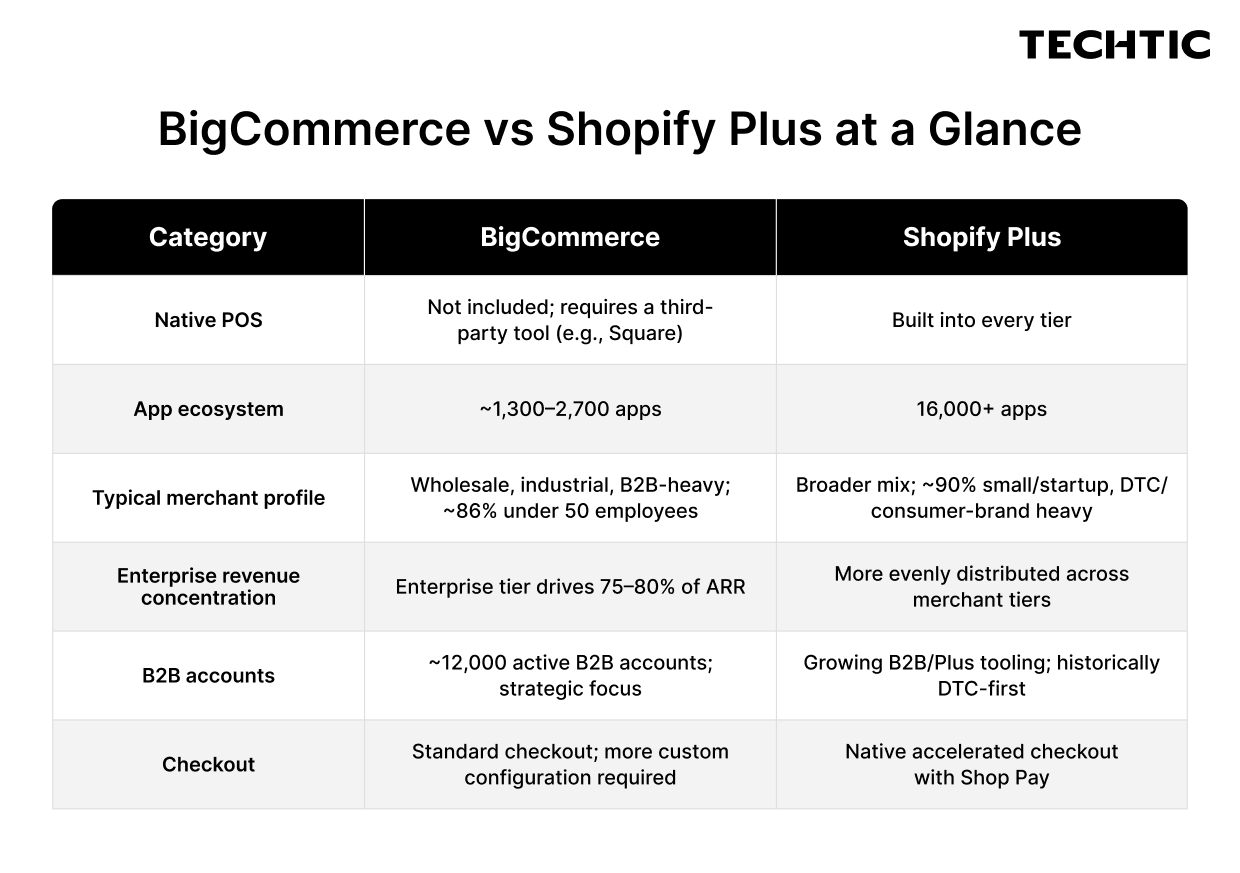
Retail is BigCommerce’s largest single merchant category at roughly 20%, followed by manufacturing at around 6%. Broken out by vertical, Home & Garden (16–17%), Apparel (13–14%), Automotive & Vehicle Parts (7–8%), Sporting Goods (7%), and Business & Industrial (7%) make up the largest store categories. On company size, the platform carries a long tail, about 86% of merchants have fewer than 50 employees, but its revenue is concentrated in a smaller enterprise segment: merchants generating $400,000 or more annually make up roughly 14% of BigCommerce’s base (compared with about 10% on Shopify), and that enterprise tier now accounts for 75–80% of BigCommerce’s total annual recurring revenue.
That enterprise concentration lines up with BigCommerce’s own strategic direction. The platform actively supports roughly 12,000 B2B accounts, and more than half of its net-new bookings in 2024 came from the B2B channel, with B2B merchants growing at a 12.6% compound annual rate, nearly double the broader B2B ecommerce market’s 6.7%. In practice, BigCommerce has increasingly built for wholesale distributors, manufacturers, and industrial sellers who need complex pricing, ERP integrations, and multi-catalog support, rather than for the fast-iterating, brand-and-community-driven DTC playbook. That’s the structural reason DTC brands look underrepresented on BigCommerce: the platform’s differentiated strengths are aimed somewhere else.
Why Brands Choose to Migrate to Shopify Plus
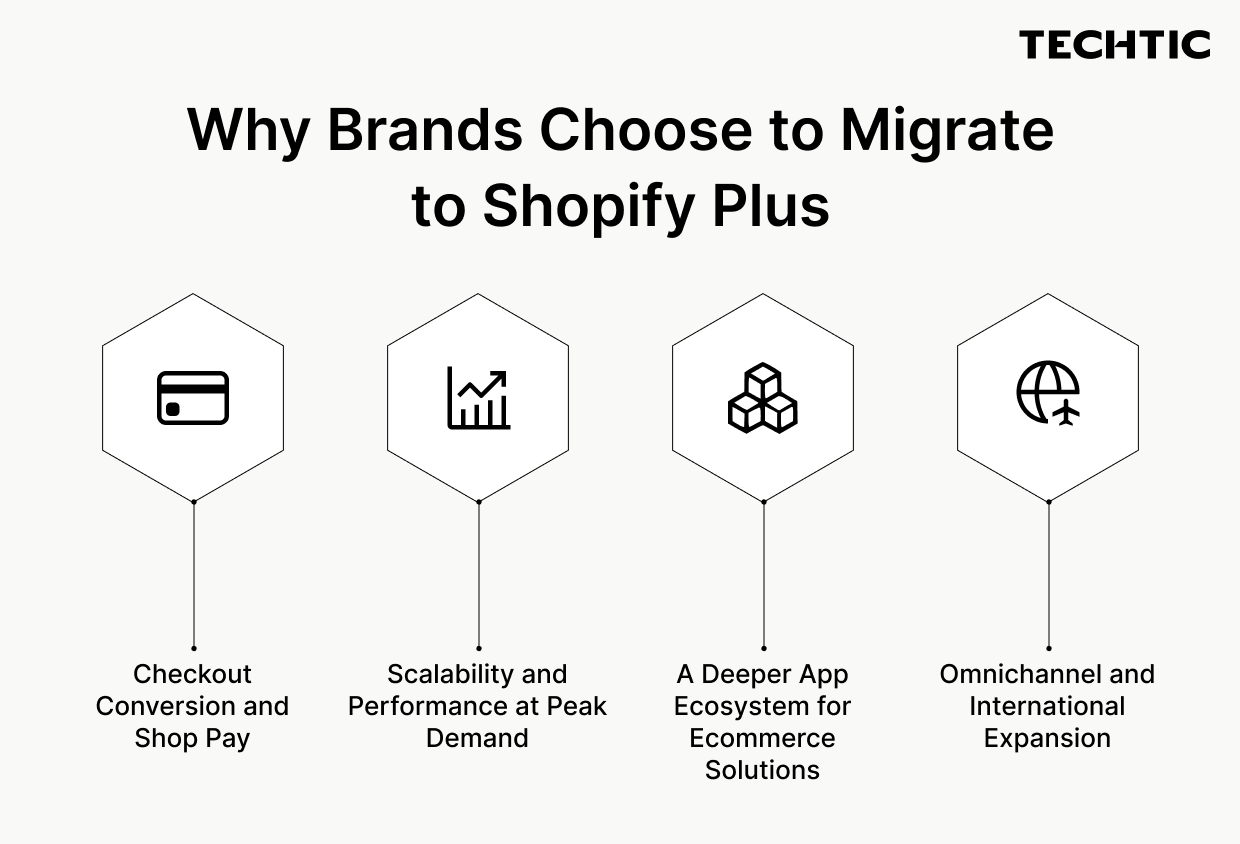
When a BigCommerce merchant does decide to migrate to Shopify Plus, the reasons tend to cluster around four areas, and they show up consistently across documented migrations.
1. Checkout Conversion and Shop Pay
Checkout is usually the first thing leadership notices, because it’s the metric on the dashboard every day. Shopify’s checkout architecture, including Shop Pay, its accelerated one-click checkout, is built into the platform natively rather than bolted on. Shopify reports that Shop Pay lifts conversion by up to 50% compared to guest checkout, and that its mere presence on a page can lift lower-funnel conversion by around 5%, even for buyers who don’t use it (these figures come from Shopify-commissioned research, so they’re worth treating as directionally strong rather than independently audited). The clearest real-world example is Skullcandy, which collapsed a five-step BigCommerce checkout into a single step after its move to Shopify Plus, a concrete, documented before-and-after rather than a marketing claim.
2. Scalability and Performance at Peak Demand
High-volume merchants replatform because they need infrastructure that doesn’t buckle during flash sales, product drops, or the holiday peak. This is where BigCommerce’s flexibility can become a liability: heavily customized implementations accumulate technical debt that makes traffic spikes riskier, not safer. Skullcandy’s migration cut homepage load time from 2.8 seconds to 0.8 seconds and helped drive 45% year-over-year holiday revenue growth. Other documented cases from Shopify’s own platform-comparison research illustrate the downside of staying on a strained BigCommerce implementation: one merchant reportedly spent around $6,000 a month in developer costs just to keep its site running, while another took a full year to launch and saw simple changes crash the site.
3. A Deeper App Ecosystem for Ecommerce Solutions
BigCommerce merchants often hit a build-vs-buy wall: a feature is possible, but it requires custom development rather than an off-the-shelf app. Shopify’s App Store carries more than 16,000 apps, versus roughly 1,300–2,700 on BigCommerce depending on the source, a gap of 6x or more. That difference compounds over time: marketing, loyalty, subscription, and customer service tooling that would need a custom build on BigCommerce is often a pre-built, deeply integrated app on Shopify. One frequently cited comparison estimates a 45% lower five-year total cost of ownership on Shopify once hidden developer costs are factored in, a figure worth validating against your own stack, but directionally consistent with what merchants report about custom-integration overhead.
4. Omnichannel and International Expansion
This is often the real root cause behind the other three. Brands opening retail locations, expanding into wholesale, or launching in new countries need multi-currency pricing, localized storefronts, and point-of-sale that talks to the same inventory as the online store. Shopify has native POS built into every tier; BigCommerce has no native POS and routes merchants to third-party tools like Square. Skullcandy’s migration is instructive here too, after its US relaunch, it stood up Canada within two weeks, and the EU and UK within three, using the same platform and infrastructure rather than rebuilding for each region.

The Real Trigger Behind Ecommerce Replatforming
It’s tempting to treat these four reasons as a menu, pick whichever one applies to your business. In practice, they tend to show up together, in a specific order. Checkout conversion is the symptom leadership notices first, because it’s visible on a dashboard every day. Scalability and performance become the forcing event, a date on the calendar, like a funding-driven growth push or a holiday peak, that turns a nagging problem into a deadline with real financial risk attached. The app ecosystem is the resolution mechanism, not the cause: once a brand has decided to move, having a pre-built app for nearly everything is what makes the project feel low-risk. And omnichannel or international expansion is usually the underlying trigger sitting beneath all three, a brand that’s outgrown a single-channel, single-market setup is the one actually straining checkout and performance in the first place.
That means the earliest, most reliable signal that a company is heading toward a BigCommerce to Shopify migration isn’t a complaint about checkout, it’s a channel or market expansion announcement, months before the platform decision becomes public.
Case Study: Skullcandy's BigCommerce to Shopify Plus Migration
Skullcandy’s migration is one of the most thoroughly documented BigCommerce to Shopify Plus migrations available, with on-record statements from both its Global VP and CIO.
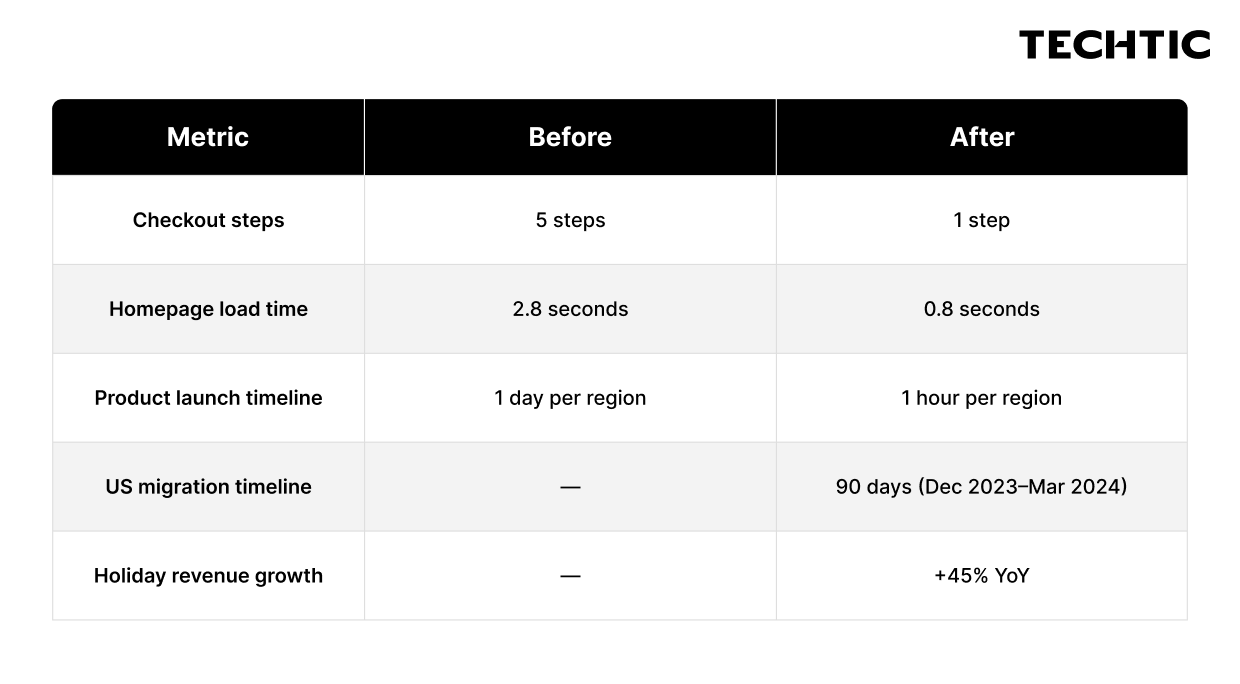
CIO Mark Hopkins summed up the technical shift directly: “We took a very complex five-step checkout system and brought it down to a single step in Shopify.” Global VP Evin Catlett described the platform constraint in blunter terms: “There were limitations that really throttled creativity. It felt like we had to say no to a lot of things.” Within weeks of the US relaunch, Skullcandy extended the same setup to Canada, then the EU and UK, the omnichannel and international expansion piece playing out in real time.
BigCommerce vs Shopify Plus at a Glance
Signals It Might Be Time for an Ecommerce Platform Migration
- You’ve been on BigCommerce for 3+ years, the platform’s average merchant tenure
- A funding round, wholesale-to-DTC pivot, or international launch is on the calendar
- Small storefront changes require a developer and a queue
- Checkout conversion is underperforming your category benchmark
- You’re planning to open retail locations or need real point-of-sale integration
- Your app or custom-dev spend keeps climbing just to maintain current functionality

How Techtic Approaches BigCommerce to Shopify Plus Migration
Techtic Solutions works as a Shopify migration agency for US-based brands weighing a BigCommerce to Shopify migration, offering full-scope ecommerce migration services: a platform and data audit, product catalog and customer data migration, theme and app rebuild, SEO redirect mapping to protect existing rankings through the move, QA across every template and checkout path, and a phased go-live with post-launch optimization.
Whether the underlying need is checkout conversion, scalability, or ecommerce replatforming ahead of an omnichannel expansion, working with Shopify migration experts who’ve mapped the likely failure points in advance, rather than discovering them mid-migration, is what keeps a replatform on schedule and off the year-long-launch list.
If you’re evaluating ecommerce solutions beyond just the platform swap, ERP integration, POS rollout, multi-region storefronts, the migration project is usually the right moment to fix them, since the underlying data model changes either way.
The Bottom Line
The brands making a BigCommerce to Shopify migration right now aren’t chasing a trend, they’re responding to a specific, recurring set of pressures: checkout conversion, scale, app ecosystem depth, and channel expansion. If more than one of those signals sounds familiar, it’s worth a structured platform audit before the next peak season puts the decision on a shorter timeline than you’d choose yourself.
Ready to migrate to Shopify Plus? Talk to Techtic Solutions ecommerce migration team about a BigCommerce to Shopify Plus migration built around your catalog, your traffic patterns, and your growth plans, not a generic playbook.
FAQ’s
Q. How long does a BigCommerce to Shopify Plus migration take?
Timelines vary with catalog size and customization, but Skullcandy’s US migration took roughly 90 days from kickoff to launch. Migrations involving heavy customization or unresolved ERP integrations tend to run longer, some brands have reported year-long timelines when scope wasn’t clearly defined upfront.
Q. Is Shopify Plus better than BigCommerce for B2B companies?
Not automatically. BigCommerce built much of its recent growth around B2B, wholesale pricing, multi-catalog support, and ERP integrations, so it remains a strong fit for many industrial and distribution businesses. Shopify Plus has closed much of that gap with its own B2B tooling, and its broader app ecosystem and checkout performance tend to make it the stronger fit for B2B2C or omnichannel B2B sellers specifically.
Q. What does a Shopify migration agency actually do?
A Shopify migration agency handles the technical and strategic work of moving a store, data and catalog migration, theme and app rebuild, SEO redirect mapping, QA, and post-launch support, so the brand’s internal team isn’t learning platform architecture under deadline pressure.
Q. Will I lose SEO rankings when I migrate to Shopify Plus?
Rankings are put at risk primarily by broken redirects and lost page equity, not by the platform change itself. A migration plan that maps every existing URL to its new Shopify equivalent before launch is the main defense against ranking loss.
Q. What's the difference between Shopify and Shopify Plus?
Shopify Plus is the enterprise tier of Shopify, built for high-volume merchants. It adds things like unlimited staff accounts, deeper checkout customization, dedicated support, and features aimed at multi-store and international operations that standard Shopify plans don’t include.