How to Scale eCommerce Order Management for Corporate Holiday Gifts
Sector: Digital Commerce
Author: Nisarg Mehta
Date: 10/20/2026

The holiday season creates growth opportunities for eCommerce businesses but also brings challenges such as managing bulk orders, tracking inventory, coordinating multiple shipping addresses, and meeting delivery deadlines. A well-planned holiday eCommerce strategy helps businesses prepare for seasonal demand and streamline fulfillment.
For companies purchasing hundreds of corporate holiday gifts, standard checkout workflows may not support personalized messages, product bundles, or scheduled deliveries efficiently. A scalable B2B eCommerce solution can simplify high-volume purchasing with flexible ordering options and improved ecommerce order management.
Techtic’s work with GiftTree demonstrates how customized Shopify functionality can improve corporate gifting workflows. Explore the GiftTree Shopify transformation case study to see how bulk ordering and tailored eCommerce solutions help businesses prepare for the holiday season.
Why Ecommerce Holiday Readiness Matters for B2B and Corporate Gifting
The holiday season concentrates significant purchasing activity into a relatively short period. Website traffic increases, but the nature of customer orders changes too.
Businesses often place larger orders, request customized product combinations, and ship gifts to multiple recipients. Companies purchasing business holiday gifts may also need to coordinate delivery dates around employee celebrations, customer appreciation campaigns, and year-end events.
According to DHL’s 2025 research cited in the original draft, 63% of B2B retailers saw higher Black Friday sales in 2024, while 48% reported selling more than during a typical period. This highlights why business purchasing deserves attention in seasonal planning.
Three factors make holiday ordering different:
- Orders get bigger. Buyers purchase multiple products and send them to different recipients, increasing the complexity of each transaction.
- Buyers expect self-service. Corporate customers want to browse products, compare options, and place orders online without relying on manual assistance.
- Delivery timing matters. Gifts need to arrive when recipients expect them. Early booking helps businesses plan purchases around specific dates and events.
Behind the scenes, inventory, warehouse operations, packing, and shipping must keep pace with demand. Without the right processes, even a successful marketing campaign can overwhelm fulfillment teams.
Many seasonal plans focus on website speed, advertising, and promotional offers. These are important, but ecommerce holiday readiness also requires reviewing the ordering experience itself.
Businesses should evaluate whether their stores can handle large orders, multiple shipping addresses, scheduled deliveries, and real-time inventory updates before demand peaks.
For a broader perspective, see Techtic’s article on the operational side of modern eCommerce.
Why Standard Ecommerce Checkout Falls Short for Bulk Orders
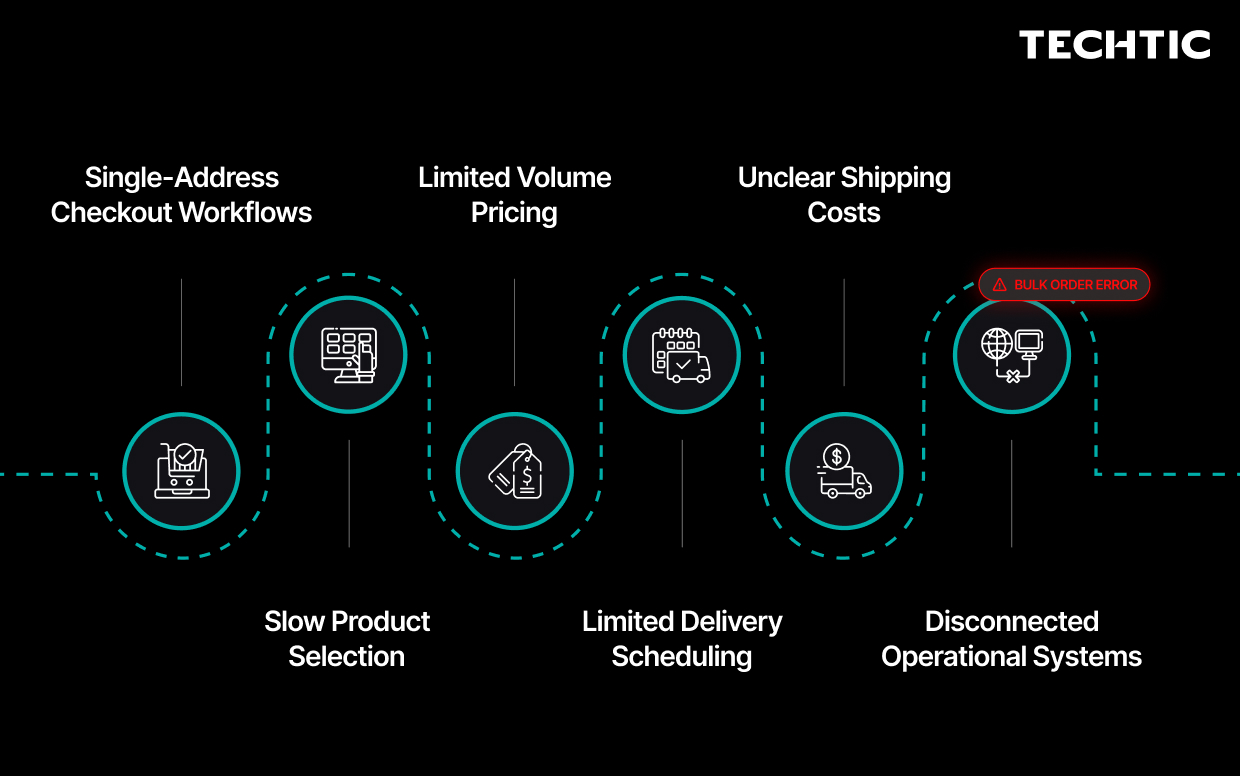
A standard checkout typically assumes one buyer, one shipping address, a straightforward product selection, and immediate fulfillment. Bulk corporate orders often require a different approach.
Common limitations include:
- Single-address checkout workflows: Corporate gifting often involves sending products to dozens or hundreds of recipients. Entering each address manually increases effort and the risk of errors.
- Slow product selection: Adding products individually makes large orders unnecessarily time-consuming.
- Limited volume pricing: Without tiered pricing or bulk discounts, businesses may struggle to offer appropriate pricing for larger purchases.
- Limited delivery scheduling: Buyers may need gifts delivered on specific dates rather than shipped immediately.
- Unclear shipping costs: Multiple destinations can make shipping estimates and final order costs harder to calculate.
- Disconnected operational systems: When the storefront and warehouse systems do not communicate effectively, inventory discrepancies and manual order corrections become more likely.
These issues create friction for both customers and internal teams.
Corporate buyers may abandon checkout, contact customer support, or request manual order processing. Each workaround adds time and operational costs. Effective ecommerce order management helps address these challenges by connecting order placement with inventory, shipping, and fulfillment workflows.
For B2B businesses, this also means providing the self-service purchasing experience customers increasingly expect while accommodating the complexity of large orders.
How a Bulk Ordering System for eCommerce Simplifies High-Volume Purchasing
A bulk ordering system lets customers build and place big orders fast. They do not have to use a checkout made for one item. These are the features that matter most:
- Quick order and bundles. Buyers add many products and quantities in one go, or build a custom bundle, instead of adding items one by one. On Shopify, this is often done with a Shopify bulk order form or a Shopify quick order form.
- Tiered pricing and bulk discounts. The more they buy, the more they save, and the savings are easy to see.
- Bulk upload of recipients and addresses. Many buyers already keep their recipient list in a spreadsheet. With a bulk order CSV upload, eCommerce stores can turn that list into one order with many ship-to addresses.
- Saved recipients and easy reorder. Repeat buyers reuse past details instead of starting over.
- Clear shipping and tax totals. Buyers see the full cost before they pay.
- Personal messages at scale. Each recipient can get their own note.
This is the heart of corporate gifting bulk ordering: one buyer, many recipients, one smooth order. A good corporate gift ordering platform makes that easy. The same features help with B2B eCommerce ordering, and with B2B eCommerce bulk ordering such as seasonal or end-of-quarter restocking.
If you are comparing bulk ordering software, use the list above as your checklist. On Shopify, you can build bulk ordering in a few ways: built-in B2B tools, apps, or custom development. The right mix depends on how complex your needs are. Shopify Plus bulk ordering gives you more room to customize pricing and checkout rules. For multi-address uploads, special pricing logic or warehouse management integration, custom work is often needed. A team with Shopify Plus development experience can help you choose the right path, and our B2B eCommerce development service covers self-serve ordering, tiered pricing and custom catalogs.
The payoff goes beyond convenience. You get higher order values, fewer manual orders to key in, and more repeat buying from corporate and loyal customers.
How an Advance Order Booking System Supports Early Holiday Planning
An advance order booking system allows customers to place orders ahead of time and select a future delivery date or fulfillment window.
Rather than waiting until the busiest days of the holiday season, buyers can plan purchases early and coordinate deliveries around important events.
For customers, advance booking provides greater certainty and reduces last-minute ordering pressure.
For merchants, it provides earlier visibility into demand and more time to plan inventory, staffing, packing, and shipping.
An effective advance booking workflow typically includes:
- Delivery date selection: Customers choose an available date during the ordering process.
- Cut-off dates and capacity limits: Merchants define order deadlines and fulfillment capacity to avoid promising more than they can deliver.
- Accurate inventory planning: Stock availability reflects current inventory and, where supported, relevant reservations for scheduled orders.
- Automated confirmations and reminders: Customers receive clear updates about their orders, delivery schedules, and tracking information.
These capabilities can strengthen a holiday ecommerce strategy by making seasonal demand more predictable and helping businesses distribute fulfillment workloads across several weeks.
That last point is where marketing and operations meet. Reminder and follow-up flows, like those covered in our guide to email marketing for DTC brands, keep early bookers engaged and make the next order easier to win.
GiftTree Case Study: Streamlining Corporate Holiday Gifts with Shopify
GiftTree is an online gifting brand that partnered with Techtic to improve its brand experience, simplify operations, enhance the customer journey, and grow revenue.
One of the key challenges involved handling large corporate orders with different shipping addresses for individual recipients. GiftTree also needed to connect its Shopify Plus storefront with its warehouse management system.
To address these requirements, Techtic implemented several capabilities.
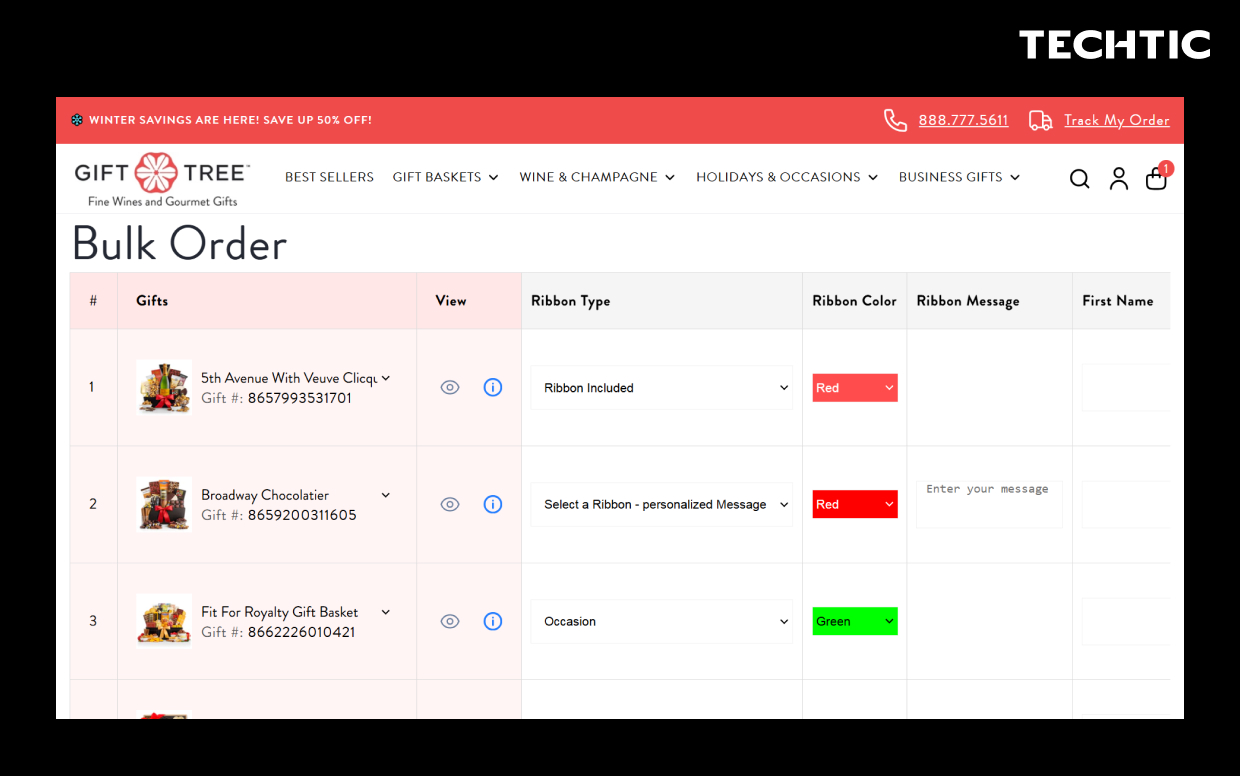
Here is what Techtic built:
- A bulk ordering option for corporate clients. Buyers create custom gift bundles with many products and quantities. Tiered pricing and bulk discounts reward bigger orders.
- A flexible gift flow. Customers pick items, write a personal message, choose the delivery date and select packaging. The delivery date choice is what makes planned, scheduled gifting possible.
- Save Recipient. Frequent senders, including corporate buyers, store recipient details and reuse them later.
- AI-powered messages. An AI tool suggests culturally fitting messages based on details such as the recipient’s location. It shows how AI personalization on Shopify Plus can keep a high-volume order feeling personal.
- A smoother checkout. Guest checkout and clear buttons made the path to purchase faster.
- Warehouse management integration. A custom Shopify app linked the store to the WMS. It gave real-time stock updates, automatic order processing and live order tracking. This is the kind of eCommerce order management that keeps busy weeks under control.
GiftTree Results: Conversion, Order Value, and Repeat Customers
- 111% increase in average order value
- 165% increase in conversion rate
- 12% increase in bulk orders
- 37% repeat customers
The lesson is simple. Bulk ordering and delivery date choice only work at scale when stock, shipping and tracking keep up behind the scenes. The storefront and the back end have to be planned together. You can read the full story in our GiftTree case study.

7 Factors to Consider When Building a Scalable B2B Ecommerce Ordering System
Before investing in bulk ordering or advance booking functionality, businesses should evaluate how customers purchase, how orders are fulfilled, and which capabilities will have the greatest impact.
1. Understand Your B2B Buyers and Ordering Requirements
Review typical order sizes, recipient counts, repeat-purchase patterns, and delivery expectations. Support requests and manually processed orders can reveal where customers experience the most friction.
2. Define Bulk Pricing and Discount Rules
Establish quantity tiers, discount thresholds, and margin requirements before implementing volume-based pricing. Clear rules help ensure that pricing remains consistent across large orders.
3. Plan Delivery Schedules and Inventory Availability
Define delivery windows, ordering deadlines, and fulfillment capacity. Make sure the store communicates availability accurately and handles changes to scheduled orders appropriately.
4. Choose the Right Bulk Ordering Interface
Quick-order forms, spreadsheet uploads, saved recipient lists, and custom bundles address different needs. Choose the combination that matches how customers actually place orders.
5. Integrate Ecommerce Order Management Systems
Inventory synchronization, order routing, and warehouse or ERP integrations are important when order volumes increase. A flexible composable commerce architecture can make it easier to connect and extend these systems as requirements evolve.
6. Select the Right Ecommerce Platform and Integrations
Shopify offers a foundation for bulk ordering and B2B purchasing, but the implementation depends on the complexity of the business.
Some stores may need apps or native capabilities, while others may require custom development for advanced pricing, multi-address orders, or warehouse integration.
Techtic’s work with ScandyCandy on Shopify upgrades, custom bundles, and scalable wholesale functionality offers another example of how tailored solutions can support different business requirements.
7. Test Your Store Before the Holiday Rush
Test high-volume orders, multiple shipping addresses, scheduled deliveries, inventory changes, and mobile checkout before peak demand begins.
Include order management and fulfillment workflows in your ecommerce holiday readiness plan, not just website performance and promotional campaigns.
Early preparation gives your team more time to identify problems and resolve them before they affect customers.

How Techtic Helps Businesses Build Scalable eCommerce Solutions
At Techtic, we help DTC and B2B brands build stores that handle real-world buying behavior, not just the standard cart-and-checkout flow. As a certified Shopify Plus Partner, our team covers the full journey: strategy, UX design, custom builds, integrations with payment, shipping and fulfilment systems, and ongoing conversion optimization.
Whether you need holiday eCommerce solutions that support bulk orders, scheduled deliveries or both, we can help you assess what your store needs and build it to scale. Explore our eCommerce development services or learn more about our Shopify Plus development expertise. If you’re ready to plan your next phase, talk to our team.
FAQs
Q. What is a bulk ordering system for eCommerce?
A bulk ordering system for eCommerce lets customers place large or complex orders quickly. Instead of adding items one by one, buyers use quick order forms, bundles, tiered pricing, spreadsheet uploads and shipping to many addresses. It suits corporate gifting, wholesale and seasonal restocking.
Q. How does bulk ordering work on Shopify?
Shopify bulk ordering can be set up with built-in B2B tools, apps or custom development. Buyers usually add many products and quantities on one form, see volume pricing and check out in one go. Multi-address orders and warehouse management integration usually need custom work.
Q. Can you ship one order to multiple addresses on Shopify?
Usually not with a standard checkout. To ship one order to multiple addresses on Shopify, you typically add an app or custom development, such as a bulk order CSV upload where each row has its own address. GiftTree faced the same need and added a dedicated bulk ordering option for corporate clients.
Q. What is an advance order booking system?
An advance order booking system lets customers place an order early and choose a future date for packing or delivery. It gives buyers certainty and gives you earlier demand data, so you can plan stock, staff and shipping across several weeks instead of a few days.
Q. What is the difference between advance order booking and a pre-order system?
An eCommerce pre-order system is usually used for items that are not in stock yet. Advance order booking is about choosing when an order should arrive, even for items you already have. You can use both: pre-orders for new stock, and advance booking for planned holiday or corporate orders.
Q. What features should a corporate gift ordering platform have?
A corporate gift ordering platform should support bulk upload of recipients and addresses, custom bundles, tiered pricing, saved recipients and personal messages. It should also offer delivery date choice and connect to your warehouse for real-time stock. GiftTree’s Shopify store uses features like these for corporate gifting bulk ordering.
Q. How can eCommerce stores prepare for peak season?
Start with last year’s data, then fix the biggest gaps. Set pricing rules for large orders, add delivery date and cut-off rules, connect stock to your warehouse, and test large carts and mobile checkout. Good eCommerce peak season preparation covers ordering, not just traffic and promotions. Start as early as you can, because ordering features need time to plan, build and test.
Q. Do I need custom development for bulk ordering?
Not always. Simple needs, such as a quick order form, can often be met with apps or built-in features. Multi-address uploads, special pricing rules and warehouse management integration usually need custom development. Start with your biggest buyer pain point, then decide how much to build.