AI in B2B Ecommerce: Practical Applications Beyond Chatbots
Sector: Digital Commerce
Author: Nisarg Mehta
Date: 10/12/2026

B2B buyers now expect the same speed and ease they get when they shop as consumers. They want accurate answers, relevant suggestions and quick checkouts. Sellers have to deliver that while handling thousands of SKUs, customer-specific pricing, long buying cycles and supply chains that don’t always behave.
This is where AI in B2B ecommerce becomes useful. It helps teams work with live data, so sales, service and operations are looking at the same picture instead of separate reports. It can predict demand, show each account a relevant catalog, suggest prices and take over repetitive tasks. That lets a team meet higher expectations without taking on more work.
AI is no longer just an idea to watch. Businesses are using it today to save time, reduce errors and support steady B2B ecommerce growth.
What Is AI in B2B Ecommerce?
AI in B2B ecommerce means using software that can learn from data and make decisions or suggestions, the way a person would, but across far more information than any team could review by hand. In practice, it looks at customer, product, order and market data to help with things like finding products, setting prices, planning stock, answering customer questions and processing orders.
For wholesalers, distributors and manufacturers, the benefit is simple. Teams spend less time on repetitive work, and buyers get an experience that fits their business instead of a generic catalog.
Most companies first meet AI through a chatbot. That’s a fine start, but it’s only a small part of what’s possible. The bigger gains come from using AI in the background: in search, pricing, inventory, sales and order handling.
Where this is heading: B2B ecommerce trends point toward a few clear changes over the next few years.
- Personalized buying: Each account sees the products, prices and suggestions that match how it actually buys.
- Predictive ordering: Systems spot when a customer is likely to need a reorder and prompt it early.
- Automated procurement: Routine purchasing, approvals and order entry run with little manual effort.
- Agentic commerce: AI agents complete multi-step tasks across systems, such as checking stock and preparing an order.
- Decisions based on live data: Pricing, stock and sales priorities rely less on guesswork and old reports.
As more businesses move their sales online, adding AI is becoming part of staying competitive. Even companies that were cautious a few years ago are now investing in cloud platforms and AI tools to work more efficiently and grow.
Types of AI in B2B Ecommerce
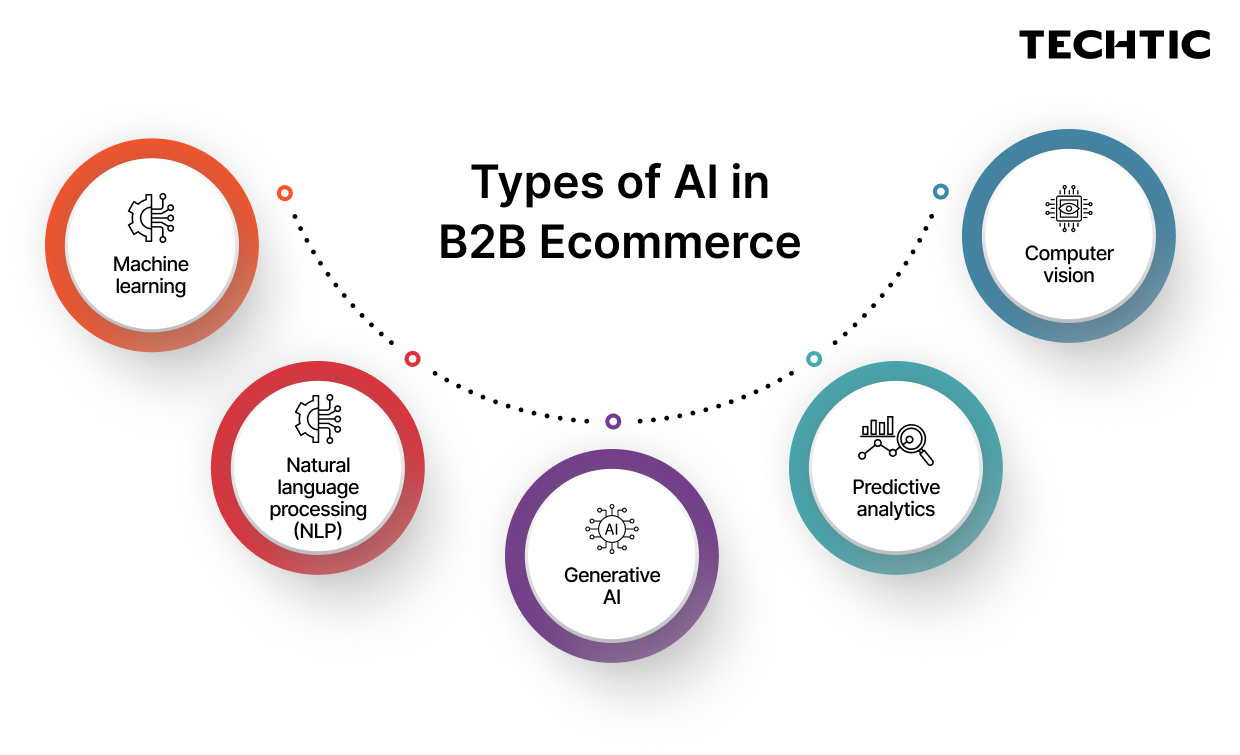
AI isn’t one single tool. It’s a group of technologies, each suited to a different job. These are the main ones you’ll come across.
Machine learning: Finds patterns in sales, customer and operational data. It powers recommendations, pricing suggestions and demand forecasts.
Natural language processing (NLP): Helps software understand everyday language. It’s behind smarter site search, chatbots and AI agents that can read a buyer’s request or an emailed purchase order.
Generative AI: Creates new content from existing data, such as product descriptions, catalog copy or draft replies for support teams. It’s useful for keeping large catalogs consistent.
Predictive analytics: Uses past data to estimate what comes next, like future demand, reorder timing or accounts that may be at risk of leaving.
Computer vision: Understands images. In B2B it’s used for visual product search, automatic product tagging and quality checks.
Most real setups combine several of these. For example, an AI agent processing a purchase order might use NLP to read the email, machine learning to match items, and predictive analytics to check stock.
Businesses can evaluate suitable use cases through AI/ML consulting services before committing to implementation.
Why AI Matters in B2B Ecommerce
B2B buying has become more complicated. Catalogs are bigger, more people are involved in each purchase, and prices often differ by customer. At the same time, buyers expect the same easy experience they get as consumers: quick search, useful suggestions and fast answers.
On the seller’s side, a lot of work is still manual. Reps build quotes by hand. Support teams check three systems to find one order. Someone types purchase orders from emailed PDFs into the ERP.
AI helps close that gap. Used well, it can:
- Reduce manual work in quoting, ordering and support
- Give each account a more relevant experience
- Help teams make better decisions on pricing, stock and sales focus
- Support steady B2B ecommerce growth without needing to grow headcount at the same pace
The goal isn’t to replace people. It’s to take repetitive, data-heavy tasks off their plate so they can focus on work that needs human judgment.
Practical Applications of AI in B2B Ecommerce
Here are six areas where AI is already useful for B2B businesses.
1. AI-Powered Search and Product Discovery
B2B buyers search in ways that basic site search often can’t handle. They paste part numbers with a missing hyphen, type a competitor’s SKU, or describe what they need in plain words, like “stainless hex bolt M8 40mm.”
AI search understands what the buyer means, not just the exact words typed. It copes with typos, synonyms, units of measure and cross-references, and it can turn a plain-language question into the right filters.
What this looks like:
- A buyer enters a competitor’s part number and sees your matching product, with stock and their price
- A search for “replacement filter for model X pump” shows compatible parts only
- Large catalogs become easier to browse without a long list of manual filters
Why it matters: Fewer dead-end searches, a shorter path to purchase, and fewer calls to your inside sales team.
One thing to keep in mind: search is only as good as your product data. If attributes are missing or inconsistent, even good AI search will struggle.
2. Personalization and Product Recommendations
In B2B, personalization isn’t just “customers also viewed.” It means showing each account what’s relevant to them: the products they usually order, items that work with what they already own, and catalogs based on their contract.
How it helps:
- Account-level personalization: A maintenance buyer at a plant sees consumables and spare parts first. A contractor sees bulk and project items.
- Recommendations from purchase history: Suggestions based on what the account has actually ordered.
- Cross-sell and upsell: Compatible accessories, upgrades or bundles show up when they’re useful.
For example, a supplier can show matching gaskets and filters on the page for a pump the customer bought last year. That’s what a good sales rep would do, just available to every customer at any time.
3. AI-Powered Pricing
Pricing in B2B is rarely simple. Contract rates, volume tiers, regional differences and margin limits all play a part. AI doesn’t replace your pricing rules. It works inside them.
Where AI helps:
- Personalized pricing: Applying the right contract and tier for each account automatically
- Discount optimization: Showing where a discount is needed to win an order and where it isn’t
- Demand and margin signals: Suggesting price changes based on demand, stock levels and cost change
A sensible setup lets fixed rules handle the hard limits, lets AI make suggestions within them, and keeps a person in charge of exceptions. The result is quicker quotes and more consistent margins.
4. Demand Forecasting and Inventory
B2B demand is uneven. Projects, seasons and a few large accounts can swing orders quite a bit, so simple averages often miss. A poor forecast means either a stockout and a lost order, or extra stock tying up cash.
AI forecasting looks at order history, account behavior, seasonality and supplier lead times to predict demand by product and location.
What you gain:
- Better demand prediction, including early signs that a key account’s ordering is changing
- Fewer stockouts on the items customers depend on
- Leaner inventory, with less money tied up in slow-moving stock
To do this well, you need a couple of years of clean order data and a good connection between your ecommerce platform and your inventory systems.
5. AI-Powered Sales and Customer Service
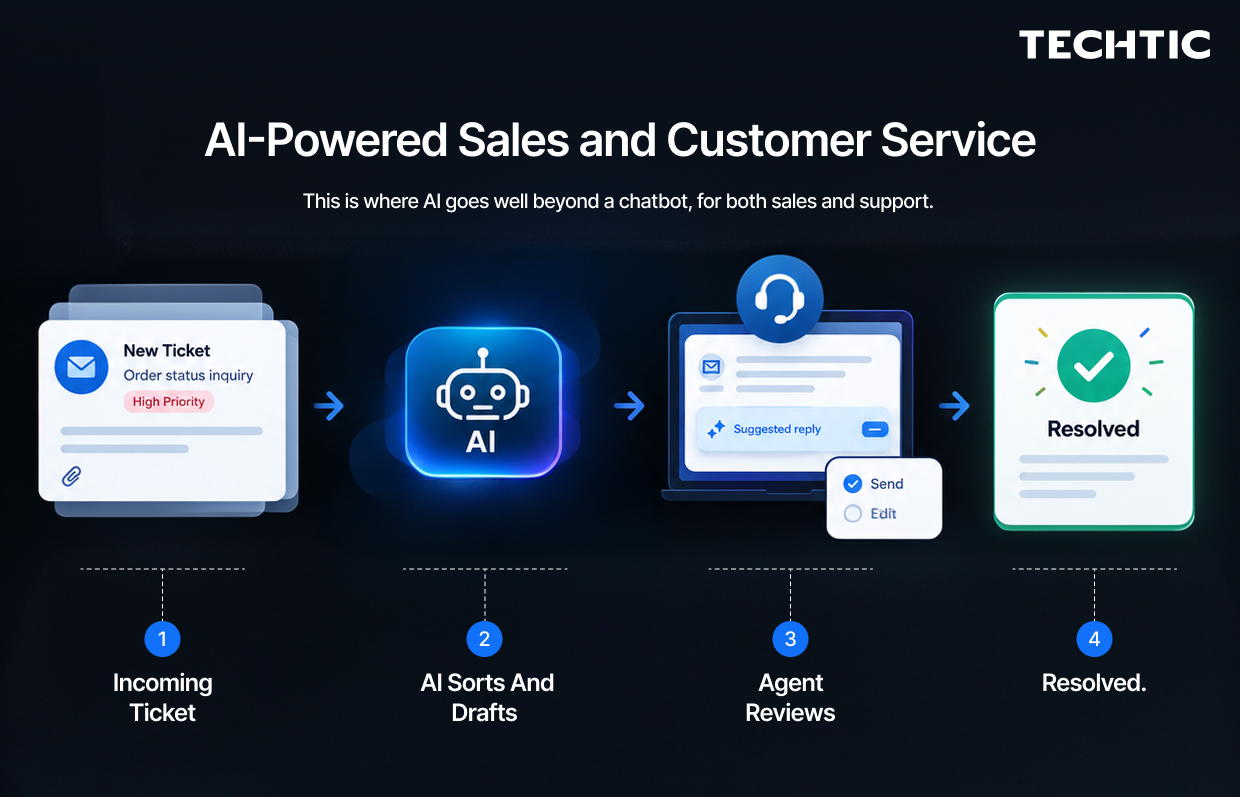
This is where AI goes well beyond a chatbot, for both sales and support.
For sales teams:
- Insights and recommendations: Which accounts are ordering less than usual, which are ready for an upsell, which might be at risk
- Lead and account prioritization: A ranked list of where reps should spend time this week
For customer service:
- Ticket sorting: Routing requests by type, urgency and account
- Order-status answers: Pulling live shipping and invoice details to answer common questions without a person
- Agent assist: Drafting replies and showing order history so agents can resolve issues faster
The outcome is quicker issue resolution and fewer repeat tickets, while your team stays free for complex cases. That’s the practical side of AI in customer service for B2B: support your people, don’t replace them.
6. Order and Procurement Automation
A lot of B2B order handling is still manual. Purchase orders arrive as email attachments, someone retypes them into the ERP, approvals bounce between inboxes, and reorders depend on someone remembering.
AI can take on much of this:
- Reordering: Predicting when an account will need a repeat order and prompting it, or placing it within agreed limits
- Purchase order processing: Reading incoming POs, matching items to your catalog and flagging mismatches
- Approval workflows: Sending orders to the right approver based on value, account or product type
- Repetitive tasks: Invoice matching, status updates and data entry
For businesses handling hundreds of orders a day, this can save a lot of time and cut down on typing errors.
Agentic AI: The Next Step in B2B Ecommerce
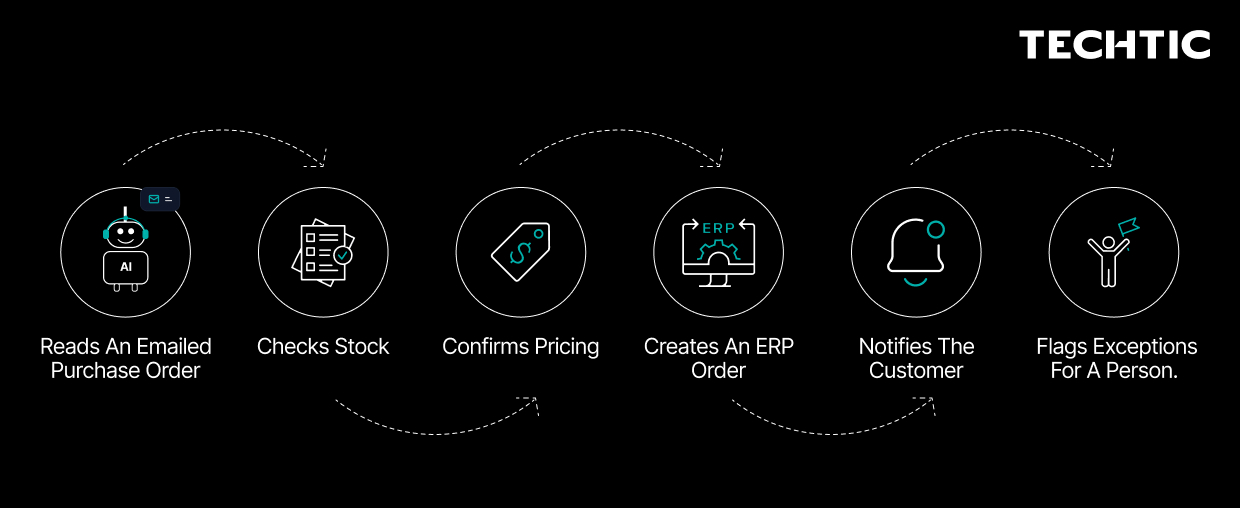
Most of the examples above are AI assistants. They answer, suggest or predict, and then a person takes action. Agentic AI goes one step further.
Assistant vs. Agent:
- An AI assistant tells you stock is running low on a product.
- An AI agent checks stock across warehouses, compares supplier lead times, prepares the replenishment order and sends it for approval.
An AI agent can plan a series of steps, use several systems along the way, and complete a task with little human input. In B2B ecommerce, that could mean:
- Checking inventory across locations when a customer asks about availability
- Preparing orders from an emailed request, including checking items, pricing and delivery details
- Reordering stock or customer supplies when levels hit a set point
- Handling exceptions, and passing to a person only when something doesn’t fit
Because agents act on real systems, they need more care than a chatbot. That means clear permissions, limits on what they can do, a record of every action and human review for higher-risk steps. A good approach is to start with simple, low-risk tasks and widen the scope as you build trust.
For companies with a heavy back-office workload, this is often where the largest time savings are. It’s also the area Techtic supports through its agentic AI automation services.
What Businesses Need Before Implementing AI
A few basic elements can make a big difference in getting AI projects off the ground, building a strong foundation for success.
- Clean, reliable data: Product details, customer records and order history should be accurate and consistent. AI will repeat mistakes in your data.
- Connected systems: Your ecommerce platform, ERP, CRM and inventory tools should share information instead of working in silos.
- Strong APIs and integrations: Most AI use cases need to read and write data in real time.
- Security and governance: Clear rules on who can access data, who approves what, and what AI is allowed to do on its own.
If your ERP integration is weak, fix that first. It will help your business with or without AI.
How to Get Started With AI in B2B Ecommerce
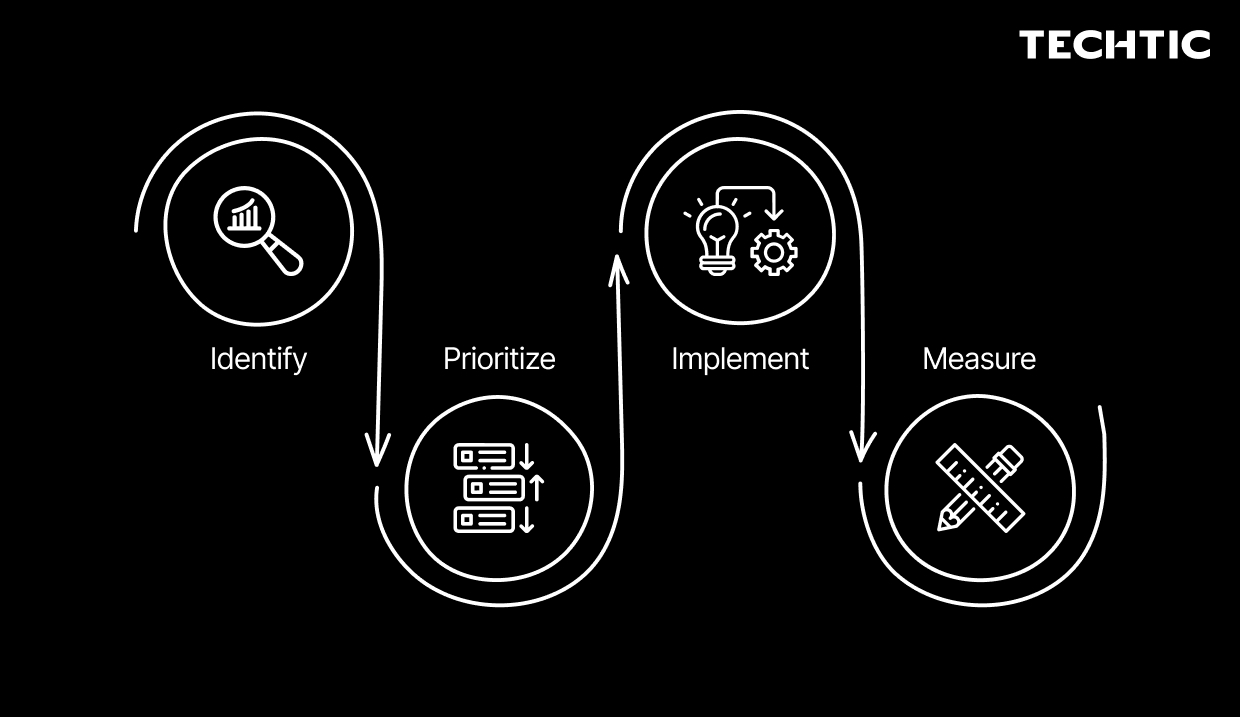
A practical four-step approach can guide your AI transformation: Identify → Prioritize → Implement → Measure.
- Identify a real business problem. Start with a pain point, not a tool. Slow quotes? Too many “where is my order” tickets? A messy catalog? Describe it in plain terms.
- Prioritize a high-value use case. Pick one with clear impact, usable data and manageable effort. Avoid tackling five at once.
- Implement with a focused scope. Run a pilot with a small group. Keep a person in the loop at first, and widen the scope once results are reliable.
- Measure and scale. Track a business result you chose in advance, such as quote turnaround, search conversion, hours saved or ticket resolution time. If it works, expand. If it doesn’t, find out why and adjust.
A common mistake is tracking how many people used the tool instead of what changed. What matters is whether quotes went out faster or orders had fewer errors.

The Future of B2B Ecommerce
A few changes are worth planning for.
- Agentic commerce: AI agents will increasingly act for both sellers and buyers by researching, comparing and ordering. Your catalog, pricing and stock data will need to be easy for machines to read, not only for people.
- Predictive and personalized buying: Instead of waiting for buyers to search, platforms will suggest what’s needed based on usage and ordering patterns.
- Automated procurement: Routine purchasing will run in the background, with people stepping in for unusual or strategic buys.
- AI-driven decision-making: Pricing, stock and sales priorities will rely more on live data and less on quarterly reviews.
Together, these shifts shape the future of B2B ecommerce: speed, accuracy and data quality will decide who wins accounts. Companies that sort out their data and integrations now will find it easier to adopt whatever comes next.
Conclusion
At Techtic, we see AI in B2B ecommerce as an intelligence layer across the whole commerce setup, covering search, pricing, inventory, sales, service and procurement. Chatbots were a good first step, and the larger gains come from applying AI where your team spends the most time and where margins are most affected.
Our advice is to start with one clear use case, get the data behind it in good shape, measure the outcome, and build from there. Our team supports this through B2B ecommerce consulting, AI/ML and Gen AI consulting, AI product development, and agentic AI automation, shaped around your systems and goals.
If you are deciding where AI fits in your B2B ecommerce roadmap, talk to our team and we can explore the right first step together.
FAQs
Q. What is AI in B2B ecommerce?
AI in B2B ecommerce is the use of machine learning and related technology to improve how businesses sell to other businesses online. It supports search, personalization, pricing, demand forecasting, customer service and order processing.
Q. How is AI used in B2B ecommerce?
Common uses include natural-language product search, account-based recommendations, pricing and quote support, inventory forecasting, sales prioritization, support ticket sorting and automated purchase order handling. More advanced setups use AI agents to complete multi-step tasks across ecommerce, ERP and inventory systems.
Q. How can AI improve B2B ecommerce growth?
AI helps buyers find products faster, supports repeat orders, speeds up quotes, reduces stockouts and removes manual work. That means a business can handle more orders with the same team and give customers a smoother experience.
Q. Can AI replace B2B sales teams?
Not likely. B2B deals often depend on relationships, negotiation and complex requirements that need people. AI works best as support: it provides insights, handles routine requests and takes care of admin, so sales teams can focus on the accounts that need real attention.
Q. How should a B2B company start using AI?
Begin with one clear business problem, such as slow quotes or high support volume. Check your data quality, choose a focused use case, run a pilot with human oversight, and compare results against a baseline before expanding.