BigCommerce vs Shopify Plus: Which Platform Should Enterprise Brands Choose in 2026?
Sector: Digital Commerce
Author: Nisarg Mehta
Date: 07/20/2026
If you’re an eCommerce manager or CTO evaluating platforms for a mid-market or enterprise brand, you’ve probably already ruled out the DIY tools. The real decision in 2026 comes down to two names: BigCommerce and Shopify Plus. Both are genuinely enterprise-grade platforms today, both power billion-dollar brands, and both will show up in nearly every RFP you send out.
That’s exactly why the choice isn’t obvious. A few years ago, the conversation was simpler, Shopify Plus for DTC, BigCommerce (or Magento) for anything with complex catalog or B2B needs. That line has blurred. Shopify Plus now ships native B2B tools. BigCommerce has leaned harder into open architecture and multi-storefront flexibility. Both platforms have matured to the point where the “right” answer depends entirely on your specific business model, not on which platform has better marketing.
This guide breaks down the real differences, architecture, pricing, customization, B2B capabilities, and ecosystem, so you can walk into your next platform decision with a clear, defensible framework instead of a gut feeling.
Platform Overview: What You're Actually Choosing Between
Shopify Plus is Shopify’s enterprise SaaS tier, built on top of the same core commerce engine that powers over 2.8 million Shopify stores globally. It’s a hosted, opinionated platform, Shopify controls the infrastructure, the checkout, and much of the underlying architecture, and in exchange you get speed, stability, and the largest app ecosystem in eCommerce. Shopify Plus is particularly strong where DTC and B2B need to coexist on one back office, and it’s the default shortlist entry for fashion, beauty, food and beverage, and consumer goods brands scaling fast.
BigCommerce takes a more “open SaaS” approach. It’s still fully hosted and managed, but it imposes fewer platform-level restrictions on things like checkout logic, API access, and storefront architecture. BigCommerce has historically been the platform of choice for manufacturers, distributors, and multi-brand enterprises that need complex catalog structures, native B2B pricing logic, and multiple storefronts running from a single backend without stitching together as many third-party tools.
Neither platform is objectively “better.” Both are viable, well-funded, actively developed SaaS platforms with enterprise customers doing hundreds of millions in annual revenue. The right choice depends on your catalog complexity, your B2B requirements, your existing tech stack, and how much customization your team realistically needs versus wants.
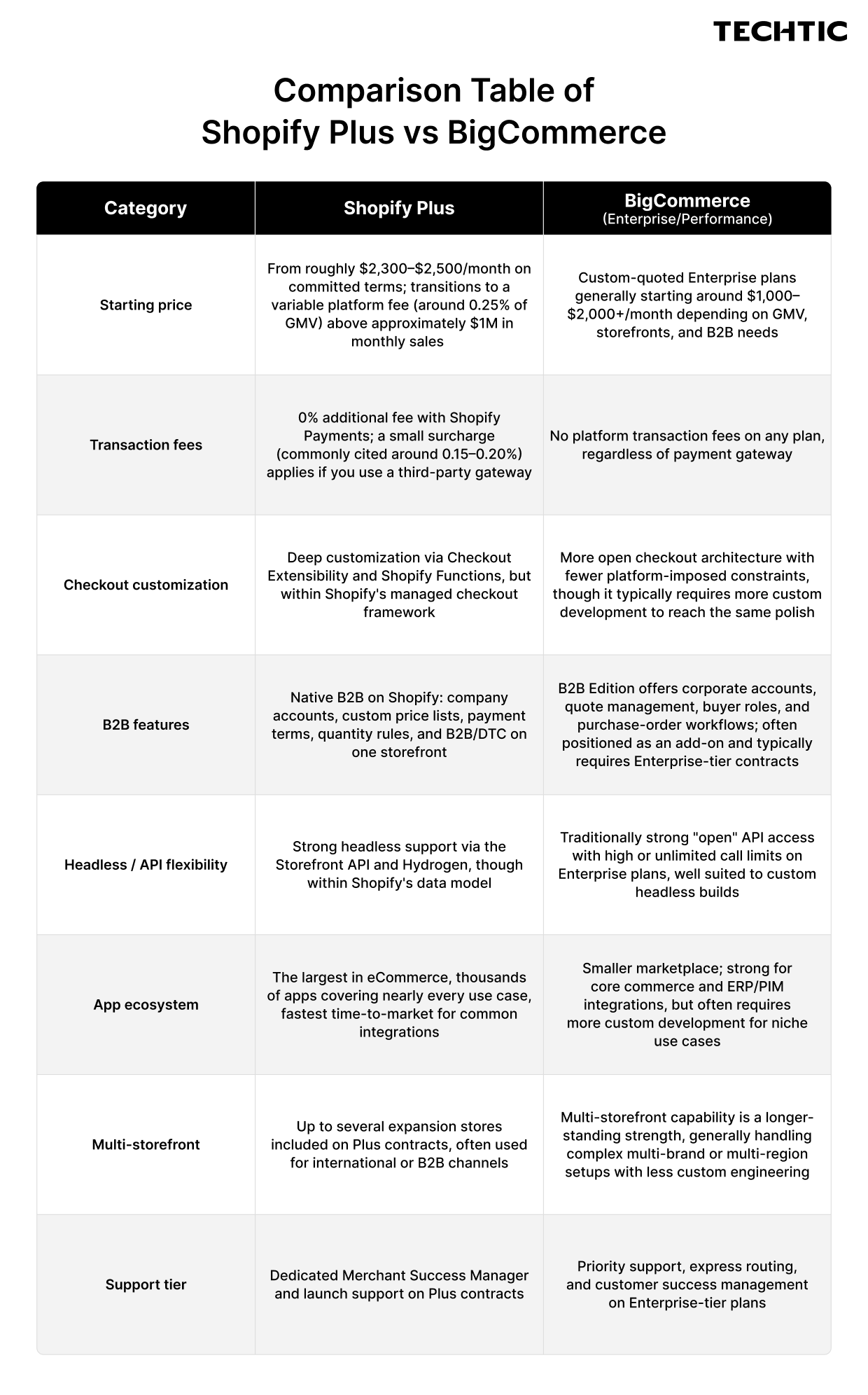
A note on pricing: both platforms have moved to complex, GMV-linked pricing models in 2026, and neither publishes a single number that applies to every business. Treat the figures above as directional, always confirm current numbers directly with a sales rep or your implementation partner before budgeting.
When to Choose Shopify Plus
Shopify Plus tends to be the stronger fit when your business fits one or more of these patterns:
- You need DTC and B2B running from the same storefront. Shopify’s native B2B tools, company accounts, custom pricing, and payment terms, sit inside the same platform your consumer storefront runs on, which cuts down on the integration work needed to serve both channels.
- Conversion optimization at the checkout is a priority. Checkout Extensibility and Shopify Functions give your team real control over checkout behavior, custom fields, upsells, discount logic, shipping rules, without forking core checkout code.
- Speed to market matters more than deep customization. With the largest app ecosystem in eCommerce, most integrations, loyalty, subscriptions, personalization, reviews, are a plug-in away rather than a build.
- You’re running high-traffic sales events. Shopify’s infrastructure is built to absorb massive, predictable traffic spikes (flash sales, product drops) without the capacity planning headaches.
- Your team wants a managed, opinionated platform. Less architectural decision-making, more shipping.
Best-fit categories: fashion and apparel, health and wellness, food and beverage, and consumer goods brands, particularly those with a strong DTC identity that are now adding wholesale or B2B revenue on the side.
If your business already looks like this, working with a dedicated Shopify Plus development agency can shorten the evaluation-to-launch timeline considerably, since a lot of the platform’s advantage comes from how well it’s configured, not just which plan you’re on.

When to Choose BigCommerce
BigCommerce tends to be the stronger fit when your business fits one or more of these patterns:
- You need more architectural flexibility than a fully opinionated platform allows. BigCommerce’s open architecture means fewer hard platform restrictions on how you build checkout logic, custom objects, or storefront experiences.
- You’re running complex multi-storefront operations. Multi-brand retailers and enterprises operating several regional or brand-specific storefronts from one backend often find this smoother to configure natively on BigCommerce than to replicate elsewhere.
- B2B is core to your business, not a bolt-on. Manufacturers and distributors with complex pricing tiers, purchase-order workflows, and buyer-role requirements have historically found BigCommerce’s native B2B tooling well suited to wholesale-first operations.
- Transaction fees matter at your volume. BigCommerce doesn’t charge platform transaction fees on any plan, which can add up meaningfully for high-volume merchants regardless of which payment gateway they use.
- You want high or unlimited API call limits for custom integrations. This matters if you’re syncing large catalogs with an ERP or PIM system in near real time.
Best-fit categories: manufacturers, distributors, and multi-brand enterprises, particularly B2B-heavy businesses where wholesale operations, not DTC checkout polish, are the primary revenue driver. For companies weighing this exact trade-off, our dedicated B2B eCommerce development practice works through requirements like buyer roles, quote workflows, and custom pricing logic before recommending a platform.
It’s also worth noting that BigCommerce’s B2B capabilities are commonly bundled with its higher-tier Enterprise plans rather than available as a standalone add-on across the board, so it’s worth confirming exact packaging with BigCommerce sales during your evaluation.

A Third Option: Should You Even Be Comparing Shopify Plus to Shopify?
One mistake we see mid-market brands make is jumping straight to Shopify Plus without first confirming they’ve actually outgrown standard Shopify. If your GMV, checkout customization needs, or B2B requirements haven’t hit the thresholds that justify Plus pricing, you may be paying enterprise rates for features you’re not using yet. Before finalizing your evaluation, it’s worth reading through the differences covered in Shopify Plus vs Shopify to confirm you’re comparing BigCommerce against the right Shopify tier in the first place.
Total Cost of Ownership: Beyond the Sticker Price
Neither platform’s headline price tells the full story, and this is where a lot of platform evaluations go wrong.
Shopify Plus contracts typically start in the low thousands per month, but once you add apps, Shopify Plus-specific development, and, for high-GMV merchants, the variable revenue-share component that kicks in above roughly $1M in monthly sales, the real monthly spend for a mid-market brand often lands well above the base subscription. Enterprise brands processing tens of millions in annual GMV should budget for platform licensing, app stack, and implementation as three separate line items, not one.
BigCommerce’s Enterprise pricing is custom-quoted and not publicly listed, which makes apples-to-apples comparison harder up front, but the platform’s zero-transaction-fee policy on all plans is a genuine, quantifiable advantage for high-volume merchants, since it applies regardless of which payment gateway you use. The trade-off is that BigCommerce’s B2B Edition and some advanced features are often priced and provisioned separately, so total cost can still climb once you account for those.
The practical takeaway: request a GMV-based cost projection from both platforms (or your implementation partner) at your current volume and your projected volume 18–24 months out. Platform fees that look competitive today can diverge significantly at scale, particularly once variable, revenue-linked pricing components are involved.
Migration Considerations
If you’re reading this, there’s a good chance you’re not launching on a green field, you’re migrating off Magento, WooCommerce, Salesforce Commerce Cloud, or a legacy custom build. A few things matter regardless of which platform you land on:
Data migration scope. Plan for four core data categories: products (including variants, custom attributes, and media), customers (with password/account handling, most platforms require a re-authentication flow), historical orders, and SEO redirects. URL structure changes are one of the most common sources of post-migration traffic loss, so a 301 redirect map should be built and tested before cutover, not after.
Timeline. A realistic enterprise migration to either BigCommerce or Shopify Plus typically runs 12–20 weeks depending on catalog size, the number of custom integrations (ERP, PIM, CRM), and how much of the existing design needs to be rebuilt versus templated. Rushed migrations are where most enterprise brands lose SEO equity, break third-party integrations, or ship broken checkout logic, all of which are more expensive to fix post-launch than to plan for up front.
Platform-specific nuances.
- Migrating to Shopify Plus generally means re-architecting checkout customizations for Checkout Extensibility (the checkout.liquid approach is deprecated) and rebuilding B2B logic around Shopify’s native company-account model if you’re not already using an app-based approach.
- Migrating to BigCommerce generally means mapping your existing catalog structure to BigCommerce’s product and category model, and confirming which B2B or multi-storefront features require the Enterprise tier before committing to a plan.
Either way, budget separate time and resources for QA on checkout, tax/shipping logic, and third-party integrations, these are consistently where enterprise migrations run over timeline.
Ecosystem, Integrations, and Talent Availability
Platform capability is only half the equation, the other half is how easily you can staff, integrate, and extend the platform once it’s live.
App and integration ecosystem. Shopify’s app marketplace is significantly larger than BigCommerce’s, which matters most in categories where off-the-shelf solutions are common, loyalty programs, subscriptions, personalization, reviews, and marketing automation. If your team wants to move fast without custom-building every integration, that breadth is a real operational advantage. BigCommerce’s marketplace is smaller but tends to be deep in categories that matter to B2B and manufacturing brands specifically, ERP connectors, PIM integrations, and catalog management tools built for complex product data.
Developer and agency talent. Shopify Plus has a considerably larger pool of certified partner agencies and freelance developers globally, simply due to platform market share. This can mean shorter timelines to find qualified help and more competitive agency pricing. BigCommerce’s partner ecosystem is smaller but often more specialized in mid-market B2B and multi-storefront work, which can be an advantage if that’s precisely your use case, you’re more likely to find a partner who has solved your exact problem before.
ERP and ecosystem integrations. Both platforms integrate with major ERPs (NetSuite, SAP, Microsoft Dynamics) through either native connectors or middleware like Celigo and Boomi. Neither platform is an ERP replacement, if your business needs multi-entity accounting, advanced inventory, or financial consolidation, plan for a separate ERP running alongside whichever commerce platform you choose.
Security and compliance. Both platforms are PCI DSS Level 1 compliant out of the box and handle infrastructure security, patching, and uptime as part of the SaaS relationship, a meaningful advantage over self-hosted platforms like Magento Open Source, where that burden falls on your internal team. Neither platform requires you to manage servers, which is worth factoring into your TCO comparison against any self-hosted alternative you might also be considering.

A Practical Decision Framework
If you want a shortcut through all of the above, ask your team these four questions:
- Is DTC or B2B your primary revenue driver? DTC-first with growing B2B → lean Shopify Plus. B2B-first, wholesale-heavy → lean BigCommerce.
- How many storefronts do you need to run, and how different are they? Multiple distinct brands or regions with complex catalog variation → BigCommerce’s native multi-storefront tooling has an edge. A handful of expansion stores for localization → Shopify Plus handles this comfortably.
- How important is app ecosystem breadth versus architectural openness? Want to move fast with proven, off-the-shelf integrations → Shopify Plus. Want fewer platform constraints and more control over custom logic → BigCommerce.
- What does your GMV trajectory look like over the next 24 months? Run the total cost of ownership projection, including transaction fees, variable pricing components, and app spend, at your current and projected volume for both platforms before signing anything.
None of these questions have a universally “right” answer. They have a right answer for your business, which is exactly why generic platform rankings and “best eCommerce platform 2026” listicles aren’t especially useful at the enterprise level.
Final Thoughts
Both BigCommerce and Shopify Plus are capable of running serious, high-volume enterprise operations in 2026. The decision isn’t about which platform is more advanced, it’s about which one maps more closely to how your business actually sells: DTC-led with emerging B2B, or B2B-led with complex catalog and multi-storefront needs.
If you’re still weighing the two, the most efficient next step isn’t more research, it’s a scoping conversation with a team that has actually built on both platforms and can be honest about trade-offs, including the ones that don’t favor whichever platform they specialize in.
Techtic works with both BigCommerce and Shopify Plus, and we don’t have a horse in this race, our job is to match the platform to your requirements, not the other way around. If you’re evaluating platforms for a migration or a new build, explore our Shopify Plus development agency work, or get in touch and we’ll give you a straightforward recommendation based on your catalog, your B2B needs, and your growth trajectory, not a sales pitch for whichever platform we’d rather sell.
FAQs
Q. Which is better for enterprise businesses: Shopify Plus or BigCommerce?
Both platforms are enterprise-ready, but the right choice depends on your business model. Shopify Plus is ideal for brands focused on DTC growth, fast implementation, and a large app ecosystem, while BigCommerce is often better suited for B2B businesses, manufacturers, distributors, and enterprises requiring greater architectural flexibility and complex catalog management.
Q. Can I run B2B and DTC from the same store on either platform?
Yes, on both. Shopify Plus offers native B2B on the same storefront as DTC. BigCommerce’s B2B Edition is generally positioned for Enterprise-tier accounts and is sometimes provisioned as an add-on rather than included by default, confirm current packaging with BigCommerce sales.
Q. Which platform is better for headless commerce?
Both support headless architecture. Shopify’s Storefront API and Hydrogen framework are purpose-built for headless builds within Shopify’s data model. BigCommerce’s historically open API access is well suited to teams that want more control over how the frontend consumes commerce data. The better fit depends on your frontend team’s existing stack and how much they want abstracted away versus controlled directly.
Q. How do I choose between Shopify Plus and BigCommerce?
Start by evaluating your primary revenue model, B2B requirements, catalog complexity, number of storefronts, integration needs, customization requirements, and projected growth. The best platform is the one that aligns with your long-term business strategy rather than a generic platform ranking.
Q. Which platform offers better checkout customization?
Shopify Plus provides advanced checkout customization through Checkout Extensibility and Shopify Functions within Shopify’s managed checkout framework. BigCommerce offers greater architectural freedom, although achieving the same level of checkout experience often requires more custom development.