The Founder’s Playbook for Turning an AI Product Idea Into a Successful Startup
Sector: Digital Product
Author: Nisarg Mehta
Date: 07/27/2026

A Founder’s Playbook for Validation, Tech Partners, Go-to-Market, and Funding, Before You Write a Line of Code
Every founder building an AI product today has heard some version of the same pitch in their own head: “This is simple, it solves a real problem, and if it catches on, it could go viral.” That instinct isn’t wrong, AI genuinely has made it possible to build and ship faster than ever. But “AI + a good idea” is not a business. It’s a starting point that thousands of other founders are starting from at the exact same moment.
The numbers make this concrete. Industry analysis projects that roughly 80% of AI startups will fail by the end of 2026, and separate research puts AI startup failure specifically at 90%, versus about 70% for traditional tech companies. Among AI “wrapper” products, a UI bolted onto someone else’s model, the picture is starker still: an estimated 80–95% fail, 60–70% generate zero revenue, and only 3–5% ever cross $10K in monthly recurring revenue.
This isn’t a reason not to build. It’s a reason to be deliberate about the four things that actually separate the 5% from everyone else: knowing which kind of AI product you’re building, validating demand before writing code, picking the right technology partner, and sequencing your go-to-market and funding so you don’t run out of runway before you find out if you were right.
Step 1: Classify Your Idea - Because the Playbook Changes Completely by Bucket
Before anything else, be honest about which of these three buckets your idea actually falls into. Founders regularly borrow the wrong playbook, running a consumer growth strategy on an enterprise idea, or trying to raise venture capital for something that should be bootstrapped, and it costs them a year.
Bucket 1: Consumer-Driven
Think AI girlfriend/companion apps, AI photo cleanup, AI dating assistants, AI chat companions, AI calorie/fitness tracking. These live or die on virality, engagement loops, and low-friction monetization (subscriptions, in-app purchases). The “magic moment” has to be demonstrable in a 15-second video.
Bucket 2: Job-Function / Enterprise-Driven
Think AI-based HRMS, AI marketing automation, AI recruitment, AI customer service agents. These are bought, not downloaded. Growth comes from outbound sales, design partners, and case studies. Trust, security, and measurable ROI matter more than polish.
Bucket 3: Vertical Utility Suite
A pool of smaller AI utility tools all serving one single industry, for example, a suite of tools purpose-built for property managers, or for construction estimators, or for veterinary clinics. You typically win with one narrow “wedge” tool first, then expand across the workflow once you’ve earned trust inside that industry.
Here’s why the distinction matters in practice:
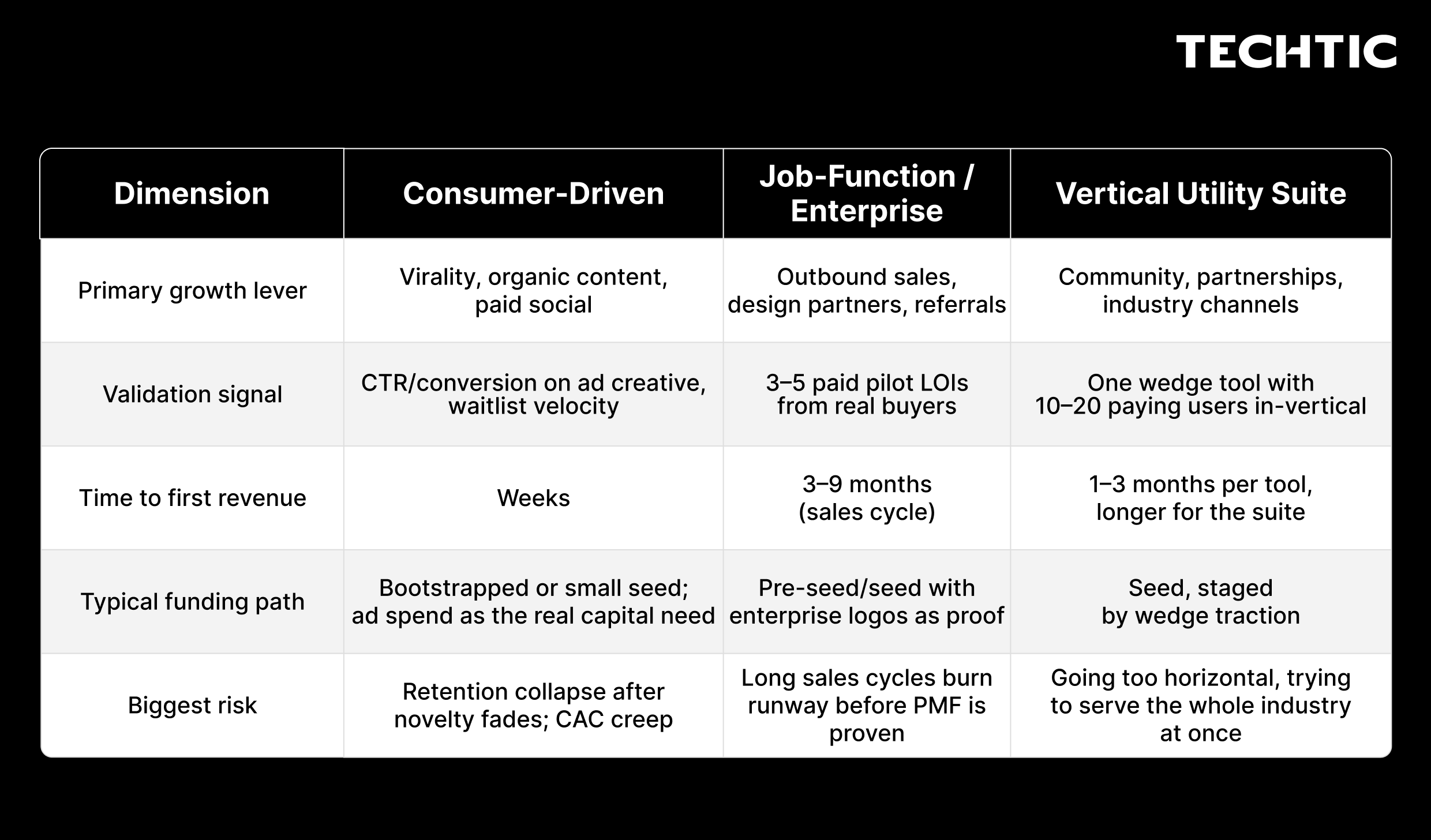
Write down, in one sentence, which bucket your idea belongs to before reading further, every section after this one assumes you know the answer.
Step 2: Key Metrics to Evaluate Before You Even Start
Before committing months of your life (and, likely, real money) to an idea, run it through these checks. Think of this as your “should I even start” filter.
Market-side questions
- TAM/SAM/SOM: is the addressable market big enough to matter, or is it a feature-sized opportunity dressed up as a company?
- Willingness to pay: has anyone in this space paid for a similar solution before, even a manual or offline version of it?
- Incumbent saturation: in crowded consumer categories, expect to compete with 10,000+ existing AI tools already fighting for attention.
Product-side questions - the moat test
The single most important question: if the foundation model provider (OpenAI, Google, Anthropic) shipped your exact feature as a default next quarter, would your customers cancel? If yes, you are building a feature, not a company. Inference cost per million tokens dropped roughly 80% between 2023 and 2025, great for users, but it means a thin margin between API cost and what you charge is not a moat, it’s a countdown clock.
- Do you have (or can you build) a proprietary data advantage? Around 85% of profitable AI startups in 2025 controlled some form of proprietary dataset competitors couldn’t easily access.
- What is your fully-loaded cost to serve one user/customer per month, including inference, and does your pricing clear that with real margin?
Founder-side questions
Do you (or your co-founder/early hire) have real domain expertise in the bucket you’ve chosen, especially for enterprise/vertical ideas? Some of the strongest recent vertical AI founders were industry insiders first, technologists second.
Are you prepared for the retention and unit-economics reality of your bucket? Consumer AI wrapper apps average roughly 65% churn within 90 days, almost double the ~35% typical SaaS benchmark. Enterprise pilots fail to show measurable ROI in an estimated 95% of cases, according to widely cited MIT research, which is exactly why a validated pilot, not a demo, is the bar.
Step 3: Basic Validation Exercises - Before You Write a Line of Code
Validation looks different by bucket, but the underlying discipline is the same: get a real signal of demand before you spend real money building.
For Consumer Ideas
- Ship a landing page with the core “magic moment” described or mocked up, and run a small amount of paid traffic to it, measure click-through and waitlist conversion, not just visits.
- Post the concept (or a rough demo) in relevant Reddit/TikTok/niche communities and gauge organic reaction before spending on ads.
- Build the thinnest possible working version of the “magic moment” only, skip the account system, settings, and polish entirely at this stage.
For Job-Function / Enterprise Ideas
- Get 3–5 letters of intent (LOIs) or paid pilot commitments from real buyers before building the full product, not “that sounds interesting,” an actual signature or PO.
- Run a concierge/“Wizard of Oz” pilot: manually deliver the outcome you’re promising to one or two design partners before automating it, to confirm the ROI story actually holds up operationally.
- Sit in on the buyer’s actual workflow for a day if you can, enterprise AI pilots fail most often not because the model is weak, but because of poor data plumbing and workflow misfit that only shows up on the ground.
For Vertical Utility Suites
- Pick the single narrowest, most painful task in that industry’s workflow and validate that one wedge tool first, rather than trying to build the whole suite at once.
- Find 10–20 potential customers in that one industry (via associations, LinkedIn groups, trade shows) and validate willingness to pay for just the wedge before expanding scope.
- Confirm the wedge creates a natural expansion path into the rest of the workflow, the suite’s economics depend on cross-sell once you’re inside.

Step 4: Identifying the Right Technology Partner
The build-vs-buy-vs-hybrid decision comes down to how central AI is to your actual moat. If AI is a commodity feature for you, lean on foundation model APIs and spend your engineering budget on the workflow and data layer instead. If model behavior itself is your differentiation, budget for fine-tuning or a hybrid approach.
Evaluation criteria for a build partner or dev shop
- Depth in applied AI/ML specifically, not just general app development with an API call bolted on.
- Prior experience in your chosen vertical, if you’re in Bucket 2 or 3, domain-blind engineering teams tend to under-build the compliance and workflow-integration layer that is often the actual moat.
- Ability to produce a working prototype fast, you’re validating, not architecting for scale on day one.
- Security and compliance competence for enterprise/vertical ideas (HIPAA, SOC 2, data residency), this is often the difference between a demo and a signed contract in regulated industries.
Red flags
- A partner who can’t clearly explain your data flow and where inference costs will land at scale.
- A proposal that is 90% UI and 10% discussion of what happens when the underlying model changes or a foundation lab ships your feature natively.
Step 5: Go-to-Market - and Doing It Fast
Consumer GTM
Growth loops beat paid acquisition early on. A documented consumer AI case study (a photo-based calorie tracker) built an exclusive network of 250+ fitness influencers whose native content was inherently demonstrable in a 15-second video, that was the primary engine to $2M/month before performance ads were layered on top. Typical paid CAC benchmarks in crowded “AI productivity” categories run $120–$600 per customer on $8–$40 CPCs, a number that only works with strong organic/viral pull underneath it.
Enterprise / Job-Function GTM
Outbound plus design partners, not spray-and-pray marketing. Recruit a handful of design partners who represent your hardest use cases (high volume, regulated, brand-sensitive) early, in stealth if needed, a fast-growing enterprise AI agent company built its first product with four design partners over 11 months before general availability, then used named customer results to drive the next dozen deals.
Vertical Suite GTM
Community and industry channels over broad marketing, trade associations, vertical-specific Slack/Discord communities, and word of mouth inside a tight-knit professional network travel faster than any paid campaign for a niche audience.
Speed tactics that apply across all three
- Build your pre-launch audience in parallel with the product, not after, waitlists, a founder’s personal following, or a content library you can start amplifying the day you launch.
- Leverage existing distribution before building your own: app stores, Product Hunt, LinkedIn, industry associations, and app-store optimization all carry an audience you don’t have to build from scratch.
- Sequence your paid acquisition to amplify what’s already organically working, rather than guessing cold, know your winning message/creative before you scale ad spend behind it.
Step 6: Funding and Budgeting the Journey
This is the piece that determines whether you get to try again if your first attempt at product-market fit is wrong, so estimate it honestly, before you start.
Rough US cost buckets to plan for
- MVP build: ranges enormously by bucket, a thin consumer wrapper can be prototyped for a few thousand dollars in API costs plus founder time; an enterprise product with real integrations and compliance work costs meaningfully more before the first sale closes.
- AI inference/API costs at scale: model your cost-per-active-user carefully, this is the line item that quietly kills consumer AI unit economics if pricing doesn’t cover it with real margin.
- GTM/marketing spend: for consumer, budget for testing paid creative even if your primary channel is organic, $7,000+/day in paid spend is not unusual once a consumer AI app is scaling past its organic ceiling. For enterprise, budget for a longer sales cycle (3–9 months) before revenue lands.
- Team costs: your most defensible early hire, in Bucket 2 or 3 particularly, is often domain expertise, not additional engineering.
Funding path benchmarks (US, 2026)
Typical pre-seed rounds run $500K–$2.5M (median around $1.2M) at pre-money valuations roughly $3M–$10M, with founders giving up 10–20% equity. Seed rounds run $2M–$6M (median around $3.8M) at pre-money valuations of $8M–$25M. AI-focused seed rounds close at roughly a 20–40% premium over non-AI peers, and seed investors increasingly expect real usage or revenue traction, not just a deck, before writing a check.
- A practical sizing rule: raise enough to fund 18–24 months of runway to your next credible milestone (often $1M+ ARR for seed-stage), plus a 6-month fundraising buffer, not the maximum amount you can talk someone into.
- Non-dilutive options worth exploring before diluting equity: accelerators (which also bring distribution and credibility), small business/innovation grants, and revenue-based financing once you have any recurring revenue at all.
- Bootstrapping remains a completely valid path for Bucket 1 ideas specifically, several of the most successful recent consumer AI apps reached eight figures in revenue with no venture funding at all, reinvesting early revenue directly into growth.
Case Studies Across All Three Buckets
Consumer: Cal AI, $0 to ~$50M ARR in 18 Months, Fully Bootstrapped
Two teenage founders built an AI-powered calorie-tracking app around a single “magic moment”: snap a photo of your food, get instant calorie and macro data, roughly 90% accurate. Month one brought in $28,000 in revenue; month two, $115,000. The growth engine was an exclusive network of 250+ fitness influencers creating native content, which alone carried the app to $2M/month before performance ads (eventually $1M+/month in spend) were layered on top. Within about 18 months the app had crossed 15 million downloads and an estimated $30M–$50M in annual recurring revenue, with a 30% retention rate, unusually strong for a health app, and was acquired by MyFitnessPal in a deal announced in March 2026. The entire journey was self-funded; no venture capital was raised.
Job-Function / Enterprise: Sierra - $150M+ ARR in Under 26 Months
Founded in February 2024 by former Salesforce co-CEO Bret Taylor and former Google VP Clay Bavor, Sierra builds an enterprise AI agent platform that automates complex customer service workflows, mortgage refinancing, insurance claims, subscription management, for large, regulated enterprises. The company recruited four design partners in stealth for 11 months before launch, then reached $100M in ARR just seven quarters after launching, and $150M+ ARR shortly after, en route to a $950 million Series E at a $15.8 billion valuation in May 2026. More than 40% of the Fortune 50 are paying customers, and the model is priced on outcomes (per successful resolution) rather than flat subscription seats, with typical enterprise contracts starting around $150,000 per year.
Vertical Utility Suite: EliseAI - A Suite Built for One Industry
EliseAI is a suite of conversational AI agents purpose-built for residential property managers, handling tenant communication, tour scheduling, maintenance requests, and related workflows as a connected set of tools rather than one standalone chatbot. Rather than trying to serve every industry, EliseAI went deep into one: it now serves 350+ institutional real estate owners and claims to automate more than 85% of tenant conversations without human intervention. The model illustrates the vertical-suite pattern well, win one workflow inside a single industry first, then expand into adjacent tasks once trust and integration depth are established.
Note: figures above are drawn from published company statements, funding announcements, and industry reporting; results vary by market, team, and execution, treat them as directional benchmarks, not guarantees.

Before-You-Build Checklist
Pull all of this together into one page you can revisit before committing:
- 1. Classify your idea. Consumer, job-function/enterprise, or vertical suite, pick one and commit to its playbook.
- 2. Pass the moat test. If a foundation model shipped your feature next quarter, would customers still pay you? If not, keep iterating before building.
- 3. Get a real demand signal. Waitlist conversion, LOIs, or paid pilots, appropriate to your bucket, before writing production code.
- 4. Model your unit economics honestly. Cost-to-serve, CAC, and payback period, using real numbers, not best-case assumptions.
- 5. Choose a tech partner for the moat, not the demo. Domain depth and security/compliance competence matter more than a slick prototype.
- 6. Sequence GTM to your bucket. Virality and paid social for consumer; design partners and outbound for enterprise; community and one wedge tool for vertical suites.
- 7. Size your funding to a milestone, not a maximum. 18–24 months of runway to a credible next-round milestone, plus a 6-month buffer, and know whether this idea should be funded at all versus bootstrapped.
None of this guarantees you’ll be in the 5% that survives. But it moves the odds meaningfully in your favor, and, just as importantly, it tells you fast and cheaply if this particular idea isn’t the one worth betting the next two years on.
Conclusion
Building an AI product has never been more accessible, but turning it into a successful business has never been more competitive. The difference between an idea that fades away and a company that scales isn’t the technology alone. It comes down to validating real customer demand, choosing the right product strategy, building a sustainable competitive advantage, and executing a go-to-market plan that aligns with your market.
Whether you’re creating a consumer AI app, an enterprise AI solution, or a vertical AI platform, resist the urge to build first and validate later. The most successful AI startups begin with customer conversations, measurable validation, clear unit economics, and a product roadmap designed around solving meaningful problems rather than chasing the latest AI trend.
As AI technology continues to evolve, your biggest advantage won’t be access to better models, it will be your ability to understand customers better than your competitors. Founders who validate early, iterate quickly, build defensible products, and partner with experienced AI product development teams will be in the strongest position to create lasting businesses in the years ahead.
If you’re ready to transform your AI product idea into a scalable, market-ready solution, start by validating your assumptions, building the right MVP, and focusing on solving a problem customers are willing to pay for. That’s the foundation of every successful AI startup.