MVP Development Cost in 2026: Complete Pricing Breakdown
Sector: Digital Product
Author: Nisarg Mehta
Date: 08/03/2026

If you’ve typed “how much does it cost to build an MVP” into Google more than once this month, you’re not alone and you’re not going to get a single honest number from anyone who hasn’t asked you what you’re actually building. The real answer is a range, and a wide one: MVP development cost in 2026 runs anywhere from around $5,000 for a bare-bones, single-feature build to $250,000+ for a complex, compliance-heavy product like a healthtech or fintech platform.
That range isn’t a cop-out it’s the whole story. Every MVP startup founder asks a version of the same question before writing a single spec, and the honest answer only gets more precise once you know your own scope. The cost to build an MVP is driven by a small number of concrete decisions: how complex the product is, what tech stack and features it needs, and who’s building it (in-house, freelance, or an agency) and how many hours it actually takes. This guide breaks each of those down with real numbers, so that by the end you’ll be able to look at your own idea and land within a realistic budget range yourself not just take someone else’s word for it.
Quick Answer: What Does an MVP Cost in 2026?
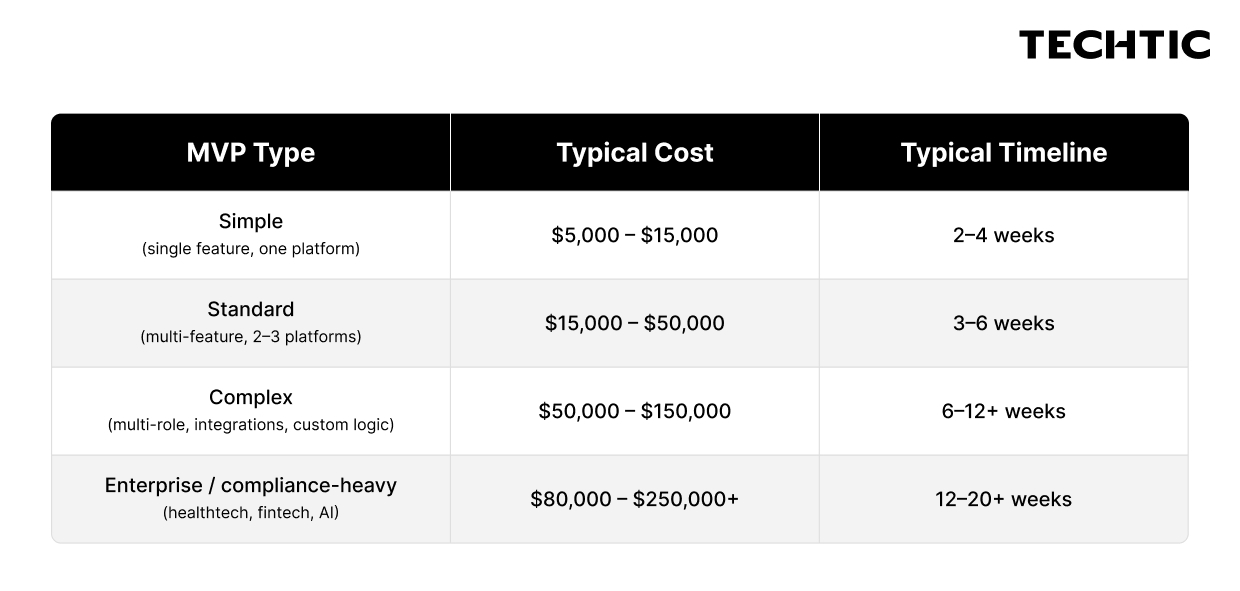
Your actual number depends on three things: what kind of MVP you’re building, what tech stack and features it needs, and who’s building it. The rest of this guide walks through all three plus the question a lot of founders are quietly asking right now: can I just skip this whole budget by building it myself with AI?
What Is an MVP in a Startup, Really?
Before founders search for pricing, most search what is MVP in startup terms first so it’s worth answering plainly. A minimum viable product is the smallest version of your idea that lets real users do the one thing your product is meant to do enough to test whether the problem and the solution actually match, without spending a year and a fortune finding out. It is not a prototype (which doesn’t need to work), and it’s not a stripped-down version of your full vision (which tries to include a little of everything). A good MVP is deliberately narrow: it proves or disproves one core hypothesis about your business as cheaply and quickly as possible.
That framing matters more than it sounds like it should, because most MVP budgets go wrong before a single line of code is written by trying to build a “small version of everything” instead of a complete version of one thing.
Why MVP Development Matters for Startups
Building an MVP for startups isn’t optional cost-cutting it’s risk management. MVP development for startups exists to answer a question you can’t answer with a spreadsheet: will real people actually use this? Founders who skip straight to a full build are effectively betting their entire budget on an untested assumption. Startup MVP development flips that you spend the smallest amount necessary to get a real, honest signal, then decide whether to double down, adjust, or walk away, before the cost of being wrong gets large.
This is true whether you’re building a consumer app, a B2B SaaS tool, or something in a regulated space like healthtech the size of the bet changes, but the logic of testing before scaling doesn’t.
The MVP Development Process, Step by Step
Regardless of who builds it, a sound MVP development process generally follows the same five stages. Understanding them is useful even if you’re not writing a line of code yourself, because this is also the framework you should expect any agency or freelancer to walk you through before quoting you a number.
- Discovery & validation – defining the one problem you’re solving, who you’re solving it for, and what “success” looks like before any design or development work starts.
- Scoping & prioritization – deciding what’s actually in the MVP versus what’s deliberately deferred, usually the single biggest lever on cost.
- Design – wireframes and UX flows for the core journey, kept simple enough not to slow down validation.
- Development & QA – the actual build, ideally with code review and testing built in rather than bolted on at the end.
- Launch & learn – shipping to real users, watching a small number of metrics closely, and using that signal to decide what comes next.
Skipping stage one is the most common and most expensive mistake. It’s also why an hour spent on discovery with an experienced team usually saves far more than an hour spent later fixing a build that solved the wrong problem.
Can You Build Your Own MVP with AI Tools Like Replit or Claude?
This question comes up in almost every founder conversation now, and it deserves a straight answer rather than a dismissive one: yes, AI tools have genuinely changed what’s possible to build alone. Tools like Replit, Claude, Cursor, and Lovable can take you from an idea to a working, clickable demo in a weekend something that would have taken weeks and real budget just a couple of years ago. If your only goal is to validate a concept, test messaging, or show investors a clickable story, this is often a smart, cheap first step.
Where it breaks down is the part that doesn’t show up in a demo: writing code has gotten faster, but the judgment around that code still belongs to a software engineer. AI tools optimize for “does this run,” not “will this scale,” “is this secure,” or “will this still make sense to work on in six months.” Someone still has to validate the logic, check for edge cases the demo never hit, confirm that user data is actually being handled safely, and make the architectural calls that determine whether the product can grow or has to be rebuilt from scratch the moment it gets real traction.
That last part is the expensive one. Unvalidated AI-generated code rarely fails loudly on day one. It fails quietly by working fine until it doesn’t, at which point untangling it costs more than building it right the first time would have. AI changes who’s typing the code. It doesn’t change who’s accountable for whether that code is correct, secure, and built to last and that accountability is exactly what you’re paying for when you bring in a software engineer, AI-assisted or not.
The honest framing: use AI tools to validate an idea fast and cheap. Don’t mistake that prototype for an MVP that’s ready to onboard real users, handle real data, or survive due diligence from an investor or acquirer. (Download our free [MVP Readiness Checklist] to see exactly where that line is it’s built around the same validation and code-review standards our engineering team holds every MVP to.)
MVP Development Cost by Complexity & Type
This is the single biggest driver of your total number, and usually the first place to look when you’re asking how much does MVP cost for something specific rather than in the abstract. The table below reflects what’s commonly seen across the market for MVP product development in 2026:
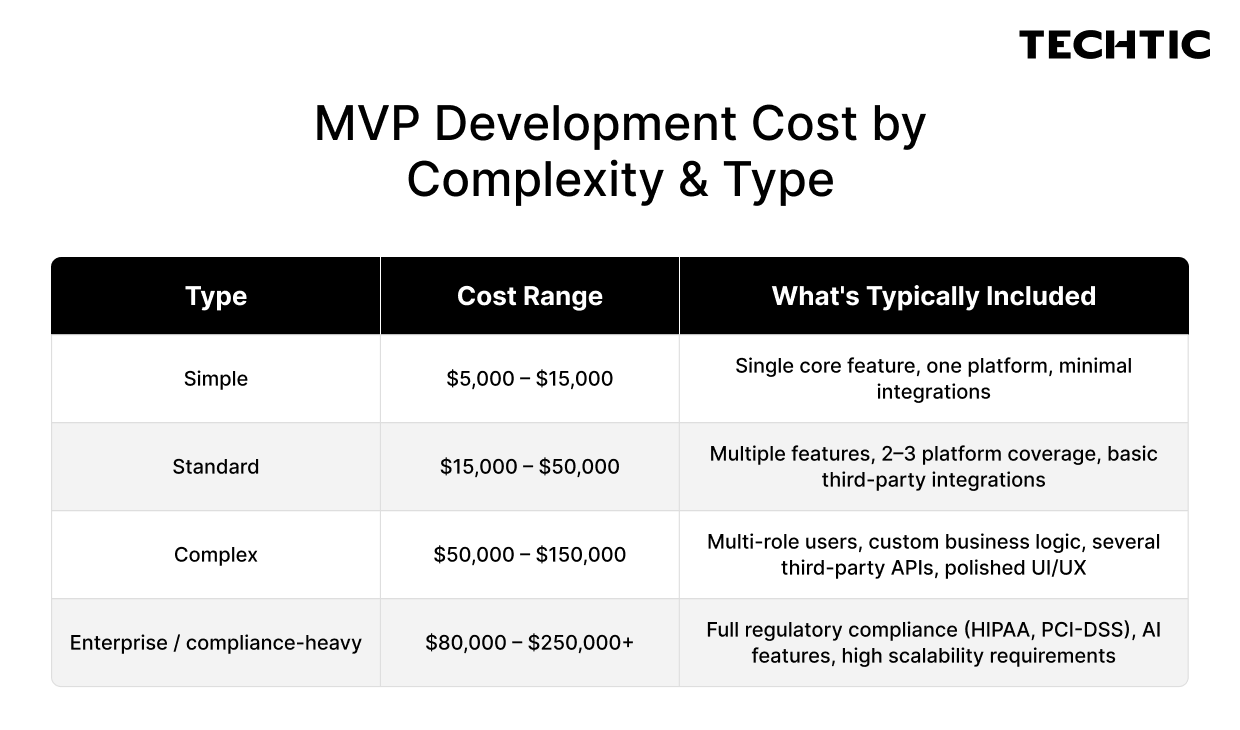
Industry adds its own multiplier on top of complexity. A standard consumer app MVP might land at $10,000–$50,000, while a fintech MVP carrying PCI-DSS requirements more typically runs $50,000–$150,000+, and a healthtech startup MVP development effort is usually the most expensive category of all:
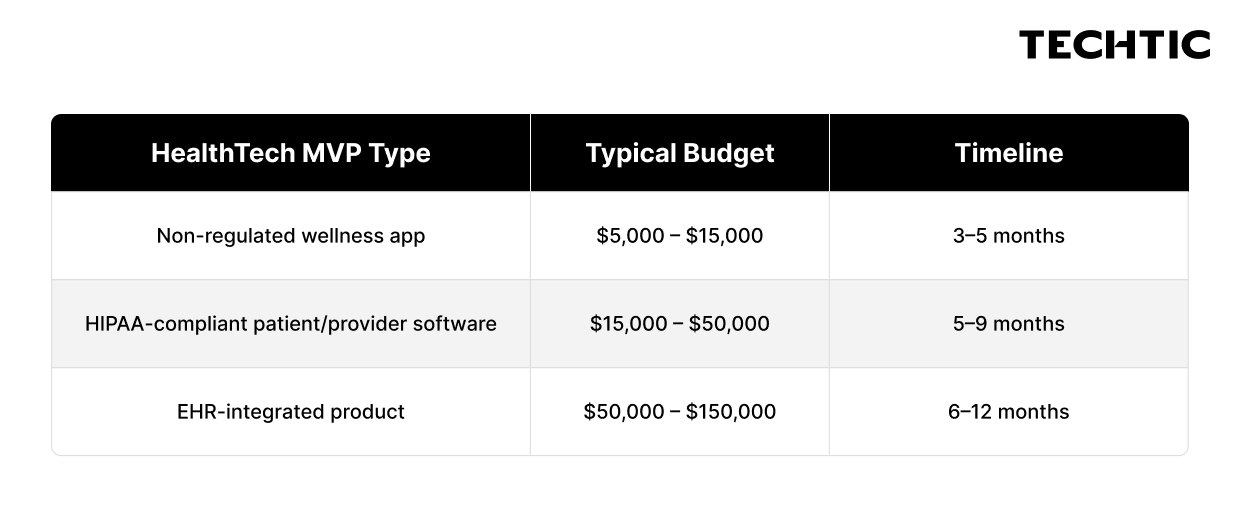
The reason MVP development for a healthtech startup costs 1.5x to 5x more than a comparable non-regulated app isn’t the core feature set it’s the compliance layer underneath it. HIPAA compliance alone typically adds $20,000–$80,000 in infrastructure and documentation work, and a properly secured environment (role-based access control, encryption at rest and in transit, audit logging, penetration testing) adds another $15,000–$50,000 before you’ve built a single user-facing feature. If you’re building a healthtech or other regulated MVP, budget for compliance as its own line item not as a rounding error inside “development.”

MVP Development Cost by Tech Stack & Features
The same MVP concept can cost wildly different amounts depending on the technical decisions behind it:
- Native vs. cross-platform: Building separate native apps for iOS and Android roughly doubles your mobile development cost compared to a single cross-platform codebase, since you’re paying for two teams, two QA cycles, and two release processes instead of one.
- No-code/low-code vs. custom code: No-code platforms can validate simple ideas cheaply, but they hit a ceiling fast anything involving custom business logic, complex integrations, or real scale usually needs custom code sooner than founders expect.
- Third-party integrations: Payments, messaging, maps, and auth providers save build time but add ongoing licensing costs and integration testing budget $1,000–$20,000 depending on how many you need and how deeply they’re woven into core flows.
- AI-powered features: Adding genuine AI/ML functionality (not just “we used AI to build it,” but AI as a product feature) is one of the fastest ways to push an MVP from the standard range into the complex or enterprise range.
Case in Point: Cost to Build MVP Booking App with Kotlin Multiplatform
Booking and scheduling apps think appointment booking, resource reservation, or service marketplaces are a good illustration of how a single tech-stack decision moves the number. Built as two fully separate native apps (Swift for iOS, Kotlin for Android), a booking-app MVP with real-time availability, calendar logic, and payment integration commonly lands in the $40,000–$70,000 range.
Building the same MVP with Kotlin Multiplatform (KMP) sharing business logic (availability rules, booking state, payment handling) across a single codebase while still shipping fully native iOS and Android UI typically cuts that initial cost by 30-50%, since you’re writing and testing the core logic once instead of twice. In practice, that often brings a comparable booking-app MVP down to roughly $25,000-$45,000, with a meaningfully shorter QA cycle since there’s one shared logic layer to validate instead of two. The savings compound after launch too: maintaining one shared codebase instead of two separate native ones typically keeps total cost of ownership 25-40% lower over the product’s first few years.
KMP isn’t the only cross-platform option Flutter and React Native solve a similar problem but for booking and marketplace style apps where the underlying business logic is the hard part (not the UI), it’s consistently one of the more cost efficient choices available in 2026.
MVP Development Cost by Team Composition & Hours
Whether you’re hiring a freelancer, an in-house team, or a startup MVP development company, the total cost ultimately comes down to roles and hours. A typical MVP build allocates budget roughly like this:
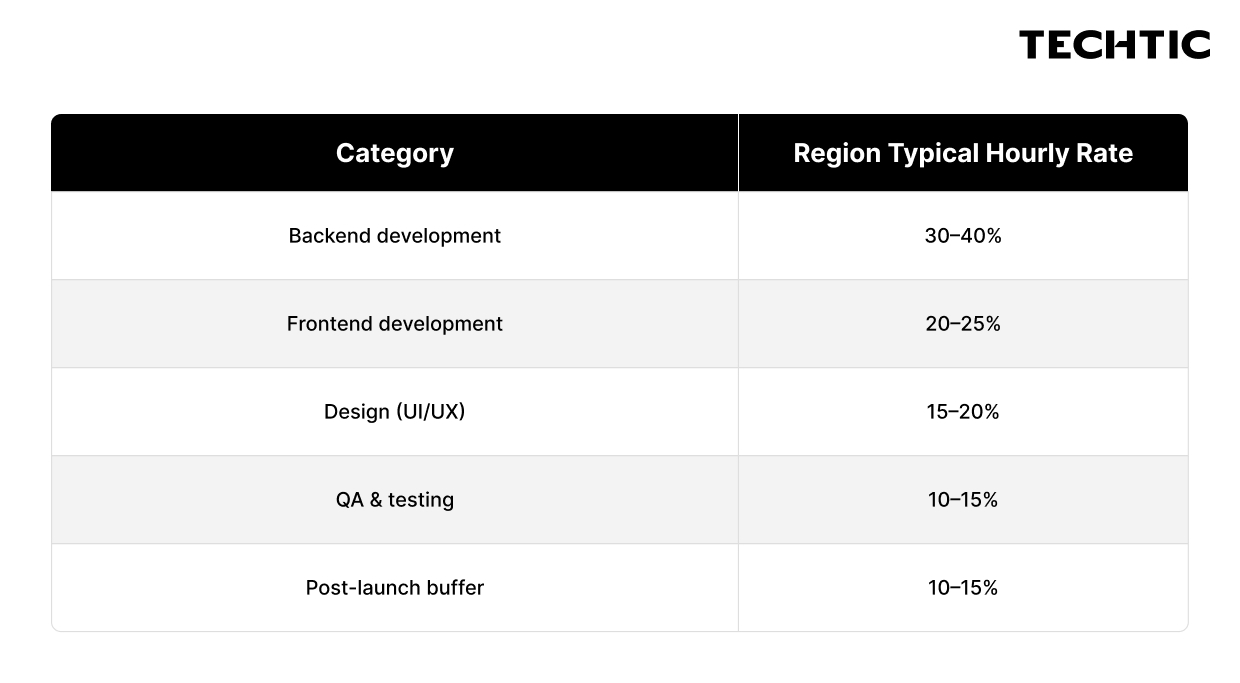
Hourly rates vary enormously by region, which is why “how much does an MVP cost” has such a wide answer depending on who you ask:
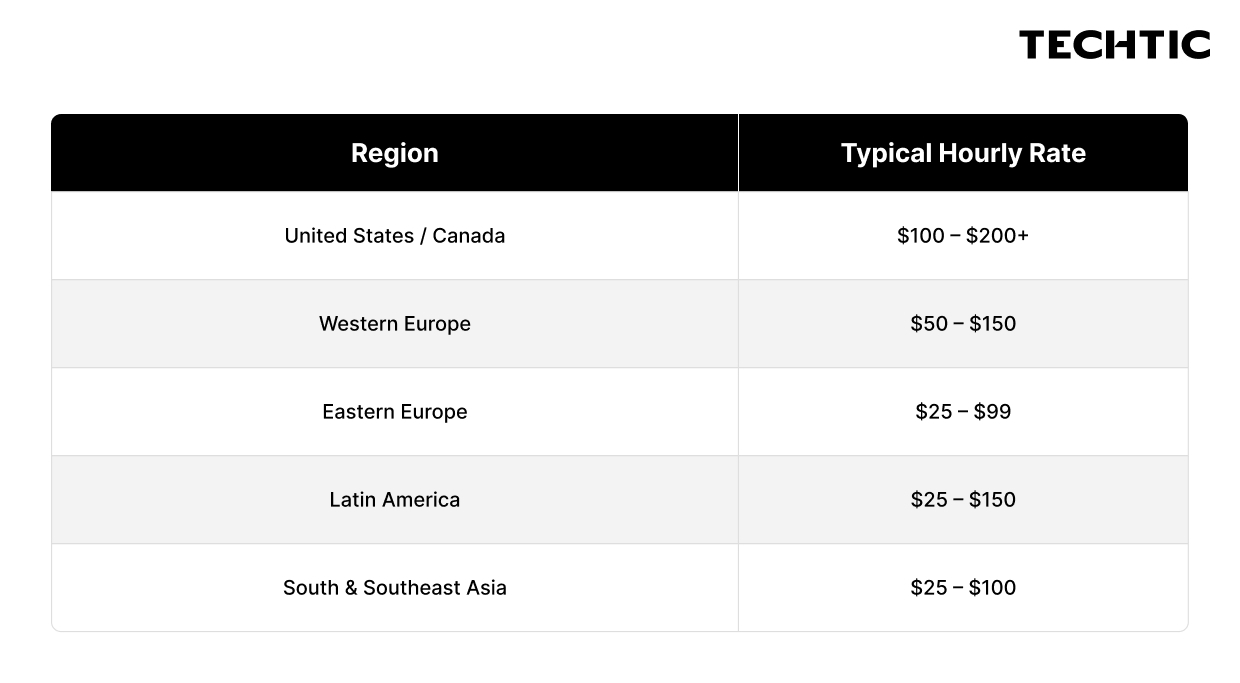
Offshore and nearshore teams can bring costs down significantly commonly cited savings run up to 40-60% compared to onshore US/Canada rates but rate isn’t the only variable that matters. Time zone overlap, communication quality, and how much senior engineering judgment is actually involved (versus just typing speed) all affect whether a lower hourly rate translates into a lower total cost, or just a longer, more expensive path to the same result.
Hidden & Recurring Costs Founders Forget
The build itself is rarely where an MVP budget quietly overruns. These are the costs that tend to get missed in the initial estimate:
- Hosting & infrastructure – cloud costs scale with usage, not with your original budget
- Third-party API and service fees – payment processors, SMS/email providers, and mapping APIs typically charge per use, not a flat fee
- App store fees – one-time developer account fees plus ongoing revenue share if you’re monetizing
- Post-launch maintenance – commonly 15–20% of the original build cost annually, for bug fixes, dependency updates, and small improvements
- Security & compliance upkeep – especially relevant for healthtech and fintech MVPs, where compliance isn’t a one-time cost but an ongoing obligation
A realistic MVP budget sets aside 10-15% specifically for the unglamorous stuff that shows up after launch, not just the build.
How to Reduce MVP Development Cost Without Cutting Corners
- Cut scope, not quality. The fastest way to reduce cost is a shorter feature list, not cheaper engineering on the features you keep.
- Validate before you build. A landing page, waitlist, or clickable prototype can validate demand for a fraction of full development cost.
- Use cross-platform where it fits. As the Kotlin Multiplatform example above shows, the right tech-stack choice can realistically cut mobile development cost by a third or more.
- Phase the roadmap. Ship the smallest version that tests your riskiest assumption, and treat everything else as a fast-follow, not a launch requirement.
- Don’t let “fast” replace “reviewed.” AI tools and no-code platforms can speed up the mechanical parts of building but skipping engineering review to save time upfront is one of the most common ways an MVP ends up costing more in year two than it saved in month one.
How to Choose the Right MVP Development Agency
If you’ve decided this isn’t a solo AI-assisted build, the agency you choose matters as much as the budget you set. Good startup MVP development services all share a few traits, and here’s what separates a strong startup MVP development company from one that will cost you more in rework than it saved you upfront:
- They ask about your business before your feature list. A good MVP product development agency starts with discovery your users, your riskiest assumption, your success metric not a build quote.
- They can explain their architecture decisions in plain language. If you can’t get a straight answer about why they’re building it a certain way, that’s worth noticing before you sign, not after.
- Code review is part of the process, not an afterthought. Ask directly: does a second engineer review the code before it ships? Is this true even for AI-assisted development? The honest answer should be yes to both.
- They’ve built in your industry before. MVP development for tech startup teams in healthtech or fintech carries compliance requirements that a team without that specific experience will learne expensively on your project.
- Their pricing is transparent about what’s included. Fixed-bid and time-and-materials models both work; what matters is knowing upfront what’s in scope and what triggers a change order.
- They plan for what happens after launch. An MVP that ships and is then abandoned by its own development team isn’t finished ask what post-launch support actually looks like.

Why Founders Choose Techtic for MVP Development
Good product development MVP practice starts with discovery, not a feature list and every point above is deliberately not abstract it’s the standard we hold our own MVP development services for startups to. Techtic’s approach to MVP product development is built around one core idea: speed and rigor aren’t opposites, they’re both outcomes of a disciplined process.
In practice, that means every MVP we build goes through the same structured discovery, architecture review, and code review process regardless of whether AI-assisted tools were used to accelerate parts of the build. A second engineer validates logic and edge cases before anything ships. Data handling and security get reviewed as a first-class concern, not a pre-launch scramble, which matters especially for founders building in regulated spaces like healthtech, where we’ve worked through HIPAA-compliance requirements as a normal part of the build rather than a surprise line item late in the project.
That operational discipline is also why we built the checklist linked throughout this guide it’s not a marketing document, it’s close to the actual internal standard our engineering team works against on every MVP engagement, from idea validation through launch readiness. If you’re evaluating a startup MVP development service and want a sense of what “done right” actually looks like before you talk to anyone, that checklist is a good place to start.
If you’re past that and ready to scope an actual build, we’re happy to walk through your idea, your budget, and what a realistic MVP timeline looks like for your specific case no obligation, no generic quote before we understand what you’re actually building.
FAQs
Q. How much does it cost to build an MVP?
Most MVPs cost between $5,000 and $150,000, with simple single-feature products at the low end and complex, multi-integration builds at the high end. Compliance heavy products like healthtech or fintech MVPs can run $80,000-$250,000+ due to regulatory and security requirements layered on top of the core build.
Q. What is an MVP in a startup?
An MVP, or minimum viable product, is the smallest version of a product that lets real users test its core value proposition built to validate a business hypothesis quickly and cheaply, not to serve as a scaled-down version of the final product.
Q. How much does a healthtech startup MVP cost?
Non-regulated wellness apps typically run $50,000–$150,000. HIPAA-compliant healthtech MVPs usually cost $150,000–$350,000, and EHR-integrated products often run $200,000–$450,000, largely due to compliance, security infrastructure, and integration work.
Q. What is the MVP development process?
A typical process runs through five stages: discovery and validation, scoping and prioritization, design, development and QA, and launch. Skipping discovery is the most common and most expensive mistake founders make.
Q. How much does it cost to build an MVP booking app with Kotlin Multiplatform?
A booking app MVP built as separate native iOS and Android apps commonly costs $40,000–$70,000. Building the same MVP with Kotlin Multiplatform, sharing core business logic across one codebase, typically brings that down to roughly $25,000–$45,000 – a 30–50% reduction driven by writing and testing shared logic once instead of twice.
Q. Is $10,000–$15,000 enough to build an MVP?
It can be, for a genuinely simple, single-feature, single-platform MVP with minimal integrations. It’s rarely enough for anything involving multiple user roles, several third-party integrations, or regulatory compliance trying to force those into a $10K budget is a common way MVPs end up under-built and needing an expensive rebuild soon after launch.
Q. How do I choose a startup MVP development company?
Look for a team that leads with discovery rather than a feature quote, can explain their architecture decisions clearly, treats code review as standard practice rather than optional, has relevant industry experience, prices transparently, and has a real plan for post-launch support.
Methodology note:
Cost ranges in this guide reflect figures commonly cited across current industry sources on MVP and cross-platform development pricing, cross-referenced for consistency rather than drawn from a single source. Actual cost for any specific MVP depends on scope, team, and region, and should be confirmed with a detailed quote.