AI Adoption for Enterprises: A Practical Roadmap Beyond the Pilot Stage
Sector: AI + Data
Author: Nisarg Mehta
Date: 08/25/2026

Most enterprises have already cleared the first hurdle of AI adoption. According to McKinsey’s 2025 State of AI survey, 88% of organizations now use AI in at least one business function – but only a third have reached real enterprise-wide scaling. For CTOs and founders, that gap is the strategic question of 2026: not whether AI for enterprise is worth pursuing, but how to convert a successful pilot into infrastructure that actually changes how the business runs. Across the artificial intelligence industry, enterprise AI adoption is what now separates companies still experimenting from those operating at scale.
Why the Pilot-to-Scale Gap Exists
A pilot succeeds because it’s contained: one team, one dataset. Scaling enterprise AI adoption means the opposite – integrating models into production systems, existing data pipelines, compliance requirements, and the daily judgment of hundreds of employees. The differentiator isn’t model quality; it’s whether infrastructure, governance, and integration were built for scale from day one, not bolted on after a demo impressed the board.
The Roadmap: What Comes After a Successful Pilot
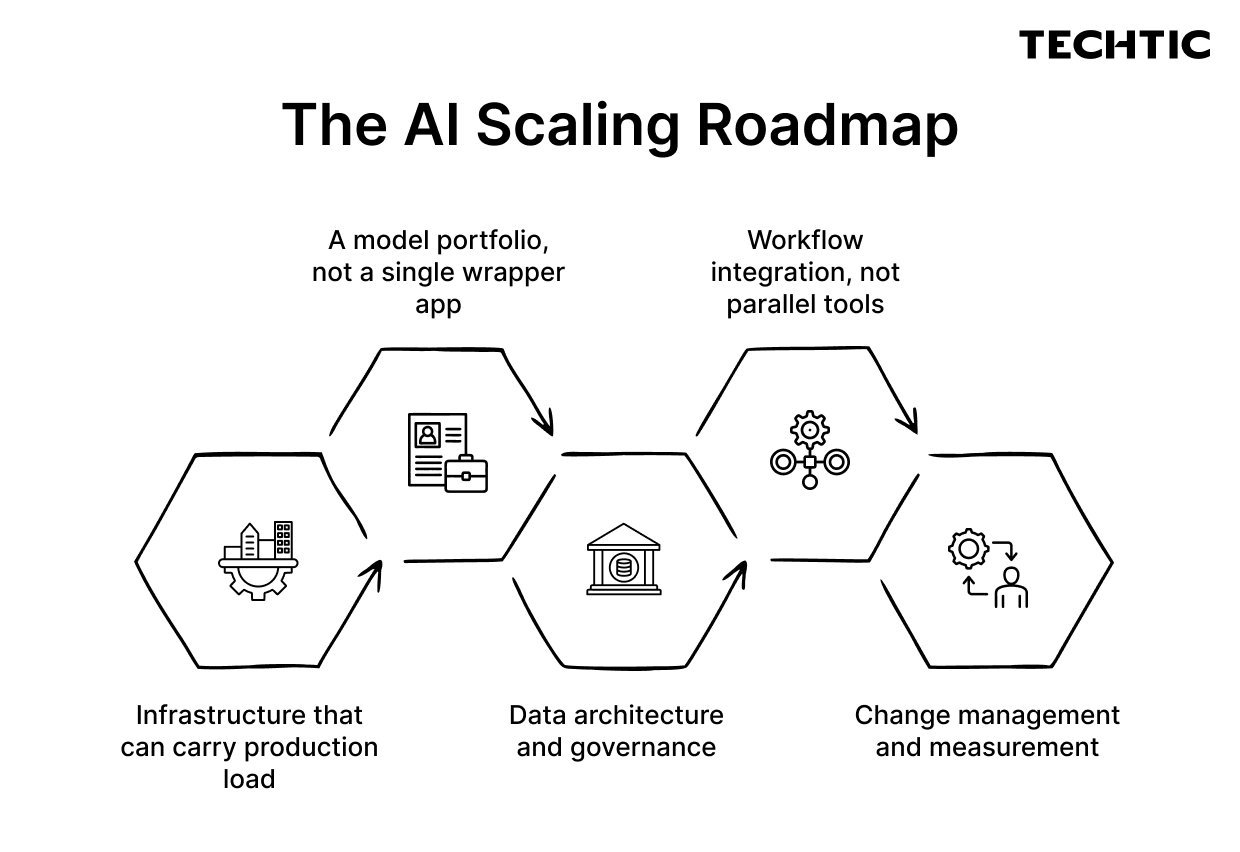
1. Infrastructure that can carry production load. Pilots run on ad hoc compute and sandboxed data. Scaling requires a real MLOps backbone – versioned pipelines, model monitoring, retraining schedules, and a compute strategy: reserved capacity, GPU orchestration, and hybrid cloud/on-prem setups for regulated data.
2. A model portfolio, not a single wrapper app. Enterprise AI solutions at scale combine several models: fine-tuned or retrieval-augmented LLMs for domain reasoning, smaller specialized models for structured prediction (fraud scoring, demand forecasting, defect detection), and orchestration layers routing each task to the right model.
3. Data architecture and governance. Scaling exposes every gap in data quality, lineage, and access control. Enterprises moving to production invest in unified data platforms, secure retrieval systems, and audit trails that satisfy compliance and risk teams – not just data scientists.
4. Workflow integration, not parallel tools. AI adoption in business only pays off when embedded inside systems people already use – ERP, CRM, EHR, core banking – rather than living as a separate app. This is where most pilots die: a great model with no path into the daily workflow delivers zero value.
5. Change management and measurement. Enterprises that scale successfully define efficiency, cost, and revenue KPIs before rollout, and track them relentlessly. Without that discipline, AI adoption becomes a perpetual pilot cycle with no accountability for outcomes.

AI for Industries: What Enterprise AI Use Cases Actually Look Like
AI adoption by industry looks very different from sector to sector, and the strongest programs share one trait: the model is wired directly into an operational system of record, not sitting beside it.
Manufacturing. The highest-value deployments pull real-time sensor and telemetry data – vibration, temperature, throughput – directly into the MES and ERP, feeding models that flag equipment likely to fail within days instead of waiting for a scheduled inspection. Computer vision on the line catches defects human inspectors miss, writing results straight back into the production record for root-cause analysis. Manufacturing AI adoption has climbed to 52% (from 29% in 2024) because these systems plug into equipment enterprises already run.
Healthcare. The systems with real traction sit inside the EHR rather than beside it: models pulling chart data to flag drug interactions, prioritize radiology reads by urgency, or pre-populate prior-authorization paperwork that otherwise eats clinician hours. Imaging models now triage scans before a radiologist opens them, cutting time-to-read on urgent cases. AI-assisted diagnostics report roughly 23% lower error rates – part of why adoption has jumped from 38% to 67% in two years.
Financial services. Fraud detection has moved from static rule engines to models scoring every transaction in real time against behavioral graphs, catching patterns rules alone would miss – the use case behind the sector’s 84% adoption rate, the highest of any industry. Risk teams run similar models against loan portfolios for early-warning signals, and personalization engines drive next-best-offer decisions inside the core banking platform itself.
Retail and e-commerce. The operational win isn’t a chatbot – it’s dynamic pricing and inventory models ingesting real-time demand signals to adjust replenishment orders before a stockout happens, plus recommendation engines tied to margin data, not click-through rate alone.
Logistics. Route and fleet optimization models sit inside warehouse and transportation systems, forecasting demand at the SKU-and-region level and adjusting maintenance across fleets – reducing downtime and improving on-time delivery network-wide.
The common thread across every one of these: leaders aren’t winning by deploying more models. They’re winning by embedding fewer, well-integrated ones directly into the systems that already run the business, and building the infrastructure to keep them accurate as conditions change. That’s the throughline behind AI adoption by industry data across the artificial intelligence industry: AI adoption in business only compounds when treated as infrastructure, not a pilot program. The result is a new class of AI driven enterprises, built on enterprise AI solutions and enterprise AI use cases wired into daily operations – proof that AI for industries and AI for enterprise strategy are really the same discipline applied at different altitudes.
How Techtic Can Help
Techtic helps CTOs, founders, and technology leaders build what separates a promising pilot from production-grade, AI driven enterprises: real infrastructure, not another demo. That includes MLOps and cloud infrastructure built for scale, integrating LLMs and specialized models into existing ERP, CRM, and commerce systems, secure and compliant data pipelines, and the custom platforms that make AI part of daily operations. With hands-on experience across AI and data consulting, digital product engineering, and commerce platforms, Techtic helps enterprises move from an isolated proof of concept to measurable, enterprise-wide impact without re-platforming the business to get there.
If your organization has a pilot that worked and now needs a real roadmap to scale it, that’s exactly the conversation worth having next.
FAQs
Q. What is enterprise AI adoption?
Enterprise AI adoption is the process of integrating artificial intelligence into business operations, workflows, data systems, and decision-making processes at organizational scale. Unlike isolated AI pilots, enterprise AI adoption focuses on production-ready infrastructure, governance, security, workflow integration, and measurable business outcomes.
Q. How can enterprises move from an AI pilot to production?
Enterprises can move from an AI pilot to production by establishing scalable infrastructure, strengthening data architecture and governance, selecting the right combination of AI models, integrating AI into existing business workflows, and defining measurable KPIs. A successful pilot should be treated as the starting point for an enterprise AI roadmap rather than the final outcome.
Q. What infrastructure is needed to scale AI in an enterprise?
A scalable enterprise AI infrastructure typically includes cloud or hybrid computing, GPU orchestration where required, MLOps pipelines, model versioning, monitoring, automated retraining, secure data pipelines, API integrations, observability, and access controls. The architecture should support increasing workloads while maintaining security, reliability, and cost efficiency.
Q. What is the role of data architecture in enterprise AI adoption?
Data architecture provides the foundation for reliable enterprise AI. Organizations need high-quality, accessible, governed, and traceable data to train, retrieve, evaluate, and operate AI systems. Data lineage, access controls, secure retrieval, integration pipelines, and audit trails become increasingly important as AI moves from experimentation into production.
Q. How should enterprises integrate AI into existing business workflows?
AI should be embedded into the systems employees already use, such as ERP, CRM, EHR, commerce, supply-chain, and financial platforms. API integrations, workflow automation, AI assistants, intelligent recommendations, and decision-support capabilities can make AI part of everyday operations instead of creating another standalone application.