Brand Storytelling in the Age of AI: Why Human-Led Content Is Your Brand’s Biggest Differentiator
Sector: AI + Data
Author: Nisarg Mehta
Date: 10/29/2026

A blog post, a set of product descriptions, or a month of LinkedIn updates can now be drafted in an afternoon. Generative AI tools have made content production faster and cheaper for almost every marketing team, from two-person D2C eCommerce brands to enterprise departments with dedicated editorial staff.
That speed is useful. It also changes the competitive picture. When every competitor can publish polished, keyword-aware copy on demand, polish alone stops being a reason for a buyer to remember you. More content does not automatically build trust, sharpen brand identity, or deepen customer relationships. Often it simply adds to the volume your buyers have learned to skim.
This is where brand storytelling earns its place. A clear brand story explains why your company exists, who it serves, and what it knows that others don’t, in a way customers recognize at every touchpoint.
This guide makes a practical case: in a market full of competent, look-alike content, human insight is what makes your brand story distinctive. Below, we explain why human-led content has become a brand’s biggest differentiator and how B2B, D2C, eCommerce, and enterprise teams can build it into every channel.
What Is Brand Storytelling and Why Does It Matter in the Age of AI?
Brand storytelling is the practice of communicating your company’s purpose, values, expertise, and customer promise as a connected narrative rather than a list of features or offers. It answers the questions buyers ask before they trust you: Why do you exist? Who do you help? What problem do you understand better than others? What can I expect if I choose you?
Storytelling is different from promotional copy. Promotion announces what you sell and why to buy now. A story shows the customer’s situation, the tension they face, and how your business helps them move forward. Both have a role, but only one builds lasting recognition.
Customers rarely meet your story in one place. They assemble it from your homepage, blog articles, product pages, personalized shopping experiences, onboarding emails, sales conversations, and social posts. That is why consistency across channels matters as much as creativity in any single asset.
This distinction matters more now because AI makes the first kind of sentence almost free to produce. When generic descriptions are everywhere, the brands that stand out are the ones that sound like they understand a specific customer’s reality.
Why Is Brand Differentiation Harder in the Age of AI?
Brand differentiation is harder now because polished, competent content has become easy for everyone to produce, so polish no longer signals anything special. When many companies draw on similar tools and similar public information, their websites, product pages, and LinkedIn posts start to sound alike. Buyers notice the sameness even when they cannot name it.
This creates three practical problems for brands:
- Interchangeable messaging. If your homepage could carry a competitor’s logo without edits, it is not telling buyers why you are different.
- Shorter attention. Readers who have seen the same advice ten times stop reading at the first familiar line
- Weaker recall. People remember specifics (a story, a number from your own work, a strong opinion) far more than smooth summaries.
Search, along with increasingly AI-driven commerce, is moving in the same direction. Google’s May 2026 guidance on generative AI search emphasizes valuable, unique, non-commodity content, and its long-standing people-first content guidance asks whether content offers original information, insight beyond the obvious, and first-hand expertise. Those are exactly the qualities that generic content lacks.
The opportunity is clear: in a market full of competent sameness, the brand that sounds like itself, and knows things others don’t, stands out.

Why Human-Led Content Is Your Brand’s Biggest Differentiator ?
Human-led content is a brand’s biggest differentiator because it carries what competitors cannot copy: your experience, your customers’ real words, your point of view, and people who stand behind what you publish. Tools can help package content. The substance that makes a brand distinctive has to come from inside the business.
1. Original Perspectives Make Your Brand Memorable
Your most valuable content material is the material nobody else has: customer interviews, sales call patterns, support tickets, product usage data, internal benchmarks, and lessons from projects that did not go to plan. An AI-powered customer insights platform can help surface patterns in that feedback, but people still decide which insight is worth telling. One honest observation from a real implementation is more memorable than a page of well-organized generalities. Google’s quality guidance describes originality as offering information or perspectives that are not already available elsewhere. That is also a fair definition of differentiation.
2. First-Hand Experience Signals Real Expertise
Buyers trust people who have done the work. A B2B article written by an engineer who has migrated twenty storefronts reads differently from one assembled from public sources. Details give it away: the edge case that broke a launch, the question clients always ask in week two, the shortcut that seemed smart but was not. Google’s people-first guidance asks whether content clearly demonstrates first-hand expertise and depth of knowledge, and it names trust as the most important part of E-E-A-T (experience, expertise, authoritativeness, and trustworthiness).
3. Authenticity and Accuracy Build Customer Trust
Brand authenticity is less about sounding casual and more about being truthful. Customers trust claims that are specific, verifiable, and proportionate. Transparent explanations of what a product does and does not do earn more credibility than inflated promises. A single wrong specification on a product page, or one unsupported claim in a whitepaper, can undo trust built across dozens of other assets.
4. Empathy Makes Stories Relevant
People who talk to customers learn what sits beneath the stated need. A B2B buyer evaluating a platform migration often worries about disruption and internal politics, not just features. A D2C shopper may be weighing price against a bad experience with a similar product. Content written with that understanding addresses the real hesitation, which is why it feels relevant rather than merely correct.
5. A Consistent Voice Makes Your Brand Recognizable
A distinctive voice comes from clear positioning, a defined personality, and opinions your brand is willing to hold. Recognizability is built through repetition across many touchpoints, so the voice needs an owner who protects it. When a reader can identify your brand from a paragraph without seeing the logo, your content is doing brand work.
6. Cultural Context Keeps Messages Landing Correctly
Tone that sounds confident in one market can sound abrupt in another. Humor, idioms, product names, and even color references shift meaning across regions and audiences. Human reviewers with local or industry knowledge catch these issues before they reach customers, which matters for any brand selling across borders or into specialized sectors.
7. Real People Behind the Content Create Accountability
Customers increasingly want to know who is speaking. In a June 2026 Clutch survey of 408 consumers, the most common answer to what would make people more loyal to a brand in an AI-driven environment was seeing real humans visibly behind it (36%). Named authors, visible expertise, and clear ownership tell readers that someone is responsible for the advice. Google’s guidance encourages accurate bylines and explicitly calls fabricated author profiles, such as made-up names or false credentials, a form of deception. Real authorship is both a trust signal and a safeguard.
None of this means human-written content automatically ranks higher or performs better. Search engines and customers judge usefulness and quality, not authorship alone. But the qualities that make content trustworthy and distinctive come from human insight, and those qualities support what businesses actually want: stronger recognition, more qualified engagement, and easier sales conversations.
How Human-Led Brand Storytelling Builds Trust for B2B and D2C Brands ?
For B2B brands, human-led storytelling turns complex solutions into clear, credible business value. For D2C and eCommerce brands, it gives shoppers a specific reason to choose you and come back.
B2B: Make Complex Value Easy to Believe
B2B buyers rarely buy features. They buy a lower-risk path to an outcome, and they usually have to convince finance, IT, and operations along the way.
- Lead with the business problem, such as fragmented order data, slow quoting, or manual approvals, before describing the solution.
- Share real trade-offs and implementation lessons. Honest guidance about what can go wrong builds more credibility than a capability list.
- Tell customer stories with permission, including the challenge, the rollout, and what was harder than expected.
- Give every stakeholder something useful. Educational articles and named-expert perspectives support long buying cycles.
D2C and eCommerce: Give Shoppers a Reason to Connect
Shoppers compare options in seconds, often on mobile. Brand storytelling here must be specific and useful, not decorative.
- Explain origins, materials, and design choices in concrete terms: what it is made of, why it was built that way, and who it is for.
- Answer real shopper questions about sizing, care, compatibility, and fit, drawn from reviews, returns, and support chats.
- Use customer language. If reviewers keep praising a feature your copy barely mentions, move it up.
- Keep the story consistent across product pages, ads, emails, packaging, and post-purchase messages. A PIM system helps keep product details identical everywhere.
How to Build a Human-Led Brand Storytelling Strategy?
A human-led strategy starts with what your business uniquely knows, puts real people at the center of content, and treats every tool, including AI, as support for that insight rather than a substitute for it.
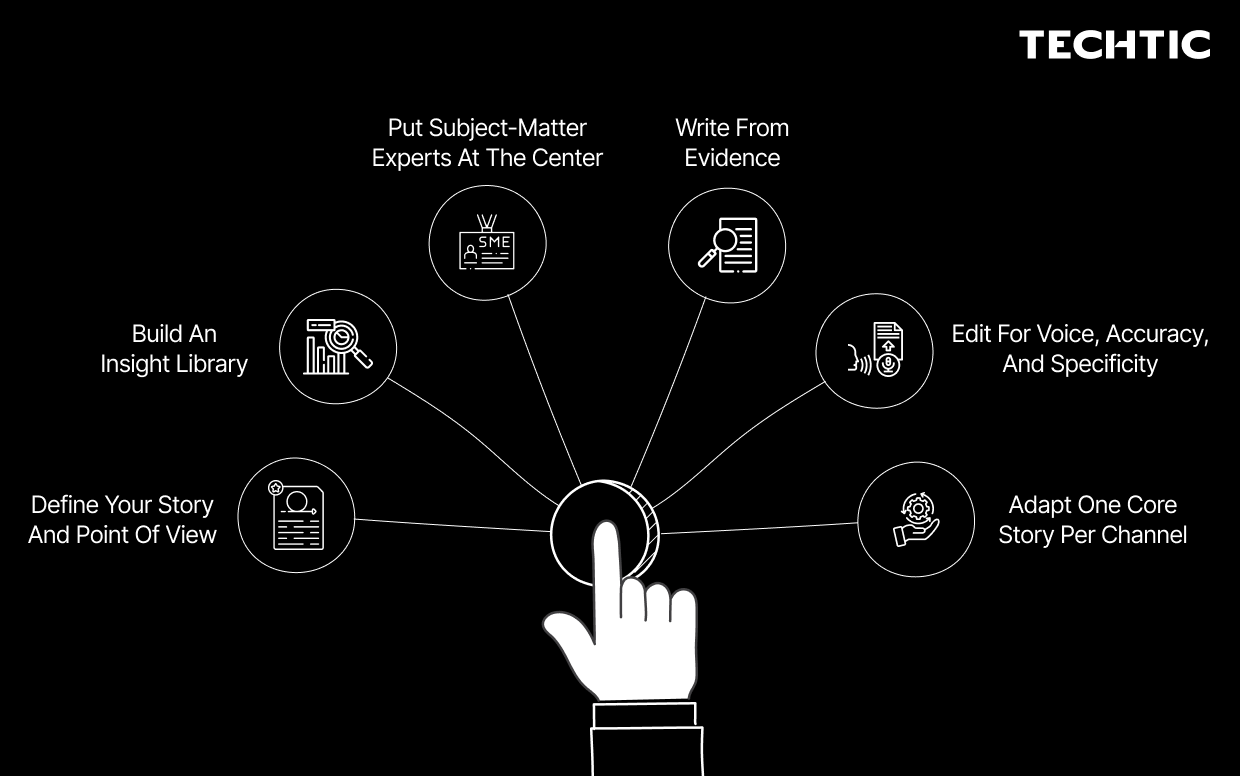
1. Define your story and point of view. Write down your purpose, primary audiences, positioning, customer promise, and the opinions your brand holds. If your team cannot explain what makes you different in two sentences, your content will drift toward generic language.
2. Build an insight library. Collect customer interviews, review themes, support conversations, sales objections, and product knowledge in one place. This is the raw material competitors cannot access.
3. Put subject-matter experts at the center. Interview engineers, consultants, merchandisers, and customer success leads. Publish under their names where appropriate. A 20-minute conversation often yields more original material than hours of desk research.
4. Write from evidence. Use AI and other tools to speed up research, organize notes, or suggest structure, but build the argument from your insight library. Verify every statistic, product detail, and claim before publishing.
5. Edit for voice, accuracy, and specificity. Cut phrases that sound polished but say nothing. Replace adjectives with facts. Check that the piece sounds like your brand.
6. Adapt one core story per channel. Turn a strong article into a LinkedIn post built around one insight, an email focused on one customer problem, and product copy focused on one benefit, instead of pasting identical text everywhere.

Best Practices for an Authentic, Distinctive Brand Voice
An authentic brand voice comes from clear guidelines, accurate source material, real customer language, and named human ownership of everything you publish.
- Document your tone of voice with words you use and avoid, example sentences, and how tone shifts between a product page, a support email, and a LinkedIn post.
- Keep one approved source of truth for positioning, product specifications, and claims, so every writer and every tool starts from verified information. For larger teams, structuring this knowledge well is often an AI and data challenge as much as an editorial one.
- Borrow your customers’ words. Phrases from reviews and sales calls usually describe problems more clearly than marketing vocabulary.
- Hold opinions. A brand that never takes a position is hard to remember.
- Verify before publishing, including titles, meta descriptions, and product data.
- Review localized content with native or regional reviewers.
- Name an owner and an approval path for every asset, with deeper review for pricing, legal, regulated claims, and executive bylines.
Authenticity is not a writing style. Adding casual phrases or first-person language does not make content authentic. Authenticity comes from saying something real, specific, and accurate about what your business knows and does.
How Do You Know Human-Led Content Is Working?
Look for signs that people remember, trust, and act on your content, measured against a baseline over a realistic period. No single metric proves a story is working.
- Engagement quality: meaningful comments, shares, replies, returning visitors, and time spent on key pages.
- Brand trust and recall: themes in reviews, survey responses, and how prospects describe you on sales calls. Branded search growth can also indicate stronger recall.
- Organic visibility: relevant impressions, clicks, and qualified traffic to priority pages, including visits referred from AI-powered search features where your analytics can identify them.
- Business outcomes: qualified leads, content-assisted conversions, product page engagement, and revenue contribution where measurable.
Record current performance before changing your approach, then compare like with like. B2B content can influence deals months later; D2C product copy may show effects within weeks. A spike in likes means little if qualified inquiries do not follow.
FAQ
Q. What Does Human-Led Content Mean for a Brand?
Human-led content means the ideas, examples, and opinions in a brand’s content come from the business itself: its team’s experience, its customers’ feedback, and its experts’ judgment. Tools can still help with research or drafting, but people decide what to say, check that it is true, and put their names behind it.
Q. Why Should Brands Invest in Human-Led Content When AI Is Faster and Cheaper?
Fast, generic content is now available to every competitor, so it rarely helps a brand stand out. Human-led content tells buyers something only that business can say, which makes the brand easier to remember and trust. Speed helps a team publish more; insight is what makes customers choose one brand over another.
Q. Can Brands Use AI Tools and Still Keep Their Content Human-Led?
Yes. AI works well for supporting tasks such as summarizing research, organizing notes, or suggesting structure. The core decisions should stay with people: what the brand believes, which customer stories to tell, which facts to include, and whether the final piece sounds right. A named owner should approve everything that gets published.
Q. How Can You Tell if Brand Content Sounds Generic?
Try the logo test: if a competitor could publish the page with their logo and no edits, it is generic. Other warning signs include vague claims like “innovative” or “seamless,” no real examples, no clear opinions, and no details only the team would know. Readers tend to stop at the first familiar line.
Q. Where Can Brands Find Original Stories and Insights for Content?
The best sources are usually inside the business. Sales and support teams know the questions customers ask most. Reviews, return reasons, and survey answers reveal real concerns. Subject-matter experts carry lessons from real projects, and product or sales data often shows useful patterns. Most brands already have more original material than they use.
Q. How Can Small Teams Create Human-Led Content Without a Big Budget?
Small teams should focus on fewer, better pieces. A 20-minute conversation with a founder or expert can become an article, several social posts, and an email. Customer questions make strong content topics. Consistency and real insight matter more than volume, so one strong piece a month can do more than daily filler.
Q. How Do Brands Keep Their Voice Consistent Across Channels and Teams?
Start with a short voice guide listing preferred words, words to avoid, example sentences, and how tone changes by channel. Keep one approved source for product facts and key messages. Have one person or a small team review content before it goes live, and update the guide as customers respond.
Q. Does Human-Led Content Help Websites Rank in Google and AI Search?
It can help, but nothing guarantees rankings. Search engines and AI answer tools aim to surface content that is helpful, accurate, and original. Content built on first-hand experience, clear answers, and named experts is better positioned than content that repeats what is already available everywhere else.
Q. How Long Does Brand Storytelling Take to Show Results?
It depends on the business. Improvements to D2C product pages can show changes in engagement or conversions within weeks. B2B content often influences deals over several months because buying cycles are longer. Record a baseline before starting, then review engagement, qualified leads, and customer feedback over at least one full quarter.