Magento to Shopify Plus 2026: The Migration Checklist
Sector: Digital Commerce
Author: Nisarg Mehta
Date: 04/21/2026

There’s a quiet crisis happening inside thousands of eCommerce businesses right now. It shows up as a developer ticket that never gets resolved, a page load time that keeps creeping up, a security patch that needs to be applied, again. It shows up in the slow realization that the platform you chose five or seven years ago wasn’t built for the way business moves today.
That platform, more often than not, is Magento Community Edition. If you’re an eCommerce manager running a mid-sized store on Magento Open Source, you’ve likely felt the friction growing. The day-to-day reality, patching, maintaining, customizing, debugging, has quietly become a second job. And when you look at the path forward, the options Adobe presents feel more like a trap than a solution: upgrade to Adobe Commerce and face licensing costs that can balloon past $40,000 per year, or stay on Magento CE and watch your tech debt compound.
There’s a third path. And more eCommerce businesses are taking it every quarter.
The State of Magento CE in 2026: The Numbers Don't Lie
The trend is clear and accelerating. Magento’s active store count has been in continuous freefall since Q4 2022, and the pace is quickening.
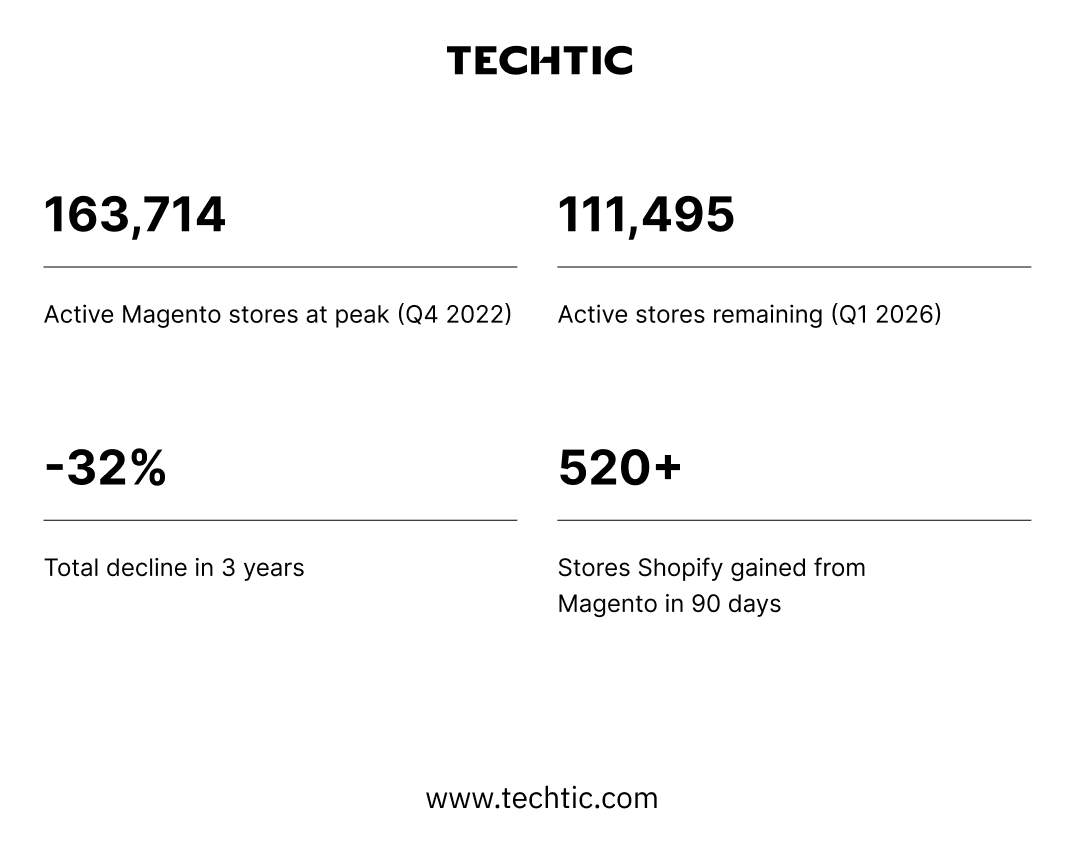
In Q3 2025 alone, Magento lost 11% of its stores year-over-year and 3.8% quarter-over-quarter. Built With data confirmed Magento powered just over 100,000 live sites as of mid-2025, a number that would have seemed unthinkable just a few years ago. This isn’t a blip. It’s a structural shift.
The Core Challenges Plaguing Magento Community Edition
1. A Steep Technical Burden That Never Goes Away
Magento CE is an enterprise-grade platform that requires enterprise-grade technical resources. For
eCommerce managers who aren’t developers, this creates an endless dependency on technical staff or agencies just to make basic operational changes. Adding a new product type, modifying a checkout flow, integrating a new shipping provider, things that should take hours often take days or weeks on Magento. Unlike managed platforms, Magento CE requires you to handle server infrastructure, security patching, PCI compliance, and performance optimization every single month.
2. Security Patches: A Relentless Treadmill
Adobe releases monthly security patches for Magento. In practice, it means your development team must evaluate, test, and apply patches regularly to avoid exposure. Miss a patch cycle and your store becomes a target. Apply it poorly and you risk breaking a customization your checkout flow depends on. Security patching has quietly become one of the most significant hidden costs of the platform, adding up to weeks of developer effort per year.
3. Extension Quality Is a Lottery
Magento’s marketplace is filled with extensions of wildly varying quality, some well-maintained, others abandoned the moment the original developer moves on. A poorly maintained extension isn’t just Inconvenient, it’s a security vulnerability, a performance liability, and a compatibility nightmare every time Magento releases an update. Managing a complex store with 20–30 third-party extensions means constantly evaluating whether each one still works and still has an active developer behind it.
4. Scalability Hits a Ceiling Faster Than You'd Expect
As your business grows, more SKUs, more orders, more concurrent users, you’ll feel the platform strain. Search performance degrades with large catalogs. Page load times creep up under high traffic. The Community Edition lacks the advanced Elasticsearch-based search that Adobe Commerce includes natively, meaning merchants with large catalogs must pay for third-party search tools or accept a degraded customer experience.
5. Limited Native Features Force Expensive Customization
Magento CE is missing features that are now standard expectations: customer segmentation, advanced promotions, B2B pricing, multi-store management, and sophisticated analytics. These all require an upgrade to Adobe Commerce or significant custom development. Over time, this custom code layer makes every update, every patch, and every new integration exponentially more expensive to test and deploy.
6. No Official Support
When something breaks at 2 a.m. the night before your biggest promotional weekend, Magento CE offers no official support channel. You’re relying on community forums, your development agency, or your internal team. For businesses managing significant revenue through their store, this is an unacceptable risk posture.
"Why Not Just Upgrade to Adobe Commerce?" - The Cost Trap
Adobe’s answer to every Magento CE limitation is Adobe Commerce. The pitch is compelling on paper: stay on the architecture you know, unlock advanced features, get official Adobe support. The reality is far more expensive than most eCommerce managers anticipate.
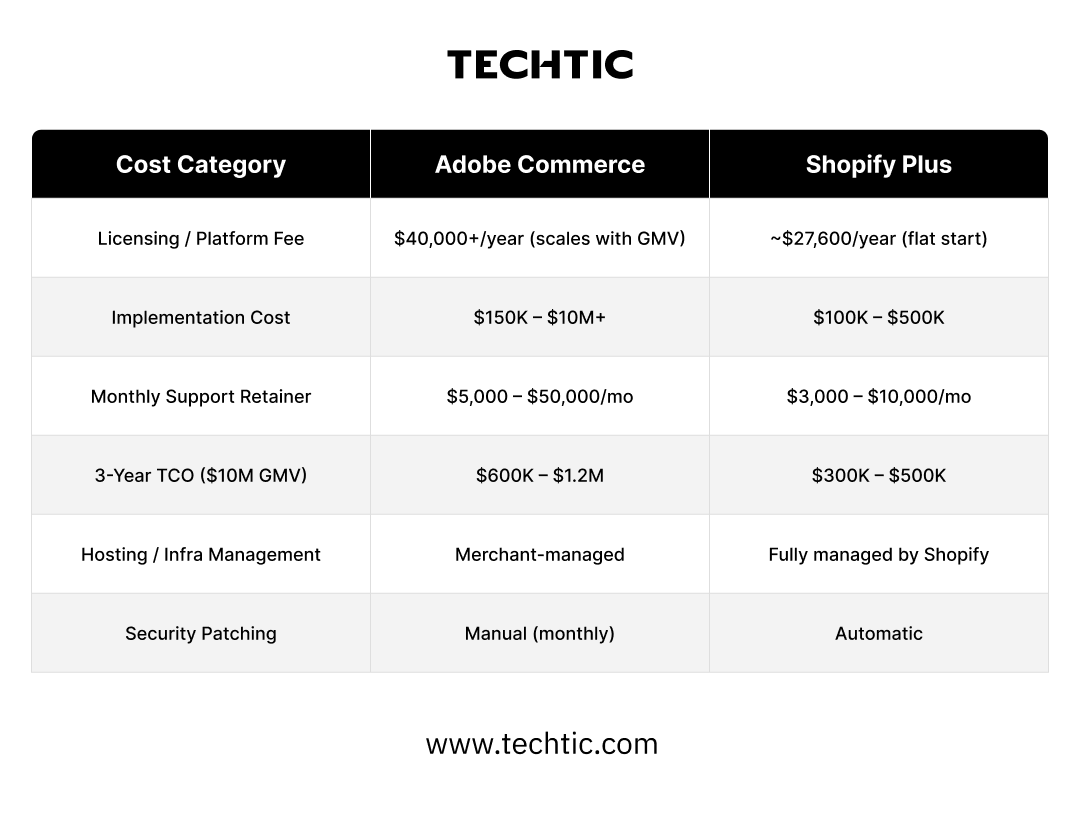
A merchant doing $10 million per year in revenue might spend $600,000 to $1.2 million over three years on Adobe Commerce, all-in. For most mid-market businesses, that math simply doesn’t work, especially when Adobe Commerce still doesn’t eliminate the underlying technical complexity of the Magento architecture.
Why Shopify Plus Is the Smarter Path Forward
Shopify Plus has evolved into a genuinely enterprise-capable platform that handles sophisticated B2C and increasingly B2B commerce with a fraction of the overhead. Here’s what makes it the compelling choice for eCommerce managers:
- Managed infrastructure, by default. Shopify owns the hosting, CDN, PCI compliance, and security patches. You never think about server capacity during a flash sale. That overhead simply disappears.
- Transparent, predictable pricing. Shopify Plus starts at ~$2,300–$2,500/month. A $10M/year merchant can expect $300K–$500K over three years all-in, roughly half the Adobe Commerce Equivalent.
- A mature, curated app ecosystem. Shopify’s app marketplace has quality and security standards. You’re far less likely to install something that becomes a liability six months later.
- Built-in growth tools. Shopify Markets for international selling, Shopify Flow for automation, Shopify scripts for checkout logic, and native analytics, all included.
- Speed to market. Changes that took weeks to plan, develop, and test on Magento can be made in hours on Shopify. For businesses bottlenecked by development cycles, this is the biggest practical Benefit.
“The migration journey is real work, but businesses that do it well end up with a
platform that empowers the eCommerce team rather than constraining it.”
The Migration Roadmap: Magento CE to Shopify Plus
A proper migration takes three to six months. Done carelessly, it can damage SEO rankings, lose
customer data, and disrupt operations. Here is the structured 7-phase approach that every migration should follow:
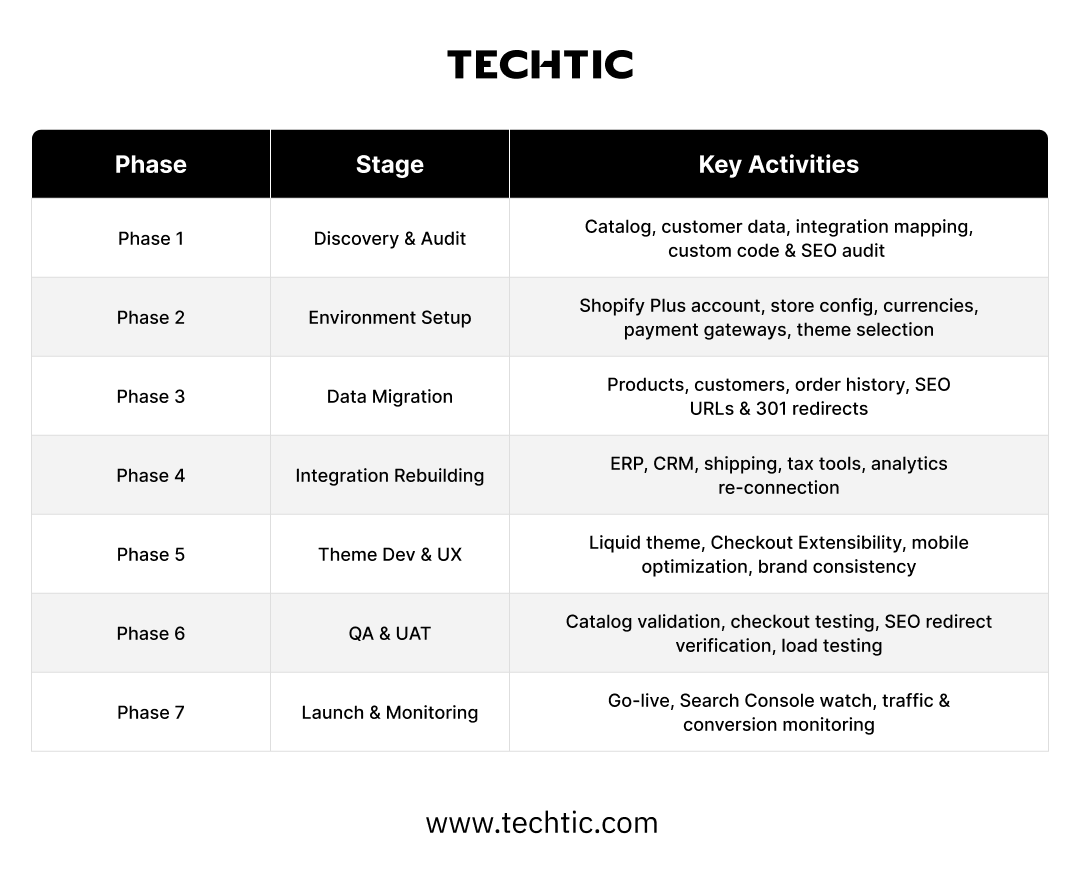
Phase 1: Discovery and Audit (Weeks 1–3)
- Catalog audit: Total SKUs, product types, configurable vs. simple, bundle & digital
- Customer data audit: Records, address books, order history, customer groups
- Integration mapping: ERP, CRM, PIM, shipping, payment gateways, loyalty programs
- Custom functionality audit: Every custom module layered on the Magento base
- SEO audit: All URLs, URL rewrites, meta data, structured data, and current rankings
Phase 2: Environment Setup
- Shopify Plus account setup
- Store configuration (regions, currencies, tax settings)
- Payment gateway integration
- Theme selection and initial setup
Phase 3: Data Migration - Critical Nuances
- Products: Configurable products become Shopify products with variants (1 SKU = 1 variant)
- Customers: Passwords CANNOT be migrated (Magento salted hashes). Plan a launch-day reset campaign
- Orders: Preserve Magento increment IDs in Shopify metafields for support reconciliation
- SEO: Every URL must map or redirect. Magento’s url_rewrite table is the source of truth
Phase 4: Integration Rebuilding
- ERP and CRM integrations
- Shipping and tax tool configuration
- Analytics and tracking setup
- Third-party app integrations
Phase 5: Theme Development & UX Optimization
- Shopify Liquid theme development
- Checkout extensibility setup
- Mobile responsiveness optimization
- UI/UX improvements for better conversion
Phase 6: QA and User Acceptance Testing
- Full product catalog validation across all product types
- End-to-end checkout testing across all payment methods and shipping scenarios
- SEO validation, confirm all 301 redirects are live and functioning
- Load testing for expected peak traffic levels
- UAT with actual eCommerce managers, not just developers
Phase 7: Launch & Monitoring
- Go-live execution and final checks
- Google Search Console monitoring
- Traffic and conversion tracking
- Post-launch performance optimization

What to Expect from a Migration Partner
A migration of this scope is a partnership, not a handoff. The right agency brings technical depth in both the Magento and Shopify Plus ecosystems, a structured project methodology, and honest communication about timelines and risks.
Red flags to watch for:
- Agencies promising unrealistically short timelines
- Proposals to migrate without a thorough discovery phase
- No clear articulation of their SEO preservation approach, this alone can devastate organic traffic
- No rollback plan in the event of a critical issue at launch
Ready to Start Your Migration Journey?
At Techtic Solutions, we’ve guided eCommerce businesses through complex platform migrations for over a decade. We know where the risks are, how to preserve your SEO equity, and how to rebuild your integrations the right way.
Get a free migration readiness assessment.
Conclusion: It’s Not Just a Platform Change - It’s a Business Upgrade
Magento Community Edition isn’t failing overnight, but it is slowly holding businesses back in ways that compound over time. What starts as minor friction, slower updates, rising maintenance costs, increasing dependency on developers, eventually turns into a bottleneck that limits growth, agility, and innovation.
For eCommerce managers in 2026, the question is no longer if the platform is creating constraints, but how much those constraints are costing the business every quarter.
Shopify Plus represents a clear shift in how modern commerce is built and scaled. It removes operational complexity, accelerates execution, and allows teams to focus on what actually drives revenue, customer experience, marketing, and growth strategy. Instead of managing infrastructure, you’re optimizing outcomes.
Migration is an investment, but staying on a platform that slows you down is a far more expensive one in the long run. The brands making the move today aren’t just upgrading technology, they’re unlocking speed, flexibility, and a future-ready foundation.
If your current platform feels like it’s taking more than it’s giving, that’s not a temporary phase. It’s a signal. And the businesses that act on it early are the ones that outperform tomorrow.
FAQs:
Q. Why are eCommerce businesses moving from Magento to Shopify Plus in 2026?
Businesses are shifting from Magento Open Source to Shopify Plus due to rising maintenance costs, ongoing security patching, and heavy developer dependency. Shopify Plus offers managed infrastructure, faster time-to-market, and predictable pricing, making it a more scalable and efficient choice for growing brands.
Q. Is Magento Community Edition still a good option for eCommerce stores?
While Magento Open Source remains flexible, it requires significant technical expertise, ongoing maintenance, and security management. For mid-sized businesses without large development teams, it often becomes costly and complex compared to modern SaaS platforms like Shopify Plus.
Q. How much does it cost to migrate from Magento to Shopify Plus?
The migration cost varies depending on store complexity, integrations, and customizations. However, businesses typically spend less overall on Shopify Plus compared to upgrading to Adobe Commerce, especially when factoring in reduced development, hosting, and maintenance costs.
Q. How long does Magento to Shopify Plus migration take?
A standard migration from Magento Open Source to Shopify Plus typically takes 3 to 6 months. This includes discovery, data migration, design, development, integrations, testing, and launch.
Q. Will I lose SEO rankings during Magento to Shopify migration?
Not necessarily. If the migration is planned and executed correctly, most businesses can maintain their search rankings and traffic. Key steps like proper redirects, preserving important page data, and maintaining site structure play a crucial role. In many cases, brands even see improvements after moving from Magento Open Source to Shopify Plus, driven by faster performance, better user experience, and a more SEO-friendly foundation.