Why Next.js 15+ Is the Best Choice for Headless Commerce
Sector: Digital Commerce
Author: Nisarg Mehta
Date: 05/18/2026

Next.js 15+ combines React Server Components. Partial Prerendering. Sub-300ms edge cache revalidation. Next.js 15+ solves the three hardest problems in headless commerce simultaneously, performance at scale, eliminated infrastructure complexity, and team scalability. Here’s the complete evidence: benchmarks, framework comparisons, rendering strategy guides, and the real-world numbers that make the case.
Headless commerce separates the customer-facing storefront from the backend commerce engine, inventory, pricing, cart, checkout, connecting them through APIs. The storefront is your responsibility to build and optimize. That distinction matters more than most teams initially realize, because the frontend is where conversions are won or lost. You control the rendering pipeline, the JavaScript budget, and the caching strategy. No theme system imposing limitations. No platform-level constraints holding you back. And no excuse when performance suffers.
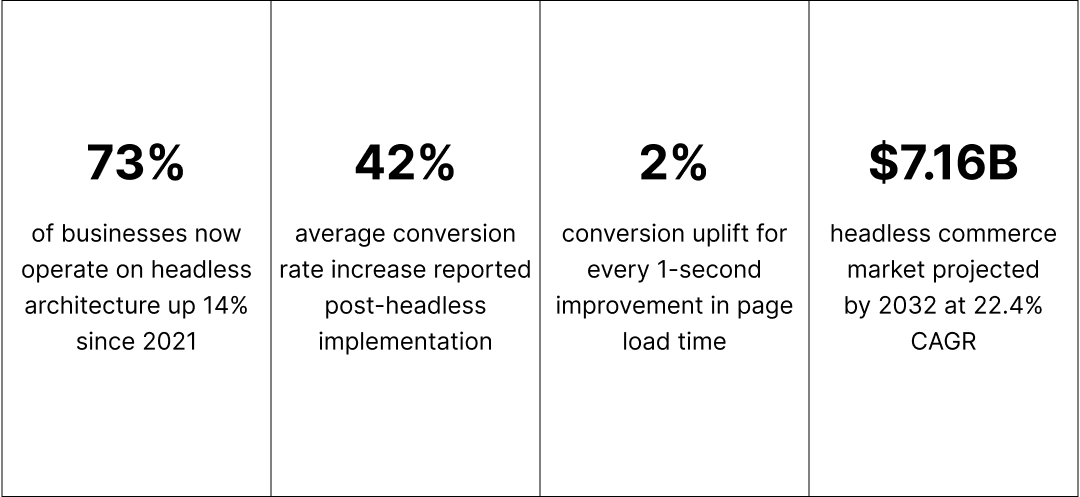
In 2025, the headless market is growing at a pace that makes the framework decision consequential for years. 73% of businesses now operate on headless architecture, a 14% rise since 2021. The market is projected to grow from $1.74 billion in 2025 to $7.16 billion by 2032 at a 22.4% CAGR. Businesses report an average 42% conversion rate increase post-implementation. And every 1-second improvement in page load time drives a measurable 2% uplift in conversions.
Picking the right frontend framework for a headless storefront is not a six-month decision, it is a multi-year architectural bet with direct consequences for engineering velocity, hiring, performance, and revenue. This article makes the case for Next.js 15+ as the default choice in 2025, with the benchmarks, framework comparisons, and rendering strategy guidance to back that case up fully.
Section 01 — What Is Headless Commerce (and Why the Frontend Matters)
Headless commerce separates the customer-facing storefront from the backend commerce engine, inventory, pricing, cart, checkout, connecting them through APIs. The storefront (the “head”) is your responsibility to build and optimize.
That distinction matters because the frontend is where conversions are won or lost. You control the rendering pipeline, the JavaScript budget, and the caching strategy. No theme system imposing limitations. No platform-level constraints holding you back.
73% of businesses now operate on headless architecture, a 14% rise since 2021. Businesses report an average 42% conversion rate increase post-implementation, and every 1-second improvement in page load time drives a 2% uplift in conversions.
The headless market is projected to grow from $1.74 billion in 2025 to $7.16 billion by 2032 at a 22.4% CAGR. Picking the right frontend framework is a multi-year architectural bet.
Section 02 — What Changed in Next.js 15
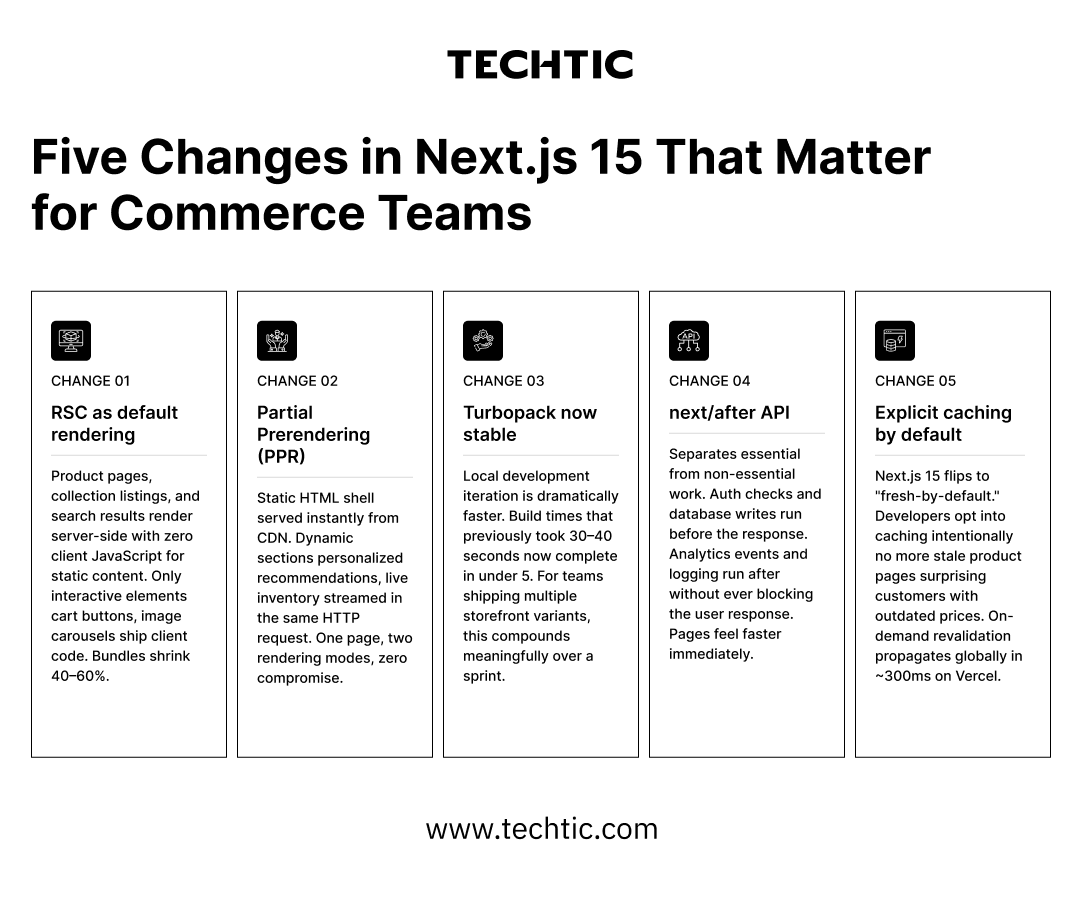
Five Changes in Next.js 15 That Matter for Commerce Teams
Next.js 15 is not an incremental update. It is a meaningful shift in the rendering model, one that addresses the specific pain points that have historically made headless commerce storefronts difficult to build and maintain at scale. Here are the five changes that commerce teams need to understand before choosing a frontend framework.
Section 03 — React Server Components
React Server Components: Eliminating the Layer Nobody Wanted to Build
The most consequential Next.js 15 change for commerce teams is not PPR or Turbopack. It is the maturation of React Server Components as the default rendering model, and what that means for the infrastructure complexity that has historically made headless commerce expensive to operate.
Traditional headless commerce required a Backend-for-Frontend (BFF) layer, a Node.js service sitting in the middle to fetch from the commerce API, transform data, aggregate responses from multiple sources, and hand the result to the React application. That meant a second service to deploy, a second service to monitor, a second service to debug at 2am when something breaks during a peak traffic event, and a second on-call rotation to staff.
React Server Components absorb that role entirely. You import the commerce SDK directly inside a Server Component, await it, and return JSX. The component runs on the server, fetches data directly from your Shopify Storefront API or Medusa instance, and ships only the resulting HTML to the client. No BFF service. No extra infrastructure. No second deployment pipeline.
1// Direct commerce API call inside a Server Component
2// No BFF layer, no separate Node.js service, no extra deployment
3import { getProduct } from '@/lib/shopify'
4import { ProductDetail } from '@/components/ProductDetail'
5export default async function ProductPage({ params }) {
6  const product = await getProduct(params.slug)
7  // ↑ Direct API call — runs on the server, ships only HTML to client
8  return
9}
10// Multiple data sources? Fetch them in parallel — no waterfall
11export default async function ProductPage({ params }) {
12  const [product, recommendations, inventory] = await Promise.all([
13    getProduct(params.slug),
14    getRecommendations(params.slug),
15    getInventoryStatus(params.slug),
16  ])
17  return
18}
19
“RSCs reduce JavaScript bundle size by 40–60% compared to fully client-rendered storefronts — directly improving Core Web Vitals and Time-to-Interactive on every product page.”
— Next.js Documentation · React Server Components, 2025
The parallel fetch pattern above is worth emphasizing. In a traditional client-rendered storefront, product data, recommendations, and inventory status would waterfall, the second request starts only after the first resolves. RSCs run all three in parallel on the server and compose the results into a single HTML response. For product pages with 3–5 data sources, this eliminates hundreds of milliseconds of latency that the client would otherwise experience as visible loading states.
Section 03 — Partial Prerendering
Partial Prerendering: Solving Commerce's Hardest Rendering Problem
PPR is arguably the most impactful Next.js 15 feature for eCommerce, and the one that most directly addresses a problem that has frustrated headless commerce teams for years. The problem is this: product pages need static rendering speed (CDN delivery, instant LCP, excellent SEO) and dynamic data (live prices, real-time inventory, personalized recommendations) at the same time. These two requirements have historically been in fundamental tension.
ISR got close but not all the way. You could serve a mostly-static page from CDN, but the dynamic sections, the ones customers actually care about, like “Is this in stock?” and “What’s the price with my loyalty discount?”, either required a client-side fetch after page load (adding a visible flash) or forced the entire page to render server-side (losing CDN benefits). PPR resolves the tension at the architecture level.
1export const experimental_ppr = true
2// ↑ Enables PPR for this route — opt-in per page
3export default function ProductPage() {
4  return (
5
6      {/* ── Static shell — served from CDN edge, instant LCP ─────── */}
7              // product title, images, description
8        // specs, details, brand info
9      {/* ── Dynamic sections — streamed at request time ────────── */}
10      }>
11                        // real-time pricing + loyalty
12
13      }>
14                  // live stock levels
15
16      }>
17         // AI-driven, user-specific
18
19
20  )
21}
22
The result is a page that loads its structural skeleton instantly from CDN, the product title, hero image, description, and brand information, while streaming the price, inventory status, and personalized recommendations as they resolve from their respective APIs. The user sees meaningful content immediately. The dynamic data arrives milliseconds later without any visible page jump.
This is not just a performance optimization. It is a conversion optimization. LCP is determined by the largest visible element on the page, typically the product hero image, and PPR allows teams to design that LCP on purpose: preload the hero image, server-render the product title above the fold, and let everything else stream in. Product pages built with PPR consistently show 15–25% LCP improvements over ISR-only equivalents.
“PPR lets you serve a static HTML shell instantly from CDN while streaming dynamic sections in the same HTTP request. One page. Two rendering modes. Zero compromise on either performance or freshness.”
— Next.js Official Documentation, Partial Prerendering, 2025
Section 04 — Framework Comparison
Next.js 15 vs Hydrogen vs Nuxt 4 vs Remix: An Honest Comparison
Every framework comparison has a bias. This one’s bias is explicit: Next.js wins on platform flexibility, React ecosystem depth, and rendering primitives. But “wins” does not mean “always the right choice”, and this comparison includes the honest cases where alternatives win instead. Read the full table before making a decision.
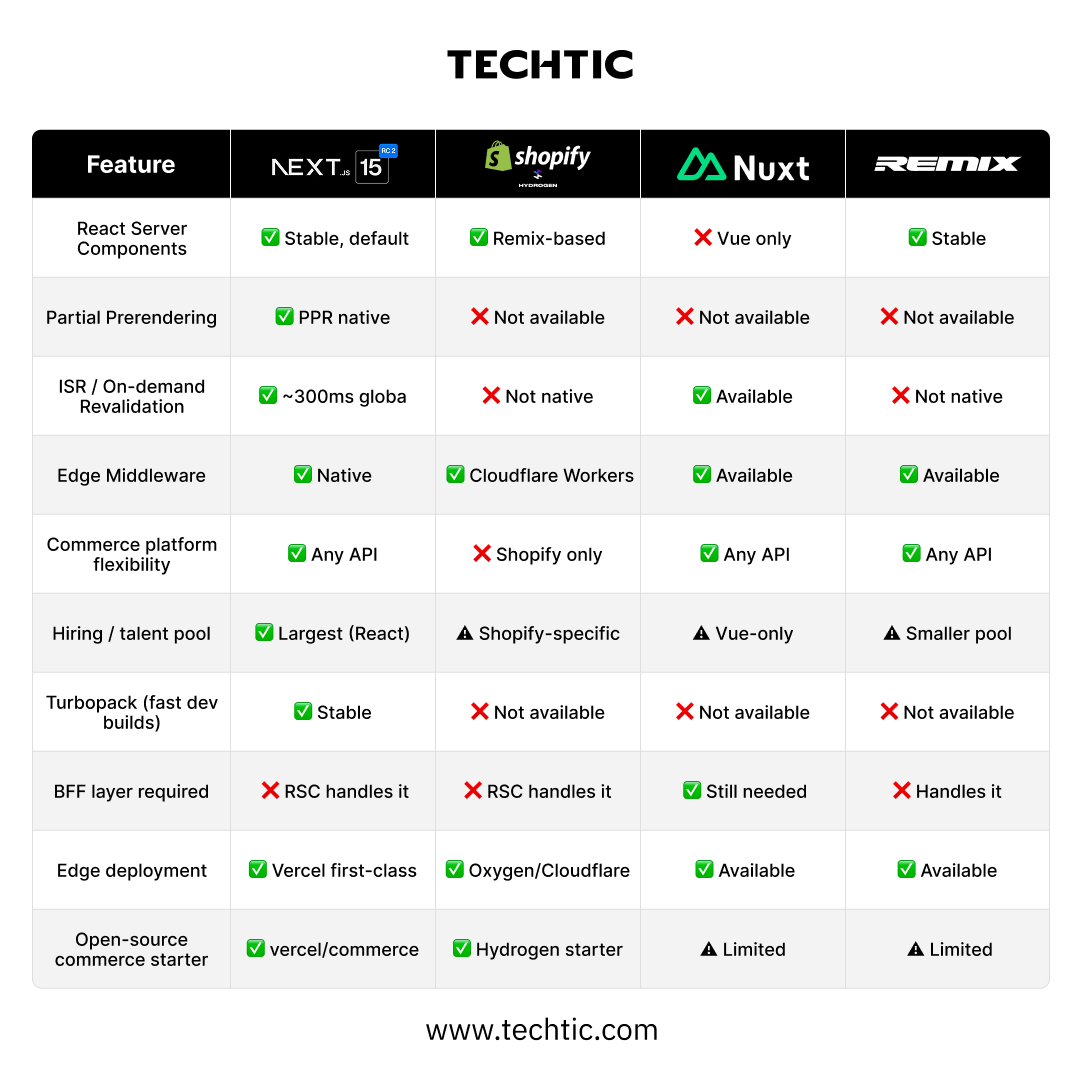
Bottom line: Next.js wins on platform flexibility, rendering primitives, and the React ecosystem talent pool, which matters more than it sounds when you are hiring for a storefront team over multiple years. Hydrogen wins for time-to-market if you are Shopify-only and want purpose-built commerce hooks and Oxygen hosting without configuration. Nuxt 4 is a strong, legitimate alternative for teams that are genuinely Vue-native and cannot justify a framework switch. Remix is a solid choice for teams who want RSC without the full Next.js footprint, though the smaller ecosystem shows up in integration availability.

Section 05 — Rendering Strategy
Which Rendering Strategy for Which Commerce Page - A Practical Guide
One of Next.js 15’s most underappreciated strengths is that it does not force you into a single rendering model. You can mix SSG, ISR, SSR, PPR, and CSR across the same application, each page using exactly the strategy that fits its data requirements and performance goals. The table below is the practical guide commerce teams need to make those decisions correctly the first time.
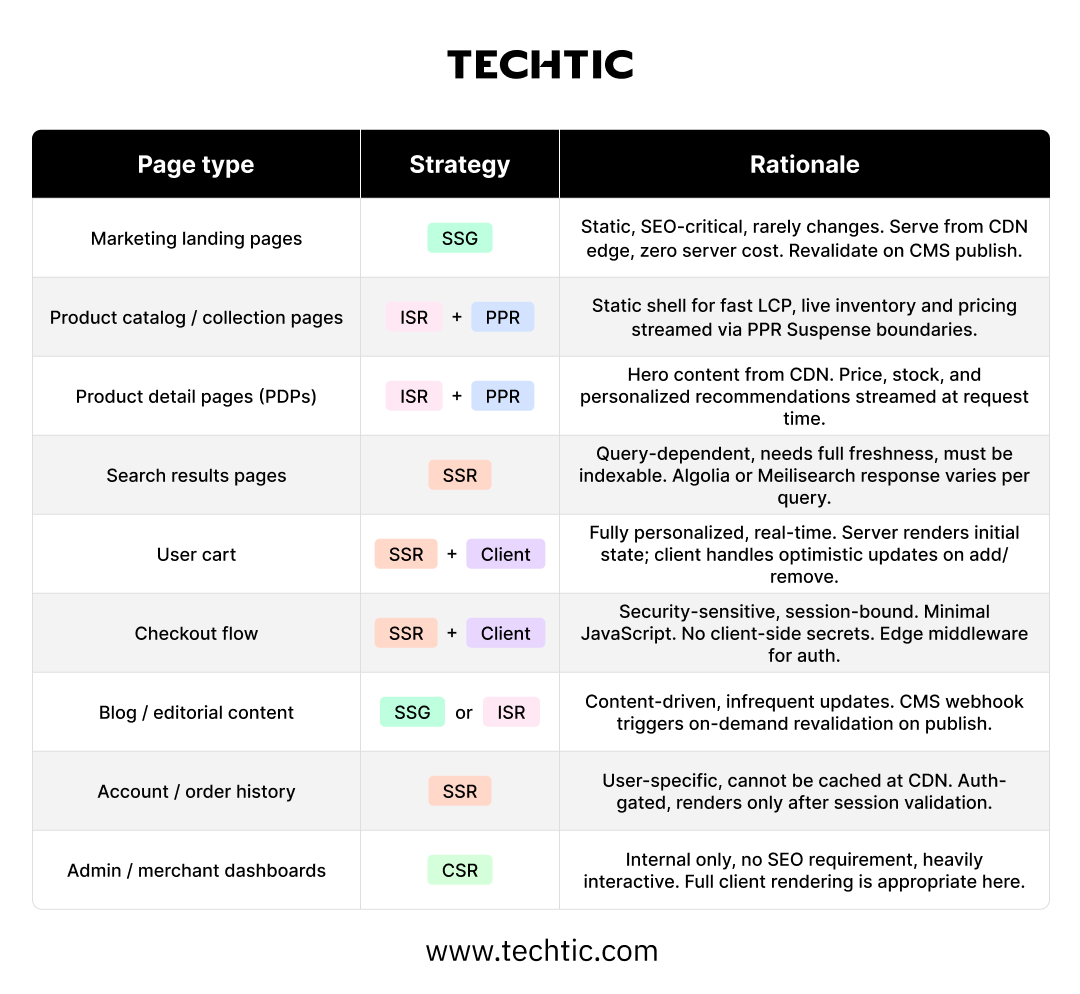
“The key Next.js 15 insight: ISR on-demand revalidation propagates globally in ~300ms when deployed to Vercel. When a product price changes in Shopify, the CDN edge cache clears in milliseconds, without a redeploy, without a build trigger.”
— Vercel Infrastructure Documentation, 2025
The ~300ms global revalidation is worth pausing on. In traditional Jamstack architectures, a price change in the commerce backend required a full build and redeploy to reach the CDN, a process that could take 5–15 minutes and affect every page simultaneously. ISR with on-demand revalidation changes only the affected page, propagates the change globally in under a second, and leaves every other cached page untouched. For large catalogs with thousands of SKUs experiencing frequent price changes, this is the difference between a viable architecture and an unusable one.
Section 06 — Real-World Benchmarks
Real-World Performance: What the Numbers Actually Look Like After Migration
Framework comparisons are easier to trust when they include real performance numbers from production deployments. The two case studies below come from PageSpeed Matters client engagements in 2024–2026, across two different business profiles, a mobile-first DTC fashion brand and a complex B2B manufacturer with a large SKU catalog.
Fashion Brand – DTC, $8M/year GMV
70% mobile traffic · Migration: Shopify Liquid → Headless Next.js
+$1.55M annual revenue
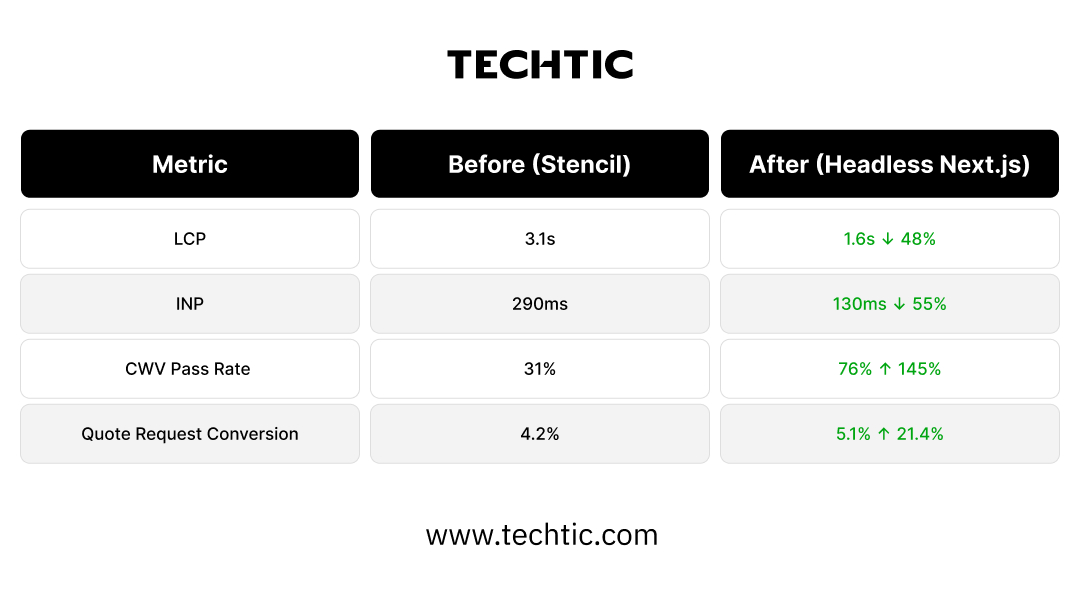
Revenue impact: +$1.55M annually. ROI break-even: 6 weeks. The LCP improvement on mobile, from 2.4s to 1.3s, was the single largest driver. Mobile sessions went from a net negative CWV signal to a consistent pass, directly improving Google Shopping ad quality scores and organic ranking.
B2B Manufacturer – $12M/year, 40,000 SKUs
Complex catalog · Migration: Stencil → Headless Next.js on Vercel
+21.4% quote conversion
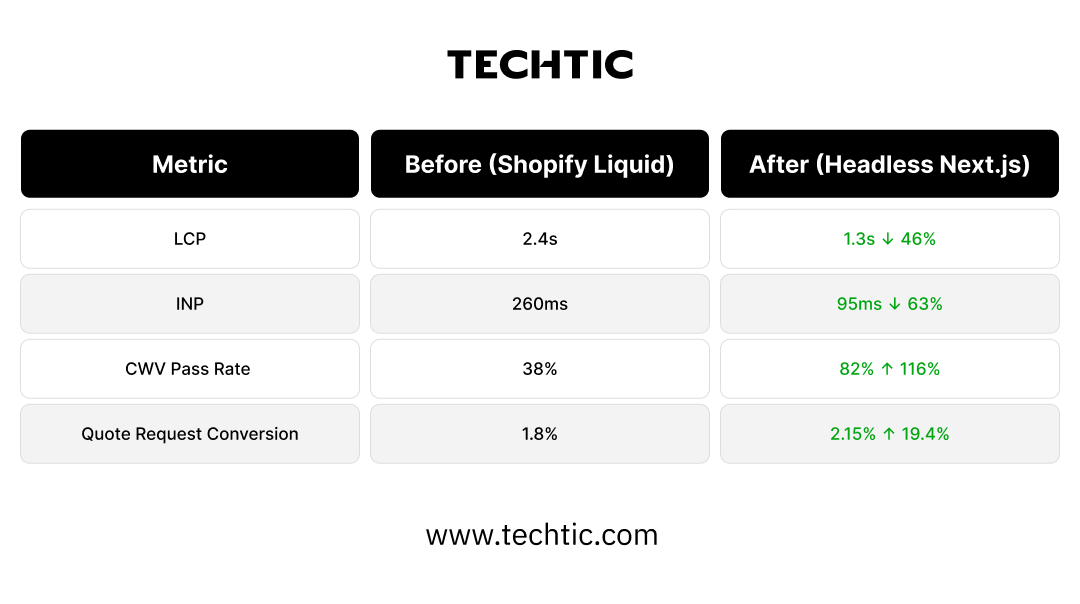
A 21.4% lift in quote request conversion on a $12M/year B2B platform is not a UX improvement, it is a structural revenue change. The 40,000-SKU catalog benefited most from ISR with on-demand revalidation: product spec pages now update in under 300ms when the PIM pushes changes, without triggering a full rebuild.
These numbers align with the broader industry picture. Brands switching to headless architectures report 20–50% page load improvements and a 15% average revenue lift in year one. The fashion brand case above shows what the upper end of that range looks like when the migration is executed well and Core Web Vitals improve significantly on mobile, where most eCommerce conversion happens.
Section 07 — The Composable Stack
The Composable Commerce Stack in 2025: What Next.js Plays Well With
Next.js 15 does not operate in isolation. It is the orchestration layer in a composable commerce stack, pulling data from the commerce backend, search, CMS, payments, and AI personalization into a unified HTML response. Here is how that stack typically looks for teams building production storefronts in 2025.
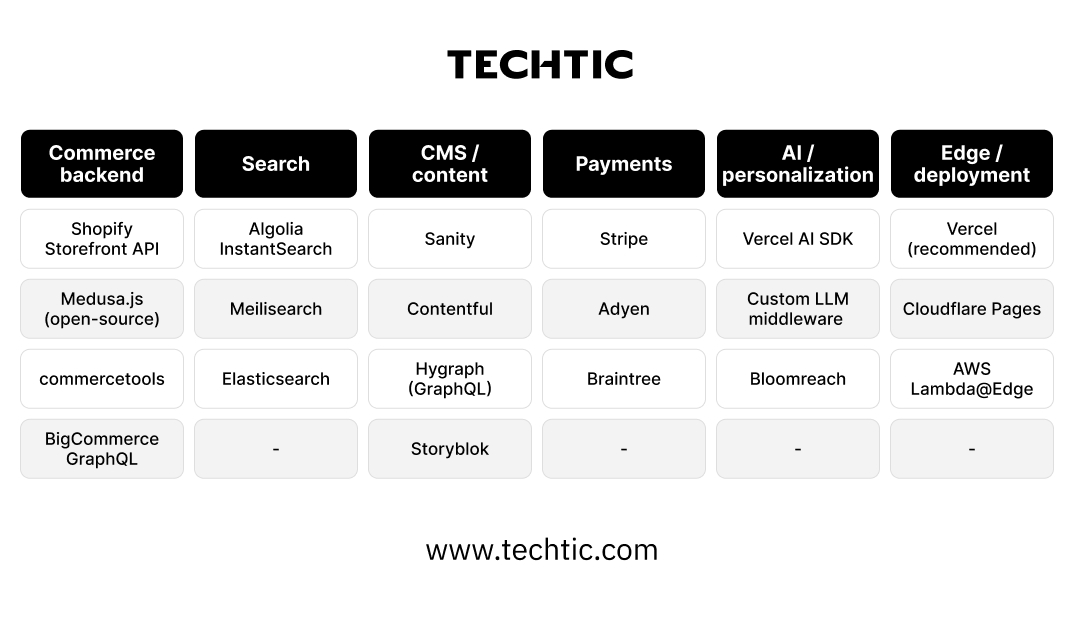
React Server Components make the glue between these layers clean in a way that was not previously possible. Each data source is fetched in parallel on the server, Promise.all([ getProduct(), getRecommendations(), getCMSContent() ]), composed into a single RSC payload, and streamed as HTML in one roundtrip. No client-side waterfalls. No sequential loading states. No data that has to wait for earlier data before it can start fetching.
The canonical open-source starting point for this architecture is the Next.js Commerce starter on GitHub (vercel/commerce). It ships with Shopify Storefront API integration, full TypeScript, App Router architecture, and a Vercel deployment target out of the box. For teams evaluating the stack before committing to a full build, it is the most useful reference implementation available.
Section 08 — When NOT to Use Next.js
When Next.js 15 Is Not the Right Choice - An Honest Assessment
Every honest framework recommendation includes the cases where the framework loses. Here are the three specific scenarios where alternatives win, and what the right choice is in each case.
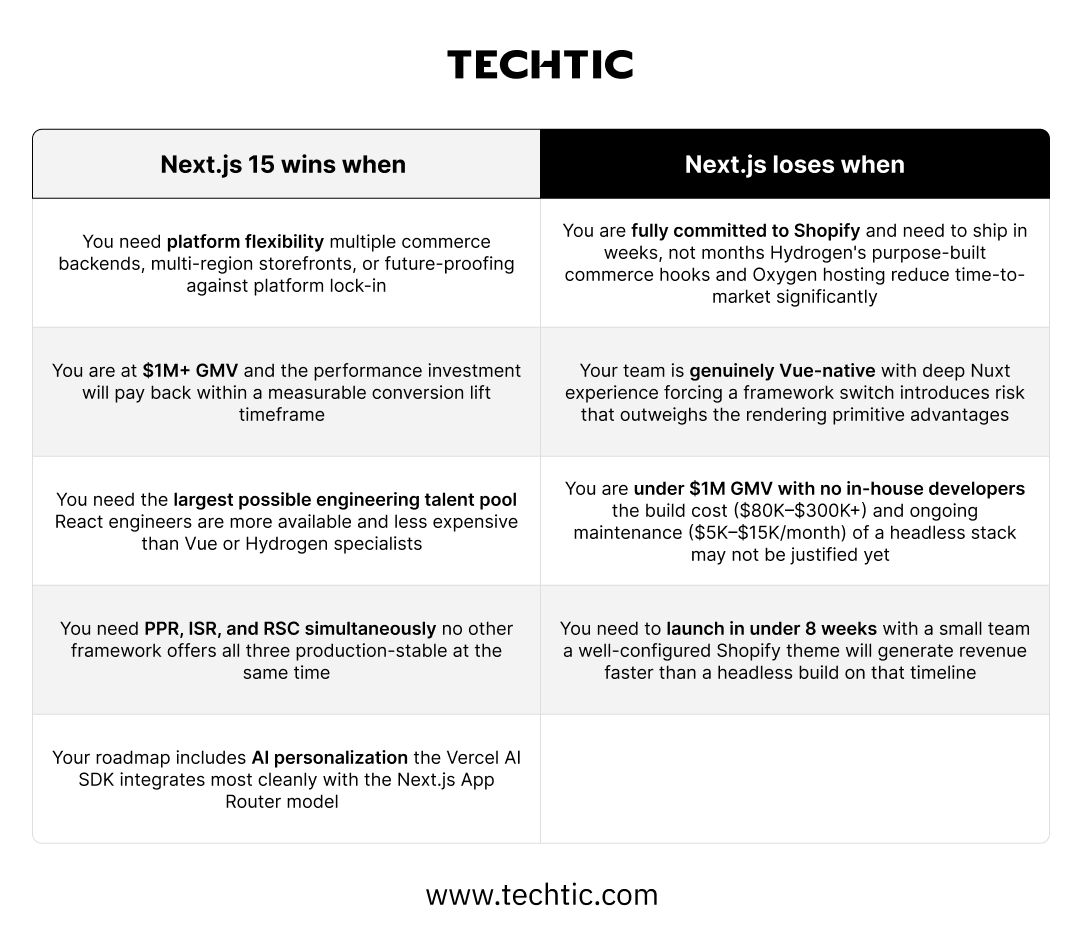
“Start on a platform theme, go headless when revenue warrants it. The $80K–$300K+ build cost and $5K–$15K/month maintenance overhead of a headless stack requires a revenue base that justifies the investment, and a team that can operate what you build.”
– Headless Commerce Readiness Framework, 2025

The Framework Decision Is a Multi-Year Architectural Bet
Picking the frontend framework for a headless commerce storefront is not a decision you revisit every quarter. It shapes your hiring strategy, your infrastructure costs, your engineering velocity, and your ability to capitalize on the rendering primitives that drive conversion. Making it based on framework trends rather than deliberate evaluation of your team’s skills, your commerce platform dependencies, and your performance goals is how brands end up in expensive rewrites two years later.
The case for Next.js 15+ in 2025 rests on three things: it is the only framework that offers PPR, production-stable RSCs, and ~300ms ISR revalidation simultaneously; it has the largest React engineering talent pool, making hiring and knowledge transfer easier over a multi-year horizon; and the performance and conversion data from production deployments is consistent, documented, and compelling. For teams at $1M+ GMV considering a headless build or migration, the framework to build on in 2025 is Next.js 15.
FAQs
Q. Why is Next.js 15 considered the best framework for headless commerce?
Next.js 15 combines React Server Components (RSC), Partial Prerendering (PPR), and fast edge cache revalidation to deliver high-performance, scalable headless commerce experiences. It helps businesses improve Core Web Vitals, reduce infrastructure complexity, and create faster storefronts that drive higher conversions.
Q. What is headless commerce in ecommerce?
Headless commerce is an architecture where the frontend storefront is separated from the backend commerce engine using APIs. This allows businesses to build highly customizable, fast, and scalable shopping experiences without being limited by traditional ecommerce platforms.
Q. How does Next.js 15 improve ecommerce website performance?
Next.js 15 improves ecommerce performance through:
- React Server Components (RSC)
- Partial Prerendering (PPR)
- ISR (Incremental Static Regeneration)
- Edge caching and streaming
These features reduce page load times, improve SEO, and create faster product experiences for users.
Q. Is Next.js 15 suitable for enterprise ecommerce platforms?
Yes. Next.js 15 is well-suited for enterprise ecommerce due to its scalability, composable architecture, strong React ecosystem, and support for advanced rendering and caching strategies.