Rebuild vs Replatform vs Redesign: How to Scale Your eCommerce Store Strategically
Sector: Digital Commerce
Author: Nisarg Mehta
Date: 04/30/2026

Every high-growth eCommerce brand eventually hits the same crossroads. Revenue is climbing, the team is shipping, and then the storefront starts pushing back. Checkout lags. New markets take months to launch. Campaigns convert below benchmark. The PDP that worked at $2M in GMV is now the bottleneck at $20M. At that moment, founders and CTOs face a deceptively simple question: do we redesign, re-platform, or rebuild?
The answer is almost always expensive, and the wrong answer is catastrophic. A redesign won’t fix a platform that can’t scale. A re-platform won’t fix a storefront that can’t convert. A full rebuild is overkill for a brand that just needs a better UX. As a Shopify Plus Partner and enterprise eCommerce agency, Techtic has seen every permutation of these decisions, including the ones that quietly eroded brand equity for two years before anyone admitted the strategy was wrong. This article gives founders and CTOs a simple, honest framework to read the signals correctly and choose the path that actually matches the problem.
The Three Paths, Clearly Defined
Before you can pick, you have to separate what these three words actually mean. In most boardrooms they get used interchangeably, which is exactly how brands end up spending rebuild budgets on redesign outcomes.
1. Redesign: Change how the store looks, feels, and converts
A Shopify redesign or broader eCommerce UX audit and redesign keeps your existing platform and rebuilds the experience on top of it. New IA, new PDPs, new cart, refreshed brand, reworked mobile flows, and a conversion rate optimization layer driven by analytics and heatmaps. You are not touching the database, the ERP connection, or the tax engine. You are fixing what customers see and how they move through it.
2. Re-Platform: Move the store to a platform that can scale with the business
A re-platform moves your catalog, customers, orders, and content from one commerce engine to another, most commonly a Magento to Shopify Plus migration, a WooCommerce to Shopify Plus migration, or a BigCommerce or Salesforce Commerce Cloud transition. The goal is to trade brittle infrastructure, runaway hosting costs, and developer dependency for a modern SaaS stack with Shopify Plus migration services, Checkout Extensibility, B2B, Markets, and a proven partner ecosystem.
3. Rebuild: Re-architect the commerce experience from the ground up
A Shopify Plus rebuild or headless commerce rebuild is a structural re-architecture. You may keep the platform, but the frontend, logic, and integrations are redesigned from scratch, usually as a headless commerce build on Hydrogen, Next.js, or a composable stack. Rebuilds make sense when the current codebase is a liability, when roadmap velocity has flatlined, or when you need differentiated commerce experiences, custom B2B portals, or global-scale performance that the theme layer cannot deliver.
How the Wrong Choice Quietly Ruins a Brand
This is the part most agencies skip. Each of the three paths has a failure mode that does not show up on the first quarterly review. It shows up in the second year, when growth has stalled and you cannot clearly explain why.
The wrong redesign: polishing a sinking ship
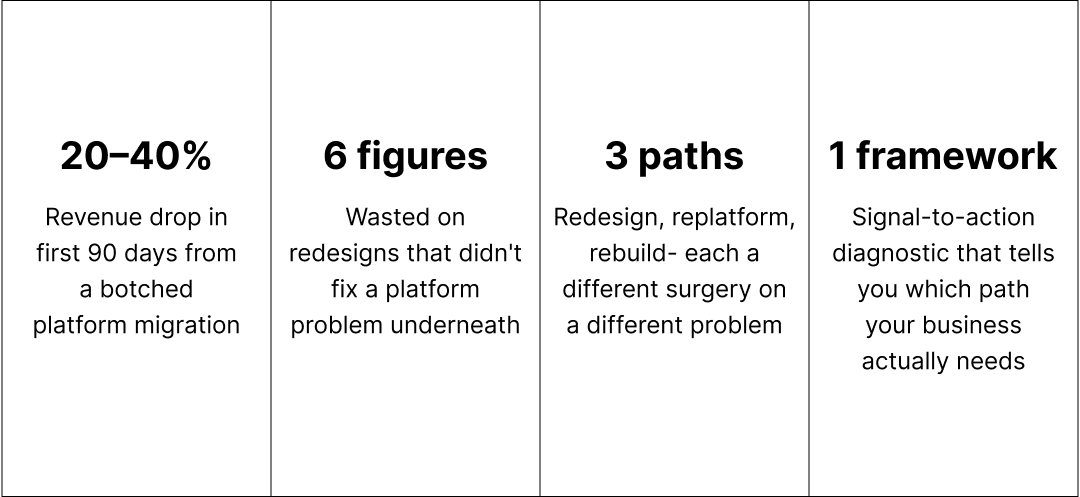
A redesign on top of a platform that is already failing is the most common expensive mistake in the industry. The site looks beautiful in Figma. It launches. Core Web Vitals are still red. Checkout still drops at the shipping step. International storefronts still cannot be launched without engineering tickets. What looked like a UX problem was a platform problem, and the brand just paid six figures to confirm it. Worse, you have now burned trust with leadership for the next real investment.
Hidden cost: Six-figure agency spend + delayed platform investment + eroded leadership trust for 12–18 months
The wrong re-platform: migrating the mess
Re-platforming without a strategic audit moves every bad decision with you. Brands lift-and-shift bloated catalogs, broken taxonomies, twelve discount logics, and three abandoned apps into Shopify Plus and then wonder why the new store feels like the old one. A botched Shopify Plus migration also routinely destroys organic traffic when 301s, canonicals, or structured data are treated as an afterthought. Revenue can drop 20 to 40 percent in the first 90 days and never fully recover. That is not a platform problem. That is a partner problem.
Hidden cost: 20–40% revenue drop in 90 days + SEO equity destruction that takes 12–24 months to rebuild
The wrong rebuild: over-engineering the storefront
Headless is a tool, not a trophy. Brands that rebuild in a composable or headless stack without the team, budget, or content-ops maturity to support it inherit a codebase their internal team cannot touch. Every campaign needs a developer. Every landing page becomes a ticket. Velocity collapses, and the marketing team, the people who actually drive revenue, are frozen out of the storefront they are supposed to be running. Over-engineering is how category leaders quietly lose ground to competitors on a well-operated Shopify Plus theme.
Hidden cost: Developer dependency on every content change + marketing team paralysis + compounding technical debt on a codebase no one fully understands
The Techtic Signal-to-Action Framework
Use the matrix below as a diagnostic. Read each symptom honestly. If a row is true for you, look at the columns to see which path it points to. Some rows point to only one path. Some point to two, which usually means the right answer is a phased engagement, not a single project.
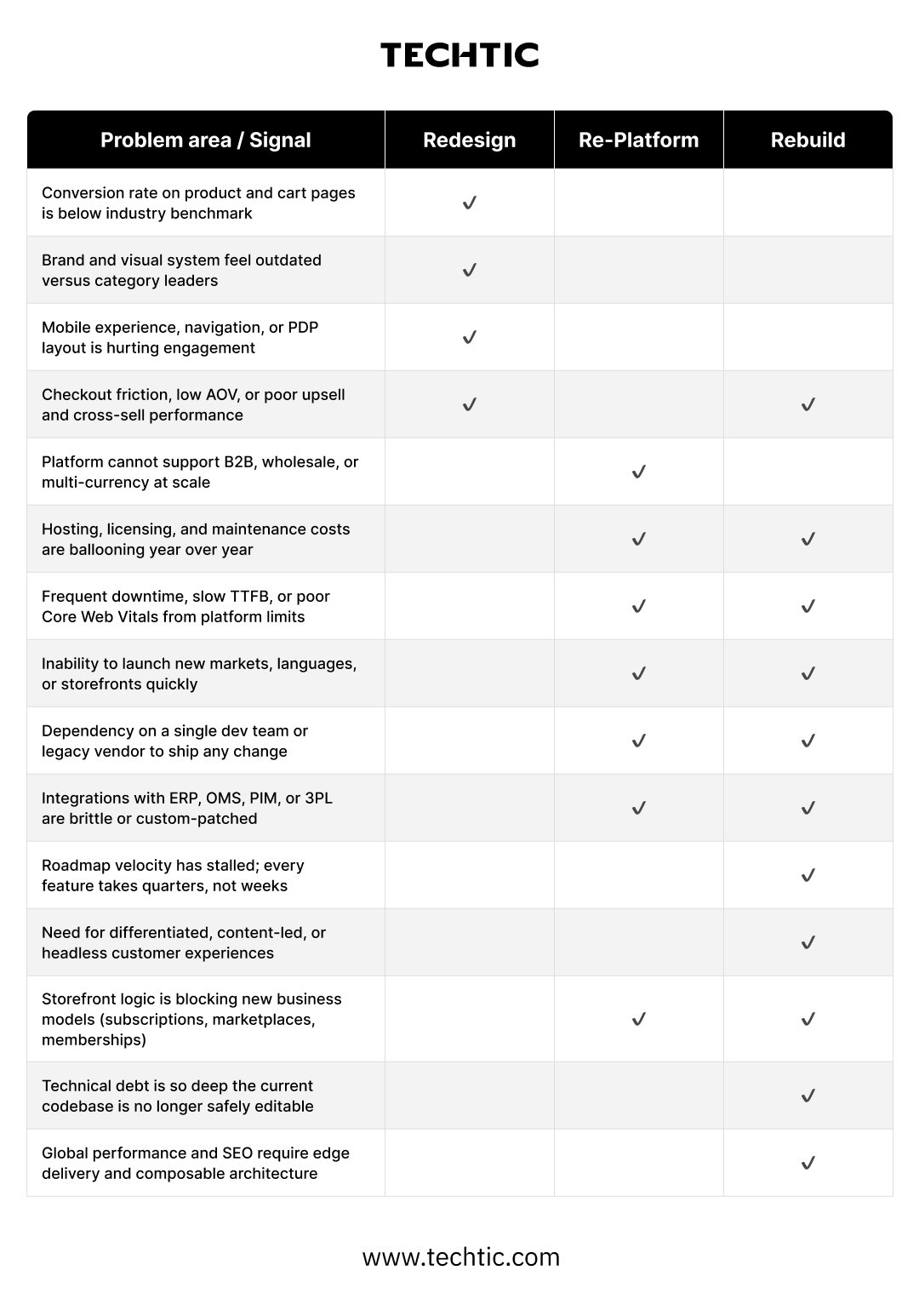
How to read the matrix: count the checks in each column for the signals that apply to your business. One dominant column is your starting point. A near-tie between Redesign and Re-Platform usually means your UX problems are real but your platform is also capping them, and the right program is a Shopify Plus migration with a redesign baked in. A near-tie between Re-Platform and Rebuild usually means you need a headless or composable build on top of Shopify Plus, not a theme-based migration.
Applying the Framework: Three Real-World Patterns
Pattern 1: DTC brand on Shopify, $5M to $30M GMV
Symptoms cluster in the Redesign column. Platform is fine. The storefront is dated, PDPs are flat, and mobile conversion is the real bottleneck. The right move is a Shopify redesign and CRO engagement, not a migration. A good agency will prove the lift with a UX audit before the team commits a rupee of dev budget.
Pattern 2: Heritage brand on Magento 2, $30M to $150M GMV
Symptoms cluster in Re-Platform. Hosting is expensive, security patches are constant, and every B2B feature is a custom module. The right move is Magento to Shopify Plus migration with a disciplined redesign during the cutover, executed by a certified Shopify Plus Partner who protects SEO equity through the transition.
Pattern 3: Category leader on Shopify Plus, $100M+ GMV
Symptoms cluster in Rebuild. The brand already scaled on Shopify Plus but the theme-based storefront cannot deliver the performance, personalization, or content velocity the roadmap demands. The right move is a headless commerce rebuild on Hydrogen or Next.js, keeping Shopify Plus as the commerce engine and moving the experience layer to a composable frontend.

Make the Right Choice for Your Business
Redesign, re-platform, and rebuild are not interchangeable products. They are three different surgeries on three different problems, and the cost of misdiagnosis is paid in brand equity, organic traffic, and the one asset you cannot buy back quickly: momentum. Founders and CTOs who win the next cycle will be the ones who read the signals honestly, resist the temptation to over-build, and invest in the smallest intervention that actually unblocks growth.
At Techtic, we run this exact diagnostic before we write a single line of code. As a Shopify Plus Partner and full-service eCommerce development agency, we help founders and CTOs choose between Shopify redesign, Shopify Plus migration, and headless commerce rebuild based on evidence, not vendor incentives. If you are staring at this decision right now, the most valuable next step is usually not a proposal. It is an eCommerce diagnostic and signal-to-action workshop that tells you which of the three paths your business actually needs, and in what sequence to fund it.
FAQs:
Q. What is the difference between eCommerce redesign, replatform, and rebuild?
eCommerce redesign improves your store’s user experience, conversion rate, and visual identity without changing the underlying platform.
Replatforming moves your store from one platform (like Magento or WooCommerce) to another (like Shopify Plus) to improve scalability, flexibility, and operational efficiency.
Rebuilding is a full structural re-architecture, often using headless commerce or composable solutions, to create advanced custom experiences and long-term scalability.
Q. How do I know if my business needs a website redesign or a platform migration?
If your current eCommerce platform is fundamentally stable but your conversion rates, user experience, or customer journey are underperforming, a redesign is often the right solution.
If your platform is creating operational inefficiencies, increasing maintenance costs, limiting performance, or restricting B2B, multi-market, or international growth, a full platform migration may be the smarter long-term investment.
Q. Can I redesign and replatform my eCommerce store at the same time?
Yes, and in many cases, it is the most efficient strategy. If your business faces both UX issues and platform limitations, combining Shopify redesign with Shopify Plus migration can reduce disruption, consolidate investment, and create a more scalable foundation.
Q. Can redesigning and replatforming together reduce business risk?
Yes, if both experience and platform are limiting growth, combining redesign with migration can often be the most efficient path.
This approach reduces duplicated costs, avoids multiple disruption cycles, and ensures your new platform launches with a conversion-focused customer experience from day one.