AI & Data Consulting
 Digital Products
 Digital Commerce
 Scale
ScaleWhat Really Matters for AI-Powered Product Development
Sector: AI + Data
Author: Nisarg Mehta
Date Published: 03/17/2026

Contents
- Introduction: The Shift Is Already Here
- AI Is Reshaping the Engineering Mindset - Not Just the Workflow
- Why Data Ontology Is the Hidden Foundation of Reliable AI Development
- Responsible AI Is a Core Engineering Discipline - Not a Checkbox
- Human Skill Has Never Mattered More
- The Tool Ecosystem Reshaping Product Development
- Conclusion: Craftsmanship Is the Real Competitive Advantage
- FAQs
Introduction: The Shift Is Already Here
The explosion of AI in software engineering isn’t hype, it’s measurable, undeniable, and accelerating. In 2025, approximately 41% of all code written was either AI-generated or AI-assisted, a seismic shift from traditional workflows where humans manually wrote virtually every line. Meanwhile, 78–84% of development teams globally now use AI code assistants, and nearly half report faster coding and debugging as a direct result.
This explosive adoption is reshaping how products are built, how engineering teams are structured, and what it means to be a skilled software professional. But with rapid adoption comes urgent responsibility. Speed without structure creates compounding risk, in code quality, security, and architectural integrity.
The organizations that win the AI era won’t be the fastest adopters. They’ll be the most intentional ones, those that embed the right disciplines, human expertise, and governance at every layer of their product development lifecycle. This article is a practical guide to exactly what that looks like.
AI Is Reshaping the Engineering Mindset - Not Just the Workflow
The most visible impact of AI on software development is raw productivity. At companies like Nvidia, embedding AI tools like Cursor into engineering workflows changed output dramatically, internal reports show teams producing three times as much code as before full AI integration. Across the industry, the numbers tell a consistent story: AI code assistants are compressing timelines, reducing boilerplate burden, and enabling developers to ship faster than ever.
But here’s what those productivity numbers obscure: code volume is not the same as product quality. More code produced faster means more opportunities for subtle architectural errors, security vulnerabilities, and long-term technical debt, particularly when AI-generated outputs aren’t reviewed with the same rigor as human-written code.
The real transformation happening in high-performing teams is not just a change in tooling. It’s a change in identity. Tools like Claude, Cursor, and the emerging generation of agentic coding assistants, which can now generate full pull requests from natural language descriptions, are amplifying human capabilities, not replacing them. The developer who thrives isn’t the fastest typist. It’s the one who can decompose complex requirements with precision, evaluate AI outputs with genuine critical judgment, and connect technical decisions to business strategy in ways that AI simply cannot replicate.
Artificial Intelligence has the potential to elevate developers from repetitive coding tasks to higher cognitive challenges, but only if organizations invest in redefining roles and building the skills to get engineers there.
Why Data Ontology Is the Hidden Foundation of Reliable AI Development
Ontology, the structured representation of concepts, entities, and relationships within a domain, is more than an academic concept. In AI-infused product development, it becomes the backbone of reliability and the single most underinvested dimension of AI adoption.
When an AI agent generates features or modifies a codebase, it must understand how data connects to your product, your business rules, and your user outcomes. Without well-defined ontologies, three costly failure patterns emerge consistently:
Miscommunication and Wrong Relationship Modeling, AI agents guess at relationships between objects and functions based on naming conventions and code patterns. When those conventions are inconsistent or relationships are non-obvious, the generated code models the domain incorrectly, producing bugs that look reasonable on inspection but fail in edge cases or at scale.
Integration Breakdown, In microservices architectures, AI-generated modules frequently mismatch adjacent systems because semantic assumptions were never made explicit. Two agents working on different services may make contradictory assumptions about the same domain concept, for example, whether “user” means an authenticated account holder or a billing entity, leading to integration failures that are expensive and time-consuming to diagnose.
Technical Debt Multiplication, AI-generated code accumulates technical debt faster when ontology is absent. Future developers, human or AI, struggle to reason about systems where the underlying model never understood the architecture’s intentions. Refactoring costs erode the original productivity gains.
The solution is treating ontology as a first-class engineering investment: shared domain models, canonical data definitions, Architecture Decision Records that document not just what was decided but why, and consistent contextual prompting standards that give AI agents the domain context they need to produce reliable outputs. It’s not glamorous, but it’s the hidden foundation that separates teams building sustainably with AI from those generating a growing mass of technically functional but semantically incoherent code.
Responsible AI Is a Core Engineering Discipline - Not a Checkbox
As AI integrates more deeply into developer workflows, risks rise alongside rewards. Research consistently shows that approximately 48% of AI-generated code contains potential security vulnerabilities, a figure that demands serious, sustained attention from any organization deploying AI at scale.
Even widely used tools have not been immune to these concerns, reports have flagged security issues in tools including Claude Code, demonstrating that no AI system operates above the need for rigorous governance and human oversight. This isn’t a reason to avoid AI tools; it’s a reason to govern them properly.
Responsible AI in product development is an ongoing operational discipline, not a one-time audit. It must be embedded into the development lifecycle at multiple points:

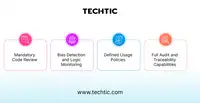
Mandatory Code Review — Every line of AI-generated code entering production should pass the same peer review, static analysis, and security scanning as human-written code. Teams that bypass this for speed are accumulating hidden risk that compounds over time.
Bias and Logic Monitoring — AI models can propagate biases present in their training data or in the code patterns they’ve been exposed to. Product teams must actively monitor outputs for incorrect logic and biased behavior, with feedback loops in place to detect and correct issues continuously.
Defined Usage Policies — Clear organizational standards for which tools are approved, what data can be included in prompts, when human review is mandatory, and how AI-generated decisions are documented. These policies don’t need to be perfect from day one, the discipline of having them matters as much as their specific content.
Auditability and Traceability — As AI-generated code becomes a larger share of production codebases, maintaining traceability, which code was AI-generated, which model produced it, what context was provided, becomes essential for debugging, regulatory compliance, and incident response.
Responsible AI is the foundation that makes sustainable, scalable AI adoption possible. Organizations that build these practices early will face dramatically lower remediation costs as AI governance standards continue to tighten globally.
Human Skill Has Never Mattered More
Here is the central paradox of AI-powered product development: as AI handles more routine cognitive work, the premium on genuine human expertise increases rather than decreases.
AI excels at pattern matching, generation within well-defined contexts, and execution of clearly specified tasks. What it doesn’t reliably do is understand unstated business context that shapes a technical decision, make architectural trade-offs that account for team capabilities and organizational constraints, recognize when a technically correct solution is wrong for non-technical reasons, or exercise creative first-principles thinking for genuinely novel problems.
These capabilities become more valuable as AI absorbs the routine work. From requirements to architecture to deployment, certain human skills remain irreplaceable:
- Translating ambiguous business requirements into precise engineering specifications that AI agents can execute correctly
- Evaluating AI-generated outputs with adversarial skepticism, asking not “does this look right?” but “how could this be wrong, and what are the consequences?”
- Understanding nuanced non-functional requirements around security, compliance, and scalability that rarely appear in ticket descriptions
- Governing AI systems with ethical judgment and contextual nuance that guardrails alone cannot enforce
Organizations that invest in upskilling developers toward these high-impact capabilities, prompt engineering, critical AI evaluation, domain ontology maintenance, agentic workflow governance, will build engineering teams that are genuinely more capable than either humans or AI could be independently.

The Tool Ecosystem Reshaping Product Development
The current landscape is a fast-evolving ecosystem of platforms redefining what development teams can accomplish:
Claude (Anthropic) offers conversational reasoning and code generation with strong contextual understanding, particularly effective for complex architectural discussions, nuanced code review, and reasoning tasks that require sustained coherence across long, detailed conversations. Its rapid adoption and growing plugin ecosystem mark it as a major force in AI-assisted development.
Cursor’s AI-assisted IDE accelerates engineering workflows by reasoning over entire codebases rather than just the current file, making it powerful for large-scale refactoring, cross-file dependency management, and understanding complex legacy systems at speed.
Vercel’s AI coding agent templates embed automation directly into deployment pipelines, unifying development and operations across the full product lifecycle rather than limiting AI assistance to the coding phase alone.
These tools are increasingly agentic, able to interpret tasks, reason across broad context, and take multi-step actions with minimal human intervention per step. That’s an extraordinary capability. But it’s only safe and productive when bounded by good ontologies, strong governance frameworks, and engineers who understand how to supervise autonomous systems effectively.
Conclusion: Craftsmanship Is the Real Competitive Advantage
AI is transforming how software gets built, but not whether it should be built well. The organizations and product leaders that succeed won’t be those chasing automation for its own sake. They’ll be those embedding ontological clarity, responsible governance, and deep human judgment into an AI-powered ecosystem where tools like Claude, Cursor, and Vercel serve the product vision, not the other way around.
To build with AI rather than simply use it, teams must shift from code production to architectural supervision, invest in shared domain ontologies, embed responsible AI practices throughout the lifecycle, and upskill developers for the high-cognitive roles that AI amplifies rather than replaces.
The essential question is no longer “are we using AI?” Almost everyone is. The question that separates the leaders from the laggards is: “Are we using AI well, with the structure, governance, and human expertise required to build products that are reliable, secure, and built to last?”
In the AI era of software development, craftsmanship and conscientious design are the real competitive advantages. AI tools amplify those strengths. They don’t replace them.
FAQs
Q. What is AI-powered product development?
It’s the practice of integrating AI tools, code assistants, agentic systems, and automated testing, into the software lifecycle to amplify human capabilities across coding, architecture, and governance.
Q. Why does data ontology matter in AI development?
Without clear ontologies, AI agents mismodel domain relationships, create integration mismatches, and multiply technical debt. Ontology gives both humans and AI a shared, reliable language to reason over the product consistently.
Q. What does responsible AI in development mean?
It means embedding governance throughout the lifecycle, mandatory code review, bias monitoring, defined usage policies, and auditability standards, treated as an ongoing discipline, not a one-time compliance task.
Q. Which AI tools lead product development today?
Claude (Anthropic) for reasoning and code generation, Cursor for codebase-wide AI assistance, and Vercel for AI-embedded deployment pipelines are currently the most impactful tools reshaping engineering workflows.